01 December 2011

Jefferson on taxes

I just stumbled across a fascinating web resource of quotations from Thomas Jefferson talking about taxation. It turns out that Jefferson clearly favored progressive taxation.

I approved from the first moment of... the power of taxation [in the new Constitution]. I thought at first that [it] might have been limited. A little reflection soon convinced me it ought not to be.
Taxes should be proportioned to what may be annually spared by the individual.
Another means of silently lessening the inequality of property is to exempt all from taxation below a certain point, and to tax the higher portions of property in geometrical progression as they rise.
the farmer will see his government supported, his children educated, and the face of his country made a paradise by the contributions of the rich alone, without his being called on to spend a cent from his earnings

Interestingly, the quotations give us a Jefferson who supports tariffs as the primary source of government revenue because imports are luxury goods used by the rich. I didn't know that.

Since quasiliberarian conservatives like to claim Jefferson as the great minarchist of the Founders, I suspect that this will come in handy. (Apropos of which, if you haven't seen it, dig a quote I blogged a while back about John Locke supporting redistribution of wealth.)

28 November 2011

Chili

A disconcerting article about what tomatoes are for:

Corn and potatoes became almost immediate staples the world over, but tomatoes took a surprisingly long road to popularity.
....
The reasons given for this lag have been several: tomatoes are a secondary crop and fell in the shadow of the other New World imports; they were misconstrued as ornamental fruits and used for display (thus the golden apples, the pomodoro, of Italy); they were quickly recognized as a relative of the poisonous belladonna by peasants who refused to grow them (they are a member of the “nightshade” or Solanaceae family, along with chile and bell peppers, potatoes and eggpant) — but I propose another, more curious reason.

What's the reason? I'll give you hint: Soylent Green presumably includes tomato flavoring ...

09 November 2011

McRib

An unreasonably fascinating speculation about the economics of McDonald's McRib sandwich:

Fast food involves both hideously violent economies of scale and sad, sad end users who volunteer to be taken advantage of. What makes the McRib different from this everyday horror is that a) McDonald’s is huge to the point that it’s more useful to think of it as a company trading in commodities than it is to think of it as a chain of restaurants b) it is made of pork, which makes it a unique product in the QSR world and c) it is only available sometimes, but refuses to go away entirely.

If you can demonstrate that McDonald’s only introduces the sandwich when pork prices are lower than usual, then you’re but a couple logical steps from concluding that McDonald’s is essentially exploiting a market imbalance between what normal food producers are willing to pay for hog meat at certain times of the year, and what Americans are willing to pay for it once it is processed, molded into illogically anatomical shapes, and slathered in HFCS-rich BBQ sauce.

The McRib was, at least in part, born out of the brute force that McDonald’s is capable of exerting on commodities markets.

I am now sold on this theory.

Update: Ian Bogost offers a windy attempt at a psychoanalytic explanation of the sandwich's appeal:

The French psychoanalyst Jacques Lacan gives the name objet a to the thing that elicits desire. In French the phrase means “object other” (the a stands for autre). Think of it as a term for the thing that elicits desire. For Lacan, our behaviors themselves may be knowable, but the causes of those behaviors aren’t always so. Objet a is not the object of desire (the thing we desire), but the thing that causes the desire to come into being (the cause of a desire for that thing). The philosopher Slavoj Žižek sometimes calls objet a the stain or defect in the world that motivates a belief or action.
....
Yet, the McRib’s perversity is not a defect, but a feature. The purpose of the McRib is to make the McNugget seem normal.

04 November 2011

My first hand account of the Black Bloc fiasco during Occupy Oakland strike, as well as the pro-violence flyer in circulation.

I didn't write this: I'm reprinting it here to help the link circulate, since the original is on Facebook, which is a lousy place to read and archive long posts.


My first hand account of the Black Bloc fiasco during Occupy Oakland strike, as well as the pro-violence flyer in circulation.

by Kallisti Partridge

Before I give my account, I'd like to request that anyone commenting actually read the entire post first, and of course, please share this. I don't mind if you disagree with me; all that I ask is that my writing ONLY be shared in its entirety, so that my words are not taken out of context.

On Wednesday, November 2nd, I spent 13 hours in the streets of Oakland witnessing what was quite possibly the most stunning display human interaction and cooperation that I've ever seen. I can honestly say that, until recently, I never thought I'd live to see the day where the people of this nation would join together in a realization that we can take our power back  and avoid what has seemed like a downward spiral crash course that this planet has been on. When I saw news reports of the people in Egypt joining together to form road blocks in their own neighborhoods, I had no idea that I would soon find myself on the port in Oakland, doing the exact same thing with people in my bay area community. I could see this same sentiment in the eyes of everyone else there as well; the people, by golly, realized, some possibly for the first time, that we are not powerless. This awe inspiring observation served to counter balance what I'd seen earlier in the day, which was far more disturbing than simply a small group of hooligans breaking windows.

Right before the afternoon march, I noticed 2 men with military style haircuts displaying suspicious looking body language. Suspicious indeed, it turns out, as they very quickly proceeded to mask themselves, and proceeded towards a group of some others that had done the same. One of them affixed a black flag to what looked like a retractable baton. At this point, they mostly fit in with the others, aside from the slight difference that all of their gear appeared to be high end, and brand spanking new right off the corporate sales rack. Their shoes had NO wear whatsoever, unlike those in the group they approached.  I decided to follow them, because my "spidey senses", to say the least, were raising curiosity with an air of alarm. I followed them throughout the entire rampage.

The two men followed the rest of the black flag group, though only appeared to talk to each other, looking around nervously while seemingly conferencing on their strategies separate from the others. They all took to the front of the march as we approached the first bank. Immediately, the windows were smashed, as they were with the next bank, and the next, only skipping, from what I saw, the bank of the Orient in Chinatown, and stopping short of citibank at the end of the march. One of the two very suspicious men I noticed earlier was one of the main window smashers, and while I did see some of the others in the masked black flag group join in, most of that groups' vandalism actually consisted of paint and the throwing of objects that stood in our way. I didn't see the second man in question smash anything at all, but rather, he put his energy into yelling out things to instigate the crowd into escalating the vandalism ("Let's go! Smash that shit!" etc.), and encourage the crowd to cheer when it happened. Just in time for video and photo being presented to the rest of the world.

This is the point when the crowd started turning against each other. An older gentleman I overheard speaking of the unions earlier was brawling with one of the masked men, and everyone was screaming. The aforementioned instigator informed everyone within earshot that Whole Foods claimed they would fire anyone that took the strike day off (a claim some say now is actually false) and everyone started marching towards the store. By the time we got to whole foods, it was total pandemonium.

Chairs, tables, paint, everything was flying through the air as some people tried to protest Whole Foods while also shielding it from the chaos.  By the time we got to the University building, a brave man was blocking the door screaming "Peaceful Protest! This is my city, and I don't want to destroy it!" He cracked his knuckles, ready to take on an attack. Behind the doors were men in badges. After all of the police brutality, even unarmed men being murdered for the apparent crime of of class or skin color, I was now watching a black man shield cops from a protest. Insanity.

The black flag group began pointing out those attempting to stop them, chanting "The peace police must be stopped", and I was, personally, rather disgusted by the strategy of comparing peacefully pissed people to police which have acted out violently against peaceful protesters. By this time, we had come almost full circle back to where we started, to the Wells Fargo that I, along with other demonstrators, had shut down earlier without incident. An individual commenced to more smashing, and a man next to me burst into tears saying "This was supposed to be Non-Violent!" A female, unmasked and without a black flag, was following around the last of the vandals, and handed the upset man a flyer saying "But didn't you get this?", extending a sheet of paper. I looked down, and lo and behold, it was the same Pro-Violence pamphlet that people have been upset about all over interweb land. All of a sudden I realized I needed to be documenting what I was seeing with the camera I brought, something that hadn't crossed my mind in all the chaos. She was unmasked while handing these out, which says to me that she doesn't mind her face being associated with this flyer, so for now I can presume that it must be okay to display her photo here with my post. If she asks me to remove it, I most certainly will. The two men I was following had now vanished. It gets worse.

[Photo removed as requested; see comments]

Today I approached the internet nervous to see what the media would say about this. What do I see? Talk of the eeevil anarchists in our midst that are bringing down the movement, "not part of the 99%" some say, and my heartbreak deepens. I'd like to ask anyone reading this to get really honest with themselves about the labels they are throwing onto living, breathing people, and their own associations with what those words mean.

Now there is debate over whether property damage is "violence" or not, and I'd like to take a moment to say this with great conviction: The most important thing we need to do right now is examine these labels collectively before using them, and most of all, get clear, collectively, about the word "violence."

Our culture is rather violent, I think it's safe to say, as there is massive profit on human suffering all across the board. Men in uniforms with guns, threatening to kidnap (imprison) other humans while robbing them of their homes; That, I'd call violence. It's endless- we've allowed death and misery to those that cannot contribute to the wealth of a health care system which, it seems in many cases, hurts more than helps as a front for drug companies. It's sick (pun intended) from my perspective, as I've had several teeth pulled at homeless clinics, and even extracted one of my own wisdom teeth in lieu of proper care I couldn't get. My father worked in a factory in Compton for 35 years, so I've had a LOT of time to observe what's been happening to the bottom of the proverbial 99% barrel in this country. I remember people in my community shooting at choppers during the L.A. riots, so I've had a hell of a lot of time to think about violence too.  I don't think that smashing objects should be put into the same category. I've broken dishes that belonged to my loved ones out of anger, and I know that these things can be cleaned up and fixed, as the Clean Up Occupy Oakland party today has shown. To anyone freaking out or anguished over some broken windows, I'd like to ask that you calm yourself and please bear with me here, because I'm about to say something that might sound totally f&%$ing crazy. Wait for it...

It's common knowledge that the most dangerous animal you will ever meet is a mother protecting her young. If you don't understand that, try approaching a grizzly bear cub in the forest and see what happens. My own cat attacked me once as a child when I attempted to touch her newborn kittens. Cops shooting unarmed men, and a window breaking are given the same label: "Violent." That means that someone attempting to rape your sister, for instance, can be labeled the same as the person whom uses physical force to stop that same rapist, should they get hurt in the process. Self defense and brutal attacks getting the same label is a problem. That means that a peaceful protester that falls under a violent attack with chemical weapons can also be called violent when, in desperation with this struggle, they decide to simply toss an empty bottle in the direction of law enforcement (whom won't be hurt by that in their robo cop style riot gear) Language is magical like that. Spellbound= bound by spelling. Anyone old enough to remember the red scare, and all the societal insanity that revolved around calling someone a commie in those days, knows what a label can do to a real person. That said, are you ready for my crazy opinion? Here it is:

Much like the mother grizzly bear, I think it's incredibly likely that some misguided individuals did what they thought was just out of love for those whom they identify with: the 99%.  A patriotic soldier can feel something similar, and it's undeniable that America, and the entire planet, may be in the throes of a massive class war as I type this. Unfortunately, the end result of their actions might have "violent" consequences to the movement as a whole in the end, not only due to the negative press, and the resulting actions of law enforcement that needs these acts as an excuse to bring REAL violence like Scott Olson received, but also in the way that it instantly began to split the people up into those who are with the evil ooga booga anarchists, and those whom are not. Don't let anarchists become the new commie style scare. That's just stupid.

I don't identify with any political party specifically, as my personal philosophy is oh so simple. My personal position always comes down to my own eternal truth which is this: Love is The Law. I think our entire political system could potentially be corrupted beyond repair at this stage of the game, and could be scrapped for an entirely new way of conducting human society as a whole on this planet. I would like to see the rule, as we currently know it, to become obsolete so that The Law (as I've defined it here) can be returned. In fact, I think we most certainly *have* to do this if we don't want to go extinct, destroying the planet with ourselves. Some people say that makes me an anarchist, or an anarcho-primitivist. Black Bloc is not a group or political party. It's a tactic of using strategic protest methods in small organized groups within the whole. How this came to mean "smash everything", I'm not sure. I definitely understand the satisfaction that would result from smashing something belonging to the oppressor, but didn't take part because I can see how it cannot be productive in this situation. It's counter productive all across the board, most likely. A broken window doesn't hurt the racket that is wells fargo, just the movement that takes the blame. Now, you're not going to like this, but it gets worse. MUCH worse.

Copwatch participants have been working hard for a long time to expose harmful and illegal activity among those we pay to protect us. I don't believe that each individual working in law enforcement is to blame for grievances against their department in general; I think we also need to recognize that Oscar Grants' murderer, along with the others guilty of police brutality make them all look bad as they serve as slaves to a corrupt organization that is costing us a fortune. Why does the department demand that their employees have an IQ that is average or lower, but never above average? Copwatch recently released a video exposing two undercover infiltrators at Occupy Oakland that work for law enforcement. Other documentarians have exposed agent provocateurs at protests in Montebello (they admitted it!), and the most disturbing footage I've seen are in an excellent documentary called "Into the Fire", where these agents are seen causing a ruckus at the G20 summit in Toronto to serve the intentions of a militarized police force that acts ABOVE the law to squash voices of dissent exercising their right of freedom of speech. Unacceptable.

If such efforts are underway, let's turn the tables. If such plans exist to harm a peaceful message, why not refuse to be stupidly predictable in our handling of it, and instead, let it backfirein a way that benefits us all. It already started today as occupiers helped reverse some of yesterdays actions. I work for an environmental clean up crew called Playa Restoration, that makes sure there is NO TRACE LEFT BEHIND after a festival of 50,000 or so people, and we spend a month or more in a brutal desert in order to do so. As volunteers. We do it out of love for our community and the land. That said, I know it's possible for people to organize big action together. The police don't protect our safety oftentimes. Let's band together to do it ourselves. How many women in Oakland get attacked/raped every year? I don't know, but why not replace the endless anarchist argument with discussion about ways to band together and protect women from this which is DEFINITELY violence? In the face of schools being closed in favor of spending in ways we don't want, Occupiers are answering by attempting to create community libraries and education. A center for outreach for the homeless, foreclosed and vacant, has been reclaimed by occupiers for these means (while stating that they welcome the re-opening of the center for it's purpose.) I was there, at the reclaimed building last night. It was beautiful. Why not exert our energy in that direction? If the city chose to attack us in the name of "sanitation" rather than using our tax dollars to clean up the park, and if the money extorted from the public is going to be put into militarizing a police force against our will, then pardon my language, but I say fuck them. We can do it ourselves.

And, my final note: As nice as it is to discuss these things on the internet, the most important thing we can do is show up for the General Assemblies. When OPD attacked the small collection of people at Oakland Oscar Grant Plaza camp, the people responded by showing up in very large numbers to agree on a strike. Now the entire world is talking about this mass action. Typing is great- but first and foremost, we need to be out there, facing each other, and addressing more constructive efforts than finger pointing. If someone is willing to physically destroy a target and risk jail or worse for a cause they love that much, why not have a goddamn NON-violent discussion among everyone with the pretense of coming to a compromise that won't damage a movement? What if people within our community are being influenced by a force that serves to keep the people down with agent provocateur actions that have been documented- shouldn't we want to protect those people in our community?!? Last night, Oakland law enforcement, along with agents from departments across the state, were sent in fully armed in response the remaining crowd, some of which appeared to be random drunk people that happened across our celebration of what we'd accomplished. I don't know who broke into the coffee shop, but frankly it's hard to be concerned when armed agents are sent in by the state with their names and badge numbers CONCEALED. That is illegal, and in my humble opinion, an EMERGENCY topic that this entire nation needs to address IMMEDIATELY. Mainstream media reported some broken windows instead. If it's safe to assume that covert opposition are present, we surely have to agree that anything destructive to our goal, however well intentioned, must be kept seperate. Indeed, that puts us in the awkward position of struggling to protect the rights of agents in our midst that oppose us, but let's just suck it up and accept that job as ours. We need more jobs everyone keeps saying, so there you go. There is a LOT of work to be done in this country (for starters.) I've worked with a collective called Food Not Bombs in the past, which operates in an anarchist fashion despite a wide range of political views among its participants. I never witnessed violence— I witnessed mostly poverty stricken individuals working via cooperation rather than under a heirarchy to feed those even more poverty stricken than themselves. I think we need our own definitions for our words, so I haven't looked it up in a dictionary, but I'm pretty sure that's what an anarchist movement does: Work cooperatively, making the 1% obsolete.

10 October 2011

Interview about the Occupy movement

Devin Hunter of Pagan Newswire Collective conducted in email interview of me for an article about Pagans and the Occupy Wall Street movement. As is the way of things, only some of my comments fit into the finished article, so here I have the full text of my comments.


The Occupy Wall Street campaign has been launched to highlight the economic, health, and taxation variances between the ruling 1% of the American population and “the other 99%”. Do you feel that as a Bay Area citizen you have witnessed a distinct variation between the lower and middle class and the upper-class?

Living in San Francisco confronts one with juxtapositions of class in a way that one does not see as often in suburban America. In an ordinary day — or even an hour — walking around San Francisco one can rub shoulders with well-to-do professionals, hardworking poor immigrants, bohemians both rich and poor, dot-com millionaires, the impoverished underclass, service industry workers just scraping by, and even the stratospherically wealthy. For a while I was working in an office in the same building as Gump’s, a big store which sells beautiful, useless, inconceivably expensive tchotchkes to rich people, yet fifteen minutes’ walk could take me to the charity kitchen under Glide Memorial church in the Tenderloin. I suspect that a similar overlap between rich and poor in everyday life in New York City contributed to the Occupy Wall Street movement beginning there.

This all comes at a time when both the US and World economies are experiencing extreme fluctuations in stability, in your opinion how does this effect your own life as well as those within your immediate community?

I count myself lucky that I work as one of the skilled professionals relatively insulated from the recent shocks in the economy, but I still find these times frightening. Technocrats like me live on a shrinking ice floe, in danger of falling out of the charmed circle: you see it in our obsessions with our careers and our kids’ educations. In the Bay Area, I know a lot of left-leaning professionals who feel frustrated at our complicity in a machine we help to run but cannot seem to change because even we do not hold the real power.

In my greater community, the economic shift has had unmistakable effects. I know a lot of people facing very hard times with no end in sight. Solar Cross has had to set aside our financially ambitious community center project for now, and focus on more tactical projects, because the economy has made the necessary fund-raising impossible.

As a pagan community leader do you feel this is the beginning of the next “American Revolution?”

(I'm not sure I qualify as a “pagan community leader.” I think of myself as just an articulate guy who keeps heavy company.)

I feel the temptation to think of Occupy Wall Street in revolutionary terms, and believe that it has exciting implications if its momentum continues to build, but I hesitate to call it a harbinger of “revolution” just yet. If the Occupy movement proves as resilient as I hope, the next stage will take a form no one can predict. But we cannot yet say what, if any, lasting significance OWS will have. Significance on the scale of the original American Revolution remains a stretch, and much more than we can likely expect of this particular movement, but I hold out hope. The rhythm of American history includes a punctuating crisis once each human lifetime — the Revolution, the Civil War, the Depression/WWII era — and if the pattern holds, that time has come again, so perhaps Occupy Wall Street will prove to be a manifestation of great change brewing.

For the first week of protests media coverage of the events was slim to nonexistence. Reports of major media covering-up the protests by not providing them the appropriate coverage have been made. As a citizen how do you feel about the supposed media cover-up?

I would not call the early invisibility of Occupy Wall Street in news media a “cover-up,” exactly. Never attribute to malice what one can explain better with incompetence. The early hesitation by mainstream news institutions to cover OWS reflects an inability to fit it into the standard narratives they understand. As the growth of the movement has finally compelled attention, we see the media’s limited narratives in another form as they reach for their tropes of hippies and political demands and so forth and stumble trying to describe OWS on those terms. Mainstream American news media is, by definition, a mechanism of our social/political/economic order, which makes it unable to apprehend a movement like OWS which makes a radical critique of that order. The media’s inability to cover OWS properly is frustrating, but unsurprising; if they could tell the story of the fundamental systemic problems that we face, we wouldn’t have those problems the way we do in the first place, and wouldn’t need OWS.

On the first day of protests Comedian Roseanne Barr called for a combination of capitalism and socialism and a system not based on "bloated talk radio hosts and that goddamn Ayn Rand book.” In your own words do you feel that incorporating Socialistic policies into our Capitalistic government is a good thing or bad thing, please explain.

Market capitalism provides enormous benefits. It efficiently allocates resources, produces a cornucopia of goods, and fosters innovation. The abundance it produces sustains modern civilization. But market capitalism for all its undeniable strengths does a lousy job of other things that you want in society, like ensuring that the goods it produces get distributed to people fairly. If you regard prosperity for all as a goal of your society, as I do, then you cannot rely on market capitalism as the only organizing principle in the economy.

The term “socialism” gets overloaded and confused in the US, so I would rather talk about what Europeans call “social democracy”: a society which uses market capitalism to address the many problems it handles well but also uses government to mitigate its rough edges, ensuring that people get fair access to their share of society’s wealth. In the US, we have some elements of social democracy already, like public education and social security, but I believe that we can and should do much more.

To frame this in Pagan terms:

Hermes stands on top of Grand Central Terminal in New York City, cresting a sculpture entitled “The Glory of Commerce;” directly at his back lies the New York Stock Exchange, an institution whose history and spirit descends directly from the agora the Greeks held as sacred to Hermes. I honor Hermes and make an offering to him every day. But a wise Pagan knows that the gods’ purposes differ from our own, and you do not want to live a life of All Hermes All The Time any more that you want to live in Morrigan World or Skaldi World or any god’s domain exclusively. The Pagan sensibility, rightly, sees exclusive devotion to one god as neither desirable nor even truly possible, seeking balance in evoking each god in its time and directed to its proper purpose. So too with market capitalism, a force I respect but wish we had better balanced with its more egalitarian cousins.

The collective movement has proposed a list of four demands for the outcome of the protests which are— One, to protect the environment. Two, to care for the people. Three, to tax the rich. And four, to end the wars. How do you feel this relates to the ethical, spiritual, and economic values of pagans? How do you feel it relates to the Bay Area?

I believe that thinking in terms of conventional demands, even ones as broad as “protect the environment”, misrepresents the nature of the Occupy movement. At this stage at least, OWS offers a radical critique that comes prior to any specific policy solutions. In its rhetoric of “we are the 99%”, Occupy Wall Street says that we have developed a social and political order that does not serve 99% of us properly, that the wealthiest 1% control the system, that therefore that 1% have responsibility for the system, and that until we recognize and address this fundamental failure of equity and democracy we cannot meaningfully talk about more specific problems.

I believe that presuming Pagans to share a set of ethical, spiritual, and economic values which translate in to a specific kind of politics or political agenda misrepresents the diversity of the Pagan movement. Politically and culturally liberal Pagans like me tend to imagine that we represent the core of Pagan culture, but we do not, any more than politically and culturally conservative Christians can rightly claim to represent the core of Christianity. We must respect how Pagans span the full political spectrum, left, right, and otherwise.

Many argue that as Pagans universally call nature sacred, Pagans share a political commitment to environmentalism, but even that seemingly uncontroversial claim of Pagan unity casts our community too simply. Obviously many Pagans have deep ties to environmentalism, and I count myself among them, but that can mean very different things to different people. For example, many environmentalists, Pagan and otherwise, find nuclear power abhorrent, but I myself have come to favor nuclear power because the vital importance of reducing carbon emissions makes it worthwhile to get electricity by every emissions-free method possible. For example, I know a Pagan — not a suburbanite who casts circles in the backyard but someone living very close to nature, deeply committed to reducing his environmental impact — who is also one of the most vigorous global warming skeptics I know. Assuming that “Pagan” implies any particular politics misses the breadth of Pagan culture.

As a Practitioner of paganism, what do you feel as a culture pagans could be doing to support the effort — if at all? If you do not support the protests how could pagans help put an end to them?

I believe that Pagan diversity precludes a general Pagan political agenda, but I also believe that Pagan visibility is important. When Pagans speak and act either for or against the Occupy movement, if we identify ourselves as Pagans that will help to make Pagans visible as citizens.

That said, as both a vigorous supporter of the Occupy movement and a Pagan, I would urge Pagans, as I would urge anyone, to take a close look at the statements from Occupy Wall Street and seriously consider supporting both OWS and their local Occupy movement, as I hope and expect that many Pagans will share my enthusiasm.

On October 6th the ongoing movement moved to the streets of San Francisco which included a march from Mission to its base of encampment at 101 Market Street where is continues. Have you experienced the protests first hand? Do you intend to?

I have contributed supplies to both Occupy Wall Street and Occupy San Francisco, and have visited Occupy San Francisco a few times now, though I did not participate in the 6 October march. I expect to continue to vigorously support both, and I hope to spend significantly more time participating in discussions among Occupy San Francisco participants in the weeks to come.

Protesting and demonstration have been a large part of movements commonly associated with paganism such as Women's Rights, the Green and Environmental Movement, and Native rights. Do you feel that this movement is of spiritual significance to the pagan community and/or US population?

I believe that Occupy Wall Street, like many activist movements, reflects for many people a spiritual hunger that many Pagans would recognize. American bourgeois consumerism in itself leaves a vacuum of meaning and purpose in society and in individual life; at the level of society, the hunger to fill that void can bring people to social justice movements like OWS, while at the level of the personal that hunger brings people to spiritual practice, Pagan or otherwise.

Cornell West famously said, linking the spiritual and the political, “never forget that justice is what love looks like in public,” and I believe that a spiritual yearning ultimately motivates OWS.

How do you feel the political climate has changed since the beginning of these protests?

I confess that like many politically-aware people, I had fallen into a kind of despair in the last year; in the wake of the supposedly-transformative 2008 election, too little had changed, suggesting that the American political process could not admit, much less affect, the grip which the wealthiest 1% held over our society. The plutocrats had driven the country into a ditch, crashing the economy with terrible consequences for most of us, and yet they still prospered and had the instruments of government supporting and favoring them. It seemed that nothing could loose their grip or get us to even name what we see happening. I spoke dismissively of the possibility of a mass popular uprising confronting the situation, and I was wrong.

Occupy Wall Street has already done more to name and confront the systemic problems in our society than I had believed possible, so I cannot help but feel excited and optimistic about what comes next. I know that other people feel the same way, and I suspect that there are a lot of us.

What do you feel is the best possible outcome from these ongoing protests?

My greatest hope for Occupy Wall Street is that it permanently changes the way we think and talk about politics in America, that we routinely ask the fundamental question, “What is society for, if not to provide for the needs of all of our citizens? What can we do to accomplish that?” I hope that OWS unlocks the yearning for justice and equity which most Americans feel, turning it into effective action. If we can break the hold of wealth and power over our current politics, and make building a social and political order of justice and equity our new politics, the results would be truly revolutionary.

06 October 2011

Declaration

Occupy Wall Street has issued their Declaration of the Occupation of New York City. The whole thing is worth reading, but I want to call attention to a segment of it.

As one people, united, we acknowledge the reality: that the future of the human race requires the cooperation of its members; that our system must protect our rights, and upon corruption of that system, it is up to the individuals to protect their own rights, and those of their neighbors; that a democratic government derives its just power from the people, but corporations do not seek consent to extract wealth from the people and the Earth; and that no true democracy is attainable when the process is determined by economic power .... We have peaceably assembled here, as is our right, to let these facts be known.

That's followed by a list of specific grievances. Emphasis mine; I read that and thought bingo; if it sounds familiar to you, too, it should. The title of the statement is no accident. Here's the US Declaration of Independence:

We hold these truths to be self-evident, that all men are created equal, that they are endowed by their Creator with certain unalienable Rights, that among these are Life, Liberty and the pursuit of Happiness. — That to secure these rights, Governments are instituted among Men, deriving their just powers from the consent of the governed, — That whenever any Form of Government becomes destructive of these ends, it is the Right of the People to alter or to abolish it, and to institute new Government, laying its foundation on such principles and organizing its powers in such form, as to them shall seem most likely to effect their Safety and Happiness. Prudence, indeed, will dictate that Governments long established should not be changed for light and transient causes; and accordingly all experience hath shewn that mankind are more disposed to suffer, while evils are sufferable than to right themselves by abolishing the forms to which they are accustomed. But when a long train of abuses and usurpations, pursuing invariably the same Object evinces a design to reduce them under absolute Despotism, it is their right, it is their duty, to throw off such Government, and to provide new Guards for their future security. — Such has been the patient sufferance of these Colonies; and such is now the necessity which constrains them to alter their former Systems of Government. The history of the present King of Great Britain is a history of repeated injuries and usurpations, all having in direct object the establishment of an absolute Tyranny over these States. To prove this, let Facts be submitted to a candid world.

The Declaration of Independence, of course, follows with a list of grievances as well. Occupy Wall Street shows that they understand and respect American founding documents a whole lot better than the Tea Party does, for all their claims.

The conclusion of OWS's Declaration is interesting, too.

To the people of the world,

We, the New York City General Assembly occupying Wall Street in Liberty Square, urge you to assert your power.

Exercise your right to peaceably assemble; occupy public space; create a process to address the problems we face, and generate solutions accessible to everyone.

To all communities that take action and form groups in the spirit of direct democracy, we offer support, documentation, and all of the resources at our disposal.

Join us and make your voices heard!

In other words: yes, this is connected to the Arab Spring, and if our leaders won't step up to encourage that global movement, then we will.

Nice work, Occupy Wall Street. Keep it up.

Why Steve Jobs

That’s a picture taken by Matt Harris of the spontaneous memorial to Steve Jobs in front of the Apple San Francisco store tonight.

I am moved by this. I am kin to the people who did this.

And yet earlier today, I invested hours and a big chunk of money into procuring and ferrying supplies for the Occupy San Francisco folks. The Occupy Wall Street movement is a protest of the unjust wealth — and more importantly, of the unjust power — of the wealthiest people in America. And make no mistake, Steve Jobs was one of those guys.

Let me underline that. I hesitated to say this today, not wanting to speak ill of the dead (and I did my little unalloyed appreciation in that spirit earlier), but it’s important to understand that an important but mostly-unhearalded part of Steve Jobs’ business mojo was his understanding of manufacturing. It was the main focus of his attentions during the last few years before he was forced out of Apple in the mid-80s, and his attention to manufacturing is integral to Apple’s current ability to field devices that deliver more for the money than competitors. So when it came out that conditions in Chinese iPhone factories were so horrific that workers were driven to suicide, there was no doubt in my mind that while he likely didn't know the specifics of the story before they came out in public, he did know fundamentally the kind of work situation at his suppliers. When the story came to light, Jobs didn't rush to change what Apple was doing but rather actively defended what Apple had done. I am very clear on that. I am very clear that though this may be the most horrifying skulduggery Apple has perpetrated at Jobs’ direction, it’s not the only example by a long shot.

How can I reconcile this with the urge to be among those building an altar to a fallen CEO?

Let me offer something I have said about Apple under Steve Jobs for years. Apple is a vast machine for making exactly the tools that Steve Jobs wants for himself, and in order to pay for the exorbitant cost of making them it sells copies of Steve's toys to all the rest of us.

People in the industry chuckle when I say that because it describes an important part of how Apple works, but I say it now in order to confess that there’s an important way in which my quip gets it exactly wrong. Just yesterday I pointed to an article by blind blogger Austin Seraphin saying that the iPhone is “the greatest thing to happen to the blind for a very long time, possibly ever.” Apple has aggressively worked on accessibility for users who are blind or deaf or have other limitations, an effort that makes no “business sense” but surely makes human sense if you read that or any of the countless other articles about what a boon the iPhone has been to the blind. Today I see Susie Bright saying that her pioneering magazine of lesbian liberation, On Our Backs, was not just the first magazine created on the Mac. It was only possible to publish it because of the Mac. Both of these stories, and countless others that people are telling today, tell how Apple products empowered and delighted them in ways that are impossible to imagine without Steve Jobs. Speaking for myself, the profession which I practice and love could not exist in the form I enjoy today without the Macintosh and its success and the influence it has had, so in an important way I owe the life I love to Steve Jobs.

That is what Apple is for. Yes, Apple makes money, but that is instrumental to its true purpose. That was what Jobs’ life was about. Yes, Jobs made a mountain of money himself and had his legendary ego gratified, but those are byproducts of his mission of making beautiful things that deliver power and pleasure to people. There are more important things, yes, but that's pretty darned good. It's why people are laying flowers at the door to his store, and why I am with them in spirit.

Bringing it back to Occupy Wall Street, consider:

Is such a memorial to any other CEO even conceivable?

Is it all that hard to see why it isn’t?


I’d leave it at that but there's just one more thing.

I dig this picture of the original Macintosh development team blogged in a fascinating remembrance by John Siracusa.

Notice that there are a lot of women in that picture? That it’s mostly White people, but not entirely? Both in an era when tech skewed even more White and male than it does now. And notice that there's a fella holding his baby right in front there?

This sure looks to me like a shaggy bunch of goddamned hippies who have cleaned up for Picture Day. Which is no surprise: Jobs himself was a goddamned hippie who once lived on an ashram and dropped acid and did his major corporate announcements dressed in a black turtleneck, jeans, and sneakers and referenced Gandhi and Bucky Fuller in advertisements and thought that finally adding the Beatles to iTunes was an announcement on a par with launching a whole new product line. Jobs was a hippie who built a hippie organization.

I submit that it’s no coïncidence that this hippie organization is now arguably the most successful company in the world. Because while we shouldn’t pretend that Apple isn’t ruthless, isn’t exploitive of its workers, isn’t deeply concerned with bean counting, and all that, just doing those things doesn’t explain Apple’s success, either in making money or in inspiring love. Making great products and services that serve people is what did it. And that, I submit, comes of taking a bunch of smart oddballs and giving them a mandate to do something great. That comes out of a culture, not just in the sense of “corporate culture” but in the sense of culture at large.


Update: To honor the 10th anniversary of us losing him, Apple made a lovely little propaganda film of him saying, basically, swing for the fences to make something worthwhile. Whatever ambivalences I still have about him, that is the right project for anyone, especially someone graced by Fortune to hold the resources he did.


05 October 2011

Goodbye Steve

Steve Jobs
1955-2011
Titan of industry

Look at his face at 4:00:


He’s not smiling for the applause. He’s smiling because he got it done.

The loss of him would have been news if had he only created the personal computer industry. Or if he had only committed to turning the Xerox Star into the Macintosh, “the first computer good enough to be worth criticizing”. Or if he had only founded the first major computer animation film studio. Or if he had only rescued Apple from the brink of disintegration. Or if he had only led the Macintosh renaissance of OS X and the iMac et cetera. Or had only rescued the music industry from their own stupidity. Or had only captained the creation of either the iPhone or the iPad.

Having done all of those is hard to conceive, even knowing it to have happened. A life well lived.

Let’s memorialize him by making it unexceptional that a corporation should make beautiful products that empower people and bring them joy, shall we?


It turns out I had a lot more to say.

29 September 2011

Marxist imagery

I've had an eye out for a thorough discussion of the history of the Marxist cartoon image of the gluttonous, well-dressed capitalist for a while, and haven't had any luck finding one. I know that it dates back at least to the 1920s. Here's a good example of the type from that era:

Here he turns up in the first Soviet animated film:


(There's a good description of both of these images over at Raymond Owen's film blog, where I found them.)

It's a surprisingly resilient image. In American popular culture it has become deracinated from its Marxist roots in figures like Scrooge McDuck, the Batman villain The Penguin, and The Monopoly Guy.

My hunger to get at the history of the image arises from seeing this country music video a few years back, Montgomery Gentry's “You Do Your Thing:”


It's basically a propaganda film for Republican talking points, and half of it is built out of old Marxist cartoon imagery. It's not only deracinated from its communist roots, in a bizarre reversal we are offered presumptively left-leaning cosmopolites as the gluttonous, well-dressed villains with contempt for the common people.

This comes to mind because at the Occupy Wall Street protest, there was an amazing life-imitates-propaganda moment as champagne-swilling Wall Street WASPs looked down over the protest.


Is there a chance that American lefties can reclaim this old image?

Update: The Gothamist has uncovered the Facebook event invite to the “Anti Hippy Protester Champagne Toast.” Only check it out if you'd like to feel a little rage.

Update: A friend finds John Hodgman in character as the Formally-Dressed Capitalist. We are, again, meant to immediately recognize the image.


23 September 2011

Indiana Jones was right

A little something I made for a friend a while back.

So true.

13 August 2011

Disenfranchised

David “The Wire” Simon, from an interview with Bill Moyers.
These really are the excess people in America. Our economy doesn’t need them—we don’t need 10 or 15 percent of our population. And certainly the ones who are undereducated, who have been ill-served by the inner-city school system, who have been unprepared for the technocracy of the modern economy, we pretend to need them. We pretend to educate the kids. We pretend that we’re actually including them in the American ideal, but we’re not. And they’re not foolish. They get it.
William Wall connects the dots in the UK riots.
We are told variously that there is no political context, no political motive, no political enemy – it is ‘criminality pure and simple’. This is because violence against the police (and therefore the state) is not considered in itself to be political. It is because the envy of, the desire for and the acquisition of luxury goods such as plasma TVs and jewellery is not considered political. The political class and the commentariat cannot conceive of themselves as enemies of the people who live in areas like Tottenham where Tory cuts are closing youth centres, which suffer massive unemployment even while the City is booming, and which are the objects of legislation designed to disadvantage them even further.

08 August 2011

Approval ratings

Think about how poisoned the word “liberal” is in American political discourse.

Now think about this: almost 1 in 6 Americans disapprove of President Obama's job performance because he is not liberal enough. And the number is climbing.

31 July 2011

If it was a snake, it woulda bit me

Matt Zoller Seitz perfectly explains something I didn't even realize should have an explanation.

Hollywood is a dream factory run mostly by and for raging narcissists with power and money. Its mass-produced dreams are overseen by people who want to be constantly reassured that they're talented, sexy, charismatic warrior-poet visionaries, and that you can absorb such invaluable knowledge by being around them that the abuse they heap on you is totally worth it. That's why the preferred dramatic configuration of ensemble TV shows is the ragtag band of eccentric professionals (read as: creative types), led by a well-dressed, middle-aged boss who reflexively needles and insults people and throws temper tantrums and sometimes puts on an expensive jacket and sunglasses, hops in his expensive car or on his expensive motorcycle, and takes off for parts unknown without warning, forcing underlings to wonder where the hell he is and talk about him nonstop until he reappears unannounced and provides them with the final piece of whatever puzzle they were trying to solve in his absence. These shows exist to kiss the asses of people who approve shows.

As always, the structure of an institution is reflected in what it produces. Of course.

Not that this will blunt my enjoyment of House, M. D..

23 July 2011

Terrorism and compassion

A Norwegian movingly responds to the terrorist attack in in his country.

He wanted to save the world from the muslim threat. He was afraid. Fear, fear, sickening fear permeates his writing. It is clever. He is well-read. It has all the good, rational ways of explaining a point of view. He is afraid. Nothing in his writing says it clearly.
....
I am proud of the fact that we arrested this murderer alive. How would that have played out in USA? Even in this situation, norwegian police was able to catch him alive. It is horrible to have to talk about this. If a sniper bullet could have saved a single life more, of course that would have been immensely much better. But somehow, he was stopped without being killed, and if that happened without risking any more childen's lives, yes, that is a good thing.

My bodily reaction was a sudden wish to have him torn apart by horses. But that is my feelings. Fear. Rage. Disgust. This rage for vengeance is not what makes us human. It is the victory of abstract thought, of faith, that makes us human. The faith that any human can be something different tomorrow than they are today. To him, maybe killing children gave him a physical reaction. For his own sake, I hope he is a complete psychopath, if such a thing exists. If he really did this just to bring attention to his thoughts, and he will now have to face it like a human being ...

I agree with him that the only thing that can truly defeat terrorism is compassion. Violence just won't do the job. A few were wise enough to see this from the beginning, but we remain all too few.

The Dark Knight Concludes

Like any good geek, I have a lot of love for Christopher Nolan's Batman films, and I eagerly look forward to the third and final installment of the series, The Dark Knight Rises.

Someday I mean to write something lengthy about Nolan's Batman as a response to Frank Miller's two hugely successful Batman graphic novels, Batman: Year One and The Dark Knight Returns. Anyone familiar with Miller's books can see their influence on Nolan's movies, but I think a lot of folks miss how Nolan offers a commentary which does not look kindly upon his predecessor. Maybe this just reflects me projecting, but I suspect that Nolan has caught on to Miller's fascism and wants to critique it.

So I believe that Alyssa Rosenberg has it right in her reflection that Nolan might put Bruce Wayne in a wheelchair by the end of his movie, and that he should.

If Batman Begins was about the virulence of criminality, and The Dark Knight was about the limits of government institutions in the face of unspeakable evil, it would make sense for The Dark Knight Rises to be about the fragility of the superhero enterprise as a whole. Batman may be able to stop a small number of very dangerous criminals and terrorists. And society may be able to accommodate his violations of rules—such as bans on electronic surveillance—because he’s one man, and because he isn’t broadly challenging norms. But if Gotham can’t or won’t change its institutions in the name of building a safer, less corrupt city, and instead relies on one man with a limited license to break the rules, then the city is awfully vulnerable to that man’s destruction.
....
His Batman has been a fragile, limited bulwark against chaos, occasionally surprised by a flash of human goodness. If Nolan breaks Batman, he’ll provide a sharp rebuke to his fellow superhero storytellers. And he’d be the first among them to tell a truly complete story, to make a cohesive argument about superheroism, in the three movies allotted to him.

I particularly like her point about the advantages of telling one big story with the trilogy. No less an expert than the greatest English-language comics writer of all time, Alan Moore, tried to tell the DC Comics editors this very thing twenty-five years ago:

As I mentioned in my introduction to Frank's Dark Knight, one of the things that prevents superhero stories from ever attaining the status of true modern myths or legends is that they are open ended. An essential quality of a legend is that the events in it are clearly defined in time; Robin Hood is driven to become an outlaw by the injustices of King John and his minions. That is his origin. He meets Little John, Friar Tuck and all the rest and forms the merry men. He wins the tournament in disguise, he falls in love with Maid Marian and thwarts the Sheriff of Nottingham. That is his career, including love interest, Major Villains and the formation of a superhero group that he is part of. He lives to see the return of Good King Richard and is finally killed by a woman, firing a last arrow to mark the place where he shall be buried. That is his resolution--you can apply the same paradigm to King Arthur, Davy Crockett or Sherlock Holmes with equal success. You cannot apply it to most comic book characters because, in order to meet the commercial demands of a continuing series, they can never have a resolution. Indeed, they find it difficult to embrace any of the changes in life that the passage of time brings about for these very same reasons, making them finally less than fully human as well as falling far short of true myth.

The reasons this all came up in the Dark Knight intro was that I felt that Frank had managed to fulfill that requirement in terms of Superman and Batman, giving us an image which, while perhaps not of their actual deaths, showed up how they were at their endings, in their final years.

I cannot imagine that Nolan has not encountered this argument.

Let me add another speculation to Rosenberg's. I notice that Nolan makes a point of showing that Batman requires more than just Bruce Wayne in a cape. We can see his Batman as a conspiracy of tough old guys. Without Gotham cop Jim Gordon, technical whiz Lucius Fox, and right-hand man Alfred Pennyworth, Batman cannot function. Plus, Nolan's Bruce Wayne regards Batman in a very instrumental way; he sees Batman as a tool for fixing Gotham City.

Contrast that with Frank Miller's Batman. While working on Dark Knight Returns, Miller said:

Bruce Wayne is Batman's host body. Bruce Wayne died when his parents got blown away. He really loves fighting crime.

Nolan gives us a completely different Bruce Wayne. He does not want the job but he feels compelled to do it. Unlike Miller's Batman, who cannot retire, Nolan's Wayne wants to. Maybe a crippled Bruce Wayne will look at the world without Batman and decide he likes it better that way. Maybe the tough old guys can do the job at least as well without him. Maybe Nolan won't just have Bruce Wayne relieved to hang up the cape ... maybe he will make us feel the same way.

21 July 2011

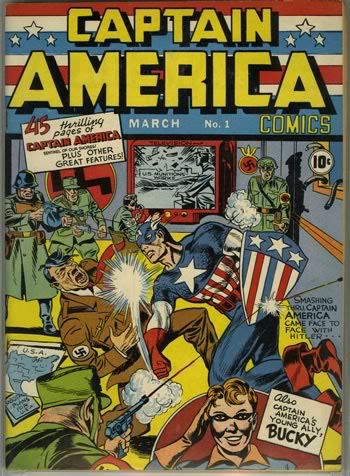
The Secret Origin of Captain America

An extra thought (after my earlier Captain America post) in honor of the Captain America movie: John Seavey’s wonderful speculation that Steve Rogers, in being a “premature anti-fascist” must have been a red diaper baby.

Ever notice how sometimes, there’s a weird synchronicity at work in the things you read? I just got done reading a book about the Hollywood blacklist, and I’m now reading The Amazing Adventures of Kavalier and Clay (not bad, but I’d still rather read a biography than a roman à clef). Both of them focused a lot on the social unrest of the 1930s, as the world headed for war, and on a society that was far less united in its opposition to Hitler and fascism than we like to mythologize. (America has a disturbing tendency to mythologize its own past, and then unfavorably compare it to the realities of the present.)

Reading the two books together have sparked an idea in my head for a comic book. And since I’m probably never going to get a chance to write it, I’ll share the idea here.

It’s the biography of Steve Rogers.

When you think about it, we really don’t know much about Steve Rogers before he became Captain America. We know he walked into a recruiting office eager to do something — anything — to help fight the Nazis. We also know that his parents were dead by then (one of the reasons he was accepted as a volunteer was that he had no family.) But beyond that, it feels almost like he wasn’t a real person until the day they gave him the Super-Soldier Serum.

But I think he must have been a very interesting person indeed. Because Steve Rogers has always been socially progressive–his attitude towards Sam Wilson might seem patronizing to modern audiences, but for someone born in 1917, Steve Rogers is pretty damned enlightened. He seems to have been working-class; there’s no real mention of an inheritance anywhere in his background, and he’s had to take jobs to make ends meet on several occasions. And he’s very strongly anti-Fascist; it’s telling that he signed up to fight against Hitler a year before the United States’ entry into the war…and was passionate enough about it that he wouldn’t take 4F for an answer.

All those things add up to a very interesting, potentially shocking, probably fascinating backstory that’s never been touched on. Namely, that Steve Rogers probably grew up in a Communist household. He might not have been a card-carrying Communist himself, but his parents almost certainly were. Because being a Communist had a different meaning during the Great Depression than it did twenty years onwards, in a Cold War America. During the 1930s, when unemployment was high and a privileged few were almost completely insulated from the Depression’s effects, lots of people joined the Communists because they believed in things like unionization, racial equality, and fighting back against the rise of totalitarian dictatorships in Europe. (Lots of prominent leftists went to help in Spain against Franco before Hitler rose to power. It was the cause celebré of its day.) The later political connotations didn’t come about until after World War II…which is part of why so many people wound up getting nailed by accusations of associating with Communists when the witch-hunts started.

Both of Steve’s parents were Irish immigrants; I see Steve Rogers’ dad as a union organizer, perhaps a dockworker or a teamster. His mother might have been a seamstress, also a highly politically charged profession (when Steve Rogers would have been born, the tragedy of the Triangle Shirtwaist Factory fire was still a pretty recent memory.) The two of them probably believed solidly in the rights of the working man and woman, joined the Communist Party because many of their friends and fellow activists were members, and probably didn’t know nearly as much about Stalin as they thought they did. They might have led a fairly bohemian social life, rubbing shoulders with upper-class leftists like Hemingway or Dorothy Parker who liked to get involved with the lives of the people they were fighting for.

And by the time Steve was twenty, they were both dead. Certainly, that’s something that shouldn’t be treated lightly in any story about his life; union organizing in the ’20s and ’30s was a dangerous business. Activists could get beaten, jailed, or even discreetly murdered by hired thugs kept on the payroll. Maybe Steve’s dad died in a riot at the docks caused by paid agitators? Maybe his mother worked herself to exhaustion, eventually dying of pneumonia from trying to support the family single-handedly because Steve was too frail to get a job like his father had?

Steve’s poor physical health speaks volumes, too. It suggests malnutrition, childhood illnesses, the sort of thing that happened a lot in families too poor to afford good food and real doctors. Maybe Steve had a brother or a sister once, someone he never talks about because it’s too painful. Maybe he narrowly avoided the same fate.

The more I think about this, the more I think it would make a great story, a vibrant chronicle of pre-WWII America as seen through the eyes of a young man who would someday become its emblem. (Although he probably wouldn’t have stayed that way if he’d been around in the 50s. The HUAC would have had a field day with him. Maybe it was a good thing he stayed frozen in ice for a decade or so…) I’d love to write it. Tom Brevoort, if you’re reading this, call me!

Updates

  • Steven Attewell at Lawyers, Guns, and Money elaborates, directly calling shenanigans on Mark Millar’s misreading of Steve Rogers
  • More from Attewell
  • And Brian Cronin offers Ed Brubaker’s response to Mark Millar
  • Infamous Brad observes that this explains why Steve Rogers and Tony Stark do not get along.
  • Lance Mannion says something similar looking at Age of Ultron
  • “Moviebob” Chipman admires movie Cap standing up for what's right
  • Delicious fanfic on this subject from Idiopathic about Steve Rodgers, PR disaster and reflections on the theme from Tumblr

(And while we are here, I also have a moving little reflection from theumbrellaseller about why Stark and Banner are Science Bros.)

Captain America

So being a geek, I've enjoyed the embarrassment of riches in superhero movies this summer. Thor was good fun and Asgard looked great. Green Lantern was kind of hokey and soulless, but impressed the heck out of my nephew. X-Men: First Class was, despite a few false notes, terrific.

But the one I was excited about opens tomorrow.

A few years back, in the pages of Marvel comics, Captain America took an assassin's bullet and died. (Don't fret; being a comic book superhero, he eventually got better.) A friend who isn't geeky—but knows that I am—asked if I could shed a little light on what it signified, but I couldn't think of anything to say. Cap has never been a character I've cared much about. Save for his memorable guest appearance in Daredevil's “Born Again” storyline, as written by the unstoppable Frank Miller, I've not felt much interest in him.

The one idea I do have about Captain America didn't do me much good in that situation, but the nifty trailer for the movie sold me completely, because it demonstrated that the filmmakers obviously have been thinking the same thing.

Captain America has a terrific arch-nemesis. Possibly the best.

Those are strong words, because the quality of your opposite number is a big deal in the superhero business. Many comics fans would say that I'm wrong about Captain America having the best foe, since the Joker obviously takes the prize. Surely Joker is an all-time great: he's the common sentiment Clowns Are Scary, made into supervillain form. Plus he plays well opposite Batman, which is important. Thanks to Christopher Nolan's Dark Knight film, you don't have to be a comics geek to know about this symbiotic relationship between superhero and archnemesis; when Joker says to Batman “you complete me” it's scary and funny, but most of all it's uncannily true, and you can see how it cuts both ways. Batman ain't Batman without the Joker to fight, and vice versa.

While we're on the subject, Batman also benefits from a deep bench of second string enemies, including supervillainous versions of a Sexy Catburglar, Earth First!, not just one but two Insane Psychologists, and many more, all contributing to Batman's general superheroic coolness. Similarly, Superman has a big rogues gallery helping to make him super, and his arch-nemesis, Lex Luthor, is great fun because he's basically Supervillain Thomas Edison.

A good enough villain can elevate a mediocre superhero into the big leagues. Nobody cared about Daredevil until Frank Miller gave him Kingpin, The Capo of All The Mafia In The World, as his nemesis, then topped that with Elektra: Your Psycho Ex Girlfriend Has Become The Deadliest Ninja In The World. (Miller is both a terrific writer and a sexist creep; Elektra remains an excellent character, nonetheless.) Reed Richards of the Fantastic Four is made much more interesting by having as his nemesis Victor von Doom, whose story is “I have lived out every damned trope in the entire Gothic literary tradition, we were best friends in college, and I have conquered an entire Eastern European country as the first step in my plan to kill you.” Superhero fans reading this may want to argue that Galactus, who is sort of Supervillain Jehovah, is Reed's greatest foe, but I think we have to reserve him as nemesis for the Silver Surfer ....

Point being, to be a superhero, you should have a cool supervillain to foil.

So who is this arch-nemesis for Captain America, who beats out the Joker, Lex Luthor, Galactus, Doctor Doom, and all the rest?

Comics fans are probably rolling their eyes reading this, because Captain America's nemesis is generally accepted to be a guy called the Red Skull, who is your basic evil megalomanic with endless cannon fodder minions and one plan after another to conquer the world. You can see him in the trailer, if you know to look. The Skull is pretty cool, but he's not in the very top tier. But I submit that Red Skull is just a stand-in for Captain America's real nemesis: Adolf Hitler.

And I don't know about you, but Lex Luthor, Darth Vader, and the kid who took my lunch money in 5th Grade can all get in line; in my fantasy life, there's nobody I'd rather punch in the face.

The people who made this film obviously know that. So count me in.


Update: The Secret Origin of Captain America, with links to reflections on his politics and the films.

20 July 2011

Politics

Timothy Burke, in the middle of struggling with why we should even talk about politics at all, says a bunch of things I think:
I think individuals, institutions, communities don’t always or even often just defend their particular self-interest. I don’t think they often accurately understand or clearly express their interests, any more than I believe human psychology or agency is well-described by the sketch version known as homo economicus. I think political agency, whether expressed narrowly in the drafting of policy or broadly in the mobilization of resources and constituencies, frequently leads to unanticipated or surprising consequences, some unexpectedly good for almost everyone and others terrifyingly destructive even to the agents who initiated a particular course of action. I think it’s intellectually possible and morally desirable to understand people unlike yourself, even people whose aspirations and worldview are genuinely antagonistic to your own. I think totalizing ideologies and totalizing social philosophies are intrinsically ill-suited to explain the human past or set a course for the human future. I think language isn’t just a framing device or an instrumental apparatus for the production of consciousness and subjectivity. I think every imagined alternative to liberalism and modernity ends up reinstating both of them under the table as well as using both of them to generate complaints about their shortcomings.
Yeah, pretty much.

11 July 2011

Yes, Minister

Yes, Minister is one of the funniest, cleverest television shows ever made. It’s also a work of political propaganda. The original is linkrotted, so here is the original pulled from archives

Yes (Prime) Minister – The Most Cunning Political Propaganda Ever Conceived

by Dan Haggard

The BBC series Yes Minister and its sequel Yes Prime Minister are two of the most renown and acclaimed television series ever made. They are timeless classics that can be watched and re-watched over and over again. Anyone who has seen them will express their admiration for the shows without hesitation. However, what many people don’t realize is that the shows were written by an advisor to Margaret Thatcher – Sir Anthony Jay – and were perhaps one of the most cleverly disguised vehicles of right wing propaganda ever conceived.

For those who don’t know of it, the series follows the exploits of a British MP James Hacker and his management of the ministry for administrative affairs, and then subsequently, the Prime Ministership. He is thwarted and manipulated at every turn by the chief public servant assigned to his department, Sir Humphrey Appleby. We learn fairly quickly that it’s the public service, not the democratically elected government, that really runs the country; and that their chief aim is to protect their own power, comforts and privilege. Hacker tries to get the upper hand, and occasionally succeeds, but rarely in the sense of actually doing any public good.

If you have friends on the left side of politics, one of the most amusing things you can do is either ask them about, or introduce them to Yes (Prime) Minister. If they are astute you’ll at least provoke an entertaining rant about its evils. But if they are not, you’ll get to watch them recount their favourite scenes and episodes; laughing all the while, praising the show for its incredible wit, acumen and insight into human nature. You’ll then get to watch their discomfort when you tell them that it was written by an advisor to Margaret Thatcher and that she was its biggest fan. And when you reveal that it is a propaganda piece for the right, a confused and pale pallor will stretch across their face that will be somewhat akin to the expression of a jock being told he had just had sex with a gay man.

If you want to be really mean, and perhaps even threaten your friendship, you can accuse your socially conscious brethren that their enjoyment of the show demonstrates that they secretly do agree with the essential psychological truths that underlie the economic theories of the right. While on the outside they profess to believe in the altruistic core of the human spirit, on the inside they delight in the satire of the essentially selfish and petty human animal.

Okay, maybe you shouldn’t do that – it’s too mean! But you should definitely educate them as to the true intent of the show. Sir Anthony Jay, along with the Thatcherites, believed in a political theory called public choice. This theory originated in the works of Kenneth Arrow, Duncan Black, James Buchanan, Gordon Tullock, Anthony Downs, William Niskanen, Mancur Olson, and William Riker. They attempted to apply the principle of rational choice theory to the realm of political theory.

Rational choice theory is the view that individual were autonomous units that act purely in their own selfish interest. There were no altruistic saints that sacrificed their own comfort for the comfort of others, rather everyone aggressively sought to position themselves at the expense of others. The best you could hope to do was to achieve a maximal equilibrium which allows each individual their greatest share. Out of this view came the ideal of freeing individuals by means of the free market which in turn led to the heady 80s where individual greed ruled the world (and in more recent times as well).

Applied to the political realm, rational choice theory became public choice theory. Led by James Buchanan, they challenged the idea that public servants and politicians act in the public good. Rather, they really only pursue their own interests and seek to consolidate their power at the expense of the people they were expected to help. The solution was to radically curb the power of government, thereby enabling the freedom of the masses.

To espouse the ideals behind public choice theory, Sir Anthony Jay began writing Yes Minister. Once you understand the philosophy behind it, it becomes impossible to view the show in any other way. The public servants, as exemplified by Sir Humphrey Appleby all work to thwart the government where it tries to break down the barriers preventing social progress. But even though the politicians express a desire to help the people, they ultimately end up only serving their own interests as well. The only real difference between Humphrey and Hacker is that Humphrey is at one with his selfish nature, where Hacker cannot admit it to himself. This lack of self-awareness allows Humphrey to easily manipulate him. Most of Hacker’s noble plans are shelved because Humphrey either shows or engineers it such that to pursue the noble policy would damage Hacker’s own self interest.

The show played directly to the cynicism that the public has for their elected representatives and the political process as a whole. It was so well written, and so genuinely funny that only recently has it been outed as the propaganda piece that it really is, with Adam Curtis making the criticism in his documentary – The Trap. One might of course wonder if its status as right wing political schill in any way lessens the quality of the show. I won’t cast judgement. No matter what your political beliefs, its very hard to deny the immediate appeal of the show and its brilliance. But you can’t ignore the role it was intended to play. You have to keep in mind that it was intended to manipulate your beliefs and your ideals. The one thing you must do is watch it with a very careful and critical eye.

I first learned this through the amazing Adam Curtis’ long video-essay The Trap mentioned at the end of the article. I have reservations about Curtis but it is still well worth your time.

10 July 2011

Federal deficit

Conservatives consistently talk about reducing government spending. Lately we've been hearing a lot of talk from them about the evils of deficit spending. Fundamentally I agree; we cannot rely on running a deficit year after year without screwing up the economy.

(Actually, economists I respect argue that if the economy is growing, modest deficits are safe and even healthy; I won't quibble. And I vigorously believe in the Keynesian argument that temporary large deficits are desirable in deep demand-failure recessions like we're in right now. But my point is that you cannot run big deficits year after year indefinitely.)

But in understanding what's going on with this conservative rhetoric, one must look at both the past and the future.

The past: Throughout Bush's administration Republicans held the House. Four out of eight years they held the Senate as well, and the other four years the Senate was exactly split between the parties. Republicans were steering the bus. They turned the balanced budget from the end of the Clinton administration into rising deficits. And no, we did not hear conservatives talking about how the deficit was bad.

Now that we have a Democrat in the White House, conservatives are talking a lot about deficits. This pattern arouses my skepticism.

The future: I was inspired to write this post because a conservative was telling me that conservative commentators promise to hold Republicans' feet to the fire about the deficit ... which they want to see addressed only through spending cuts, not by raising taxes.

This tells us that the deficit itself is not the priority. If it were, tax increases would be worth discussing. Combine this with conservatives' silence about the deficit during the Bush administration and I conclude that conservatives are insincere with their concern about the deficit. The point is cutting spending, the deficit is just rhetorical support for that project.

Well okay, conservatives are unmistakably consistent in talking about cutting spending. But most conservatives and practically all Republican politicians are evasive about what spending they would cut. Saying they want to eliminate “waste” and the Department of Education isn't enough. What will it take?

Federal spending consists of four roughly-equal major chunks:

  1. Military
  2. Social Security
  3. Medicare/Medicaid (and miscellaneous other health insurance stuff)
  4. Everything else (embassies and the FBI and maintaining the interstate highway system and NASA and farm subsidies and federal prisons and keeping the lights on in Washington DC and the immigration and naturalization service and the CIA and on and on ....)

The deficit is currently about 30% of total expenditures. So you have to cut two of those in half, and then some, or eliminate one of those entirely and sweat something else down significantly. If you're sincere and serious about cutting spending then you have to say which of those it's gonna be.

But conservative commentators and Republican politicians don't do that, because most Americans are in favour of Items 1, 2, and 3, and if you cut significantly into Item 4 you can count on hitting something they care about there, too.

So: What's it going to be? What are you going to cut? Until you answer that, I say shenanigans.

I'm sincere and serious, so here's my plan:

  1. Fix the weak-demand recession with as much deficit-funded stimulus spending as Paul Krugman says we need. This is a temporary measure, so it should focusing as much as possible on one-time infrastructure investments.
  2. Cut the military in half.
  3. Raise taxes on income over $100k to fill the gap.
  4. Switch our broken health insurance system to Medicare For Everyone so we start working on long-term cost controls. (No, this doesn't have to cost more money; most rich countries with universal government health insurance spend no more per capita than we already do.)


Update:

A clever video about how projects Republicans propose cutting have trivial costs:


Update

Since people get confused about what these numbers are, checking Wikipedia I see that the Federal budget for 2011 was $3700 billion. That breaks down to $835B for Medicare/Medicaid, $725B for Social Security, $700B for the military (or about $1000B or even more, it depends on how you count), and $1340B (or $1000B) for Everything Else, including $225B in interest on the outstanding debt. Note that this is on $2300B in revenue, leaving a deficit of $1400B. (Note also that Social Security payroll taxes brought in $820B, so that program is almost $100B in surplus, which is set aside to pay for rising expenditures in benefits for retiring Boomers.)

Note also that the $1400B deficit sounds pretty scary until you realize that total GDP for 2011 was $15,000B. No, we cannot tax all of that out of the economy — that would leave nothing for people to buy shoes and pay for groceries — but it means that the country isn't “broke”. We can pay for everything in the Federal budget now if we really want to.

Deficit hawkery is a lie.

09 July 2011

The Jerusalem of our imagination

Posts on this subject are obviously fraught, so first:
  • I keep an index of resources
  • the moral question is simple:
    Palestinian liberation is right & necessary
  • the history is complicated:
    I have a survey which addresses many common misunderstandings
  • the praxis is complicated:
    antisemitic entryism into the movement for liberation is subtle, pervasive, and unacceptable

David Shulman at the New York Review of Books blog offers hope that the Arab Spring is inspiring Arab Palestinians.

A Mediterranean variant of Gandhian-style mass protest has by now taken root among Palestinian communities in several parts of the West Bank: Ma’asara, Nabi Saleh, Dir Kadis, Na’alin, and Bil’in, to mention only a few. There is by now a clear awareness among many that non-violent resistance is far more likely to be effective against the Israeli occupation than violence; and these days the humane principles of Gandhi and Martin Luther King are frequently and clearly articulated in Arabic by grass-roots Palestinian leaders.

An eloquent statement of the philosophy and method was delivered on June 5 by Bassem al-Tamimi, one of the leaders of the Nabi Saleh protests, at his trial at an Israeli military court for organizing demonstrations. Al-Tamimi’s text will, I am sure, someday be taught in schools, maybe even in Israel; it is remarkably reminiscent of Mahatma Gandhi’s famous statement to a now forgotten British judge in Ahmedabad in 1922, when the judge sentenced him to jail for six years.

Non-violent resistance is also the official policy of the Palestinian government in Ramallah.

He isn’t fooling about the statement from Bassem al-Tamimi. It’s good stuff.

I organized these peaceful demonstrations in order to defend our land and our people. I do not know if my actions violate your Occupation laws. As far as I am concerned, these laws do not apply to me and are devoid of meaning. Having been enacted by Occupation authorities, I reject them and cannot recognize their validity.

Despite claiming to be the only democracy in the Middle East you are trying me under military laws which lack any legitimacy; laws that are enacted by authorities that I have not elected and do not represent me. I am accused of organizing peaceful civil demonstrations that have no military aspects and are legal under international law.
[⋯] Regardless of how just or unjust this ruling will be, and despite all your racist and inhumane practices and Occupation, we will continue to believe in peace, justice and human values. We will still raise our children to love; love the land and the people without discrimination of race, religion or ethnicity; embodying thus the message of the Messenger of Peace, Jesus Christ, who urged us to “love our enemy.”

The example of the Arab Spring presents a great opportunity to break the tragic deadlock in Israel and Palestine. May we, for once, miss the opportunity to miss the opportunity.