it is encouraging that well-crafted thrillers are still being made about characters who have dialogue, identities, motives and clean shirtsI'm glad I'm not alone in thinking this.
09 May 2006
Today's quote
From Roger Ebert
Religious foreign policy
I know some folks think that we lefties are being paranoid when we worry about the President believing that he's on a Mission From God. Esepcially since the Mission appears to involve war, war, and more war.
It's been surfacing in the President's rhetoric a lot lately. Consider these quotes from an appearance that produced a bumper crop of quotes about the President's chilling banalisms about "freedom" and "liberty."
I base a lot of my foreign policy decisions on some things that I think are true. One, I believe there's an Almighty. And, secondly, I believe one of the great gifts of the Almighty is the desire in everybody's soul, regardless of what you look like or where you live, to be free. I believe liberty is universal. I believe people want to be free.God made us all Americans under the surface. Our foreign policy objective is doing God's will, to bring out that inner American. Our foreign policy is the will of God.
Personally, I think that when you hear a voice telling you to invade another country, that voice isn't Jesus. It's somebody else.
08 May 2006
Art
#
culture

Via Eric Red, I learn that a giant time-travelling mechanical elephant got lost on its way to Black Rock City and found itself in Nantes, France. It's a whole story, so keep following through the links at the bottom of the page. The elephant (and the sultan, and the marionette giantess, and more) later descended upon London, and are predicted to make appearances in Antwerten, Calais, and Le Havre. Who knows where else they will turn up?
07 May 2006
WMDs
If the Bush Administration sincerely believed that there were WMDs in Iraq, as they claimed, then you would expect that their plan for the invasion would take care to secure all of the sites where intelligence suggested there were WMDs, right? Otherwise, the war would be counterproductive, right?
You know where these questions are leading, don't you?
Today's quote
DeLong makes an astonishing observation:
the years since 1945 have been the longest period since 113 B.C. in which no army has crossed the Rhine with fire and swordYou know, whenever I hear American hawks complaining about the gutless French and pacifist Germans, I reflect that history teaches us that these are good problems to have.
06 May 2006
Rule of law
The Boston Globe tells us:
President Bush has quietly claimed the authority to disobey more than 750 laws enacted since he took office, asserting that he has the power to set aside any statute passed by Congress when it conflicts with his interpretation of the Constitution.He does this in "signing statements," and as the New York Times explains ...
The founding fathers never conceived of anything like a signing statement. The idea was cooked up by Edwin Meese III, when he was the attorney general for Ronald Reagan, to expand presidential powers. He was helped by a young lawyer who was a true believer in the unitary presidency, a euphemism for an autocratic executive branch that ignores Congress and the courts. Unhappily, that lawyer, Samuel Alito Jr., is now on the Supreme Court...Let that sink in. Think about rule of law. Separation of powers.
Think about this, too: one of those 750 laws is the ban on torture.
Digby dares to call this what it is, a constitutional crisis ... and reminds us what constituted an impeachable offense just a few short years ago ... and explains that the American people don't know this is happening because it's so dramatic an abrogation of democratic principles that we don't believe that it could really happen.
05 May 2006
Goss
If you care about Porter Goss' sudden resignation as head of the CIA, after a long tenure as yet another anti-competent Bush appointee, then Talking Points Memo Muckraker is keeping tabs on the details.
If it helps to pique your interest, this Bush administration scandal involves sex. In epic, too-good-to-be-true, and profoundly schadenfreude inducing quantities.
Art

While looking for something very different, I stumbled across the Thelemic qabalistic paintings of artist The Black Bull on flickr. His work has a bit of the same sort of rich, obsessive detail as the paintings of famous, brilliant, disturbing Joe Coleman, and I thought some of my readers might appreciate the link.
Today's quote
From the Variety review of Mission Impossible III
Tom Cruise ... seems determined to give a persuasive human impersonation of a Ferrari. He succeeds to an almost alarming degree.God bless little Tommy Cruise. He may not act all that well, but not because he isn't working hard enough.
The BBC reviewer agrees.
Run, Tom, run! He might have gone a bit batty lately, but you can always rely on the Cruiser for first-class running action. That boy just loves to run.Somebody's got to do it. How many more movies about running does Harrison Ford have in him?
04 May 2006
Translation
It is popularly reported that the President of Iran has declared an intent to wipe Israel off the map. Juan Cole argues that this just isn't true.
I object to the characterization of Iranian president Mahmoud Ahmadinejad as having "threatened to wipe Israel off the map." I object to this translation of what he said on two grounds. First, it gives the impression that he wants to play Hitler to Israel's Poland, mobilizing an armored corps to move in and kill people.As usual, Cole further explicates at great length. He is meticulous, thoughtful, and very illuminating about how Iran's supposed anti-Israeli and anti-American belligerency is utter nonsense.But the actual quote, which comes from an old speech of Khomeini, does not imply military action, or killing anyone at all. The second reason is that it is just an inexact translation. The phrase is almost metaphysical. He quoted Khomeini that "the occupation regime over Jerusalem should vanish from the page of time." It is in fact probably a reference to some phrase in a medieval Persian poem. It is not about tanks.
Then he goes from there into a series of body blows against Christopher Hitchens and a brilliant rant against a war on Iran. Check it out if you like that sort of thing. (And if you're an addict, then the Hitchens thing is turning into a soap opera.) But the key thing is that the "wipe Israel off the map" quote is BS.
Shorter Richard Cohen
Shorter Richard Cohen
So Not Funny
So Not Funny
- It's rude to satirize the news media by alluding to real news items if the President is in the room.
("Shorter" invented at D-Squared Digest and brought to fullness at Busy Busy Busy.)
Immigration
Brad DeLong, economist and Internet Hero First Class, stacks up a bunch of great resources on immigration.
03 May 2006
Net neutrality
Via Wil Wheaton, a great Huffington Post article on net neutrality.
If Net Neutrality is gutted, Google, eBay, and YouTube either pay protection money to companies like AT&T or risk that their sites process slowly on your computer. Comcast could intentionally slow access to iTunes, steering Internet customers its own music service.Again, check out SaveTheInternet.com to see what you can do.
....
This isn't just speculation -- it's already happened in places without Net Neutrality. Heck, AT&T's CEO blatantly announced, "The Internet can't be free."
Green card
Fareed Zakaria explains why proposed "guest worker" programs are pernicious, dumb, and bad for America by pointing to how this has failed in Germany.
The German Green Card was misnamed, I argued, because it never, under any circumstances, translated into German citizenship. The U.S. green card, by contrast, is an almost automatic path to becoming American (after five years and a clean record).What's true for bright young Indian tech workers is no less true for hardworking middle aged Latino service industry workers, or anyone else coming to America for a new life. There are places where I think reasonable people may differ about immigration policy, but the guest worker programs many folks—including the Bush administration—have proposed are just a bad idea, period.The official dismissed my objection, saying that there was no way Germany was going to offer these people citizenship. "We need young tech workers," he said. "That's what this program is all about." So Germany was asking bright young professionals to leave their country, culture and families; move thousands of miles away; learn a new language; and work in a strange land -- but without any prospect of ever being part of their new home. Germany was sending a signal, one that was accurately received in India and other countries, and also by Germany's own immigrant community.
02 May 2006
United 93
Ron Rosenbaum at Slate has some interesting, pessimistic observations about United 93, the new film about the events on the 9/11 flight that didn't make it to its intended target.
Nothing can take away from that collective act of heroism, but something makes me wonder: Why is this the third film made about Flight 93?There is that source of fascination with Flight 93, yes, but I don't think that's all there is to it. I think there's something else folks feel happening in the Flight 93 story that they haven't heard articulated, and can't quite put their finger on, that brings us all back to it because we have some unfinished business in understanding it.
....
The conjectural response to the hijacking has become (even more than the courage of the rescuers in the rubble) the redemptive fable we cling to, the fragment we shore against our ruin. Or so it is as envisioned in The Flight That Fought Back and Flight 93 and now United 93. A film in which, we are told by its production notes, we see "the courage that was born from ... the crucible" of 9/11. A story of "something much larger than the event itself," Greengrass tells us, a story in which "we ... find wisdom." One almost hears the subtext: This is "the feel-good film about 9/11."
Contemporary terrorist networks are made possible, in part, by advanced communication and information technologies that enable them to plan and coördinate "asymmetric" attacks like 9/11. This is very scary, but I've pointed out before that those same communication and information technologies make it easier to adapt and respond to these inventive attacks, as demonstrated by Flight 93. The 9/11 attack worked by taking advantage of passengers' assumption that the hijackers wanted to survive their own attack, and would regard the passengers as valuable hostages ... but cellphones and airphones ensured that this trick only worked for about an hour before the Flight 93 passengers got wise.
Think about that.
This is simultaneously harrowing and reassuring, and one of the key lessons of 9/11. Knowledge, not fear, is security. We could eliminate all of the gate security at airports. Heck, we could let you bring a revolver onto an airplane if we wanted to, now. The 9/11 trick just won't work again.
93
#
esoteric
One other thing about that Ron Rosenbaum article, for folks who raise an eyebrow whenever they see the Spooky Number of the Æon. (For those who don't, let me summarize a great deal of esoteric weirdness by just saying that there's an occult idea that the number 93 represents the fierce zietgiest of our time and thus a road to enlightenment.)
If you eliminate the words "United" and "flight" from the article, you get something ... interesting.
But is the fable of 93 the recompense that it's been built up to be? Does what happened on 93 represent a triumph of the human spirit, a microcosmic model and portent of the ultimate victory of enlightenment civilization over theocratic savagery, as the prerelease publicity about the new film insists? Or is the story of 93 a different kind of portent, not "the DNA of our times," but rather the RIP?Sorry, I know I sound a bit batty, but it just lept out at me.
....
Both pro- and anti-war camps have seized upon 93 in one way or another.
....
a Navy Seabee Iraq support base in Kuwait was called "Camp 93"
....
And what seems central to both the 93 conspiracy theories and the new 93 movie is the imagery of control and loss of control.
....
93 is a film that, we're told, will give us inspiration, courage, and wisdom.
....
No one wants to admit it, but no 93 fable of heroism can mask the fact that we now live in a world we are utterly unprepared for, a world out of control.
....
I did not come away from watching 93 feeling optimistic about the triumph of the human spirit and the superior resilience of enlightenment values. Quite the opposite. I came away with a feeling that history has been hijacked by a cult of the undead, or the wannabe dead, suicidal mass murderers driven by theocratic savagery. That, if you want a metaphoric fable, we're all on 93, we're all doomed to crash and burn; whatever we do, the best we can hope for is that the existential rewards of local acts of courage will help us hold on a little longer before the end of enlightenment civilization and the dawn of the dead.
01 May 2006
May 1
Yezida has a beautiful thought in honour of the day. Though it occurs to me that really it's traditional to say "&#@!! The Man" in honour of May Day.
Not your monkey
The White House Correspondents' Dinner is a who's who of Washington—the President is always the guest of honour—and it's traditionally a funny, good natured roast of the President. The legendary, very funny little video "Bill Clinton: The Final Days" was made for the Dinner.
This year, they invited Stephen Colbert to speak. He's funny and does The Colbert Report, which is a goof on journalism and politics, right?
But this represents a failure to learn the lesson of Jon Stewart's super-cool appearance as a guest on Crossfire. As Atrios said about that:
[The journalists] seem under the impression that the Daily Show is a satirical take on politics and politicians. It is that, a bit, but mostly it's a parody of the news media.Colbert's speech did not go over well. The satire was actual satire, which was a little too sharp for them. By the middle of Colbert's talk, most of the laughter had died. Kos has a transcript. Colbert went after the President ...
I stand by this man. I stand by this man because he stands for things. Not only for things, he stands on things. Things like aircraft carriers and rubble and recently flooded city squares. And that sends a strong message, that no matter what happens to America, she will always rebound—with the most powerfully staged photo ops in the world.... but then he also went after the press ...
As excited as I am to be here with the president, I am appalled to be surrounded by the liberal media that is destroying America, with the exception of Fox News. Fox News gives you both sides of every story: the president's side, and the vice president's side.... and boy, there wasn't a lot of laughter in that room. Not even when Colbert showed a video of a little thriller with himself as White House Press Secretary being stalked by Helen Thomas asking him again and again, "why did we go to war with Iraq?"But the rest of you, what are you thinking, reporting on NSA wiretapping or secret prisons in eastern Europe? Those things are secret for a very important reason: they're super-depressing. And if that's your goal, well, misery accomplished. Over the last five years you people were so good—over tax cuts, WMD intelligence, the effect of global warming. We Americans didn't want to know, and you had the courtesy not to try to find out. Those were good times, as far as we knew.
YouTube has video AOL (!) has video, Peter Daou observes that you cannot expect the media to cover its own embarassment, and Shakespeare's Sister concludes some spicy comments with a well-deserved award for Mr. Colbert:

30 April 2006
Social democrat
John Kenneth Galbraith
1908 - 2006
Economist
I'll let Brad DeLong say it better than I could.
If there were justice in the world, John Kenneth Galbraith would rank as the twentieth century's most influential American economist. He has published several books that are among the best analyses of modern U.S. history, played a key role in midcentury policymaking, and advised more presidents and senators than would seem possible in three lifetimes.
A helpful reader informs me that the New York Times also has a long obit.
Jane Jacobs and Galbraith in one week. They say these things come in threes. We don't have many other public intellectuals of that stature to spare.
29 April 2006
Conundrum
Via Gary Farber's Amygdala, I learn of a survey of intellectual property weirdness that includes this gem:
For including a 60-second piece of silence on their album, the Planets were threatened with a lawsuit by the estate of composer John Cage, which said they'd ripped off his silent work 4'33". The Planets countered that the estate failed to specify which 60 of the 273 seconds in Cage's piece had been pilfered.Intellectual property law has gone mad.
28 April 2006
Logic
Zellweger
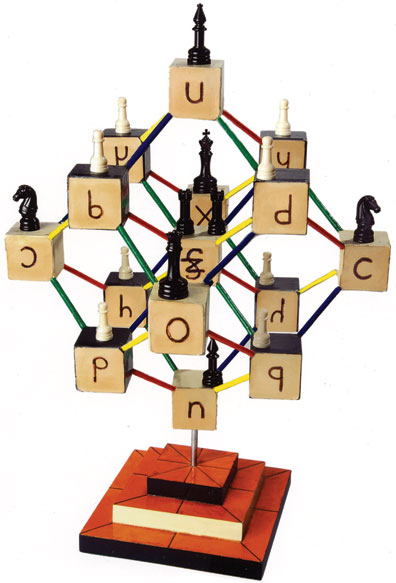
A rogue mathematician named Shea Zellweger has created a notation he calls the logic alphabet.
We need a better set of signs for and, or, if
[⋯]
These three are themselves only a small part of the 16 binary connectives.
As a big math nerd and symbol nerd, I fell in love after looking at this for all of five minutes. The fundamental structure of the system is immediately apparent — as are its advantages over ordinary logical notation.
The 3-d “chessboard” above is a kind of diagram of the relationships of the different symbols, which should properly be rendered in 4-dimensional space. I could not resist doing a mapping of my own, taking advantage of an orthographic hypercube projection that I learned in high school and have been obsessed with ever since. I think it makes the patterns in Zellweger’s notation even more apparent.

Since Zellweger is a maverick, with no academic math credentials, his system has had almost no impact on the world of mathematics. But the art world has taken a little interest, because some of the artifacts of his work are so beautiful. So I discovered him through a science-art museum that Indri of Waterbones turned me on to, and they in turn point to a fascinating interview with Zellweger in the art and culture magazine Cabinet.
his notebooks (made between 1953 and 1975) have remarkable visual appeal, passing through phases reminiscent of Russian Constructivism, outsider art, concrete poetry and pop
In the Cabinet interview, Zellweger asserts a kind of Sapir-Whorf hypothesis of mathematics ...
Yes, you only see the symmetric patterns in the system when you look at the whole thing with all 16 elements together. When you use only a few, you don’t see the beautiful crystalline structures. My notation is designed to highlight these wonderful patterns, not obscure them, as most notations do.
... and goes on to make interesting comparisons with the cool math manipulatives used in Montessori education.
Frege
a much later addition
In 1879, the mathematician Gottlob Frege proposed his notation Begriffsschrift, “logicwriting”, which has a delicious two-dimensional quality a bit like diagrammed sentences.

It did not stick.
I discovered it through Matthew Attoparsec Dockrey, a nerd’s nerd who created a programming language based on it. A daring step far beyond fonts with ligatures for common programming operators!
Today's question
Jeanne at Body and Soul asks
Do you ever get the feeling Jimmy Carter just took the stupid little job of being president for a few years as a stopgap on his way to a real job?Yeah, actually, I get that feeling all the time. Jeanne was asking in reference to a New York Times story that could make you cry.
Guinea worm, a plague so ancient that it is found in Egyptian mummies and is thought to be the "fiery serpent" described in the Old Testament as torturing the Israelites in the desert.Mind you, this is the guy that, as I observed recently, made it to many conservatives' Ten Worst Americans lists.
...
Now, thanks to a relentless 20-year campaign led by former President Jimmy Carter, Guinea worm is poised to become the first disease since smallpox to be pushed into oblivion.
Carter isn't the only President for whom the Presidency is arguably a second-string résumé item. Thomas Jefferson famously wrote his own epitaph, which doesn't bother to mention the Presidency among the three achievements for which he wanted to be remembered. And as I've commented before, I think we're currently grooming a commissioner of baseball.
27 April 2006
B. D.'s recovery
I posted a while ago about the turn Doonesbury has taken with B. D. injured in the Iraq war. It's remained a recurring element of the strip, and in recent months, he's been wrestling with post-traumatic stress, grudginly seeing a counselor at the VA hospital.
If you have an interest in the strip but haven't looked at it lately, now would be a good time to catch up. In the last couple of weeks Trudeau has obviously chosen to try to take a four-panel strip as far as it can possibly go.

26 April 2006
Today's quote
J.A.C.Brown, from Social Psychology of Industry:
If managers' orders were completely obeyed, confusion would result and production and morale would be lowered. In order to achieve the goals of the organisation workers must often violate orders, resort to their own techniques of doing things, and disregard lines of authority. Without this kind of systematic sabotage much work could not be done. This unsolicited sabotage in the form of disobedience and subterfuge is especially necessary to enable large bureaucracies to function effectively.Found as the header in a delightful discussion of work-to-rule strikes, via Jim Henley.
25 April 2006
A giant passes
Jane Jacobs
1916-2006
Urbanist
Dilettante
We just lost Jane Jacobs. Ninety years old, and working on yet another book.
She didn't need to be. She secured her claim to greatness for having written The Death and Life of Great American Cities forty-five years ago. To my mind—and many others'—it's the most important book about urban design ever. And, dear to my heart, she was a great dilettante. She was smart about subjects that defy categorization and demand synthesis, and she got there by virtue of paying attention and doing her own homework, rather than by virtue of any formal qualifications.
I blogged a link to a terrific web post about her a while back. If you didn't check it out then, you missed out. Now might be a good time; you'll see why I mourn her passing.
Genocide
Today is Yom Ha'Shoah, Holocaust Remembrance Day.
I presume that you've heard of the Holocaust already. Let me offer you a thing about the Holocaust you may not know, and a few other things about genocide worthy of reflection.
First is that you may know the figure of 6 million dead in the Holocaust. That's actually a misleading figure. The Nazis killed 6 million Jews plus, in the same processes of concentration camps and mass executions, at least 4 million other folks they didn't like. That includes: Poles, Russians, and other Slavs ... Roma ("Gypsies") ... communists and other political dissidents ... Jehovah's Witnesses, Freemasons, and other religious minorities, as well as antifascist Christian clergy ... lesbians and gay men ... and on and on. About ten million total, maybe more depending on how you count.
Second, there's this observation about the Nazi concentration camps from Hannah Arendt, writing in The Origins of Totalitarianism. (Chapter 12, Part III)
Torture, to be sure, is an essential feature of the whole totalitarian police and judiciary apparatus; it is used every day to make people talk. This type of torture, since it pursues a definite, rational aim, has certain limitations: either the prisoner talks within a certain time, or he is killed. To this rationally conducted torture another, irrational, sadistic type was added in the first Nazi concentration camps and in the cellars of the Gestapo. Carried on for the most part by the SA, it pursued no aims and was not systematic, but depended on the initiative of largely abnormal elements. The mortality rate was so high that only a few concentration-camp inmates of 1933 survived these first years. This type of torture seemed to be not so much a calculated political institution as a concession of the regime to its criminal and abnormal elements, who were thus rewarded for services rendered. Behind the blind bestiality of the SA, there often lay a deep hatred and resentment against all those who were socially, intellectually, or physically better off than themselves, and who now, as if in fulfillment of their wildest dreams, were in their power. This resentment, which never died out entirely in the camps, strikes us as a last remnant of humanly understandable feeling.
The real horror began, however, when the SS took over the administration of the camps. The old spontaneous bestiality gave way to an absolutely cold and systematic destruction of human bodies, calculated to destroy human dignity; death was avoided or postponed indefinitely. The camps were no longer amusement parks for beasts in human form, that is, for men who really belonged in mental institutions and prisons; the reverse became true: they were turned into "drill grounds," on which perfectly normal men were trained to be full-fledged members of the SS.
That quote comes from a brilliant Arthur Silber essay cycle on torture as a tool of state violence in which he plumbs the unwholesome depths of our current American madness on the subject.
Third, via Dionysus Devotee, a poignaint reminder about the Armenian genocide. According to legend, Hitler exhorted his commanders on the Eastern Front to ruthlessness by asking, "Who remembers the Armenians?" If you don't, you ought to follow the link and find out.
Fourth, if that isn't bad enough for you, I have an old post about Rwanda and Iraq for you which I think really is worth your time if you didn't read it the first time around.
Film school
Okay, remaking trailers we've done soundtrack, editing, and voiceovers; now let's look at transitions in Sleepless.
Subscribe to:
Posts (Atom)