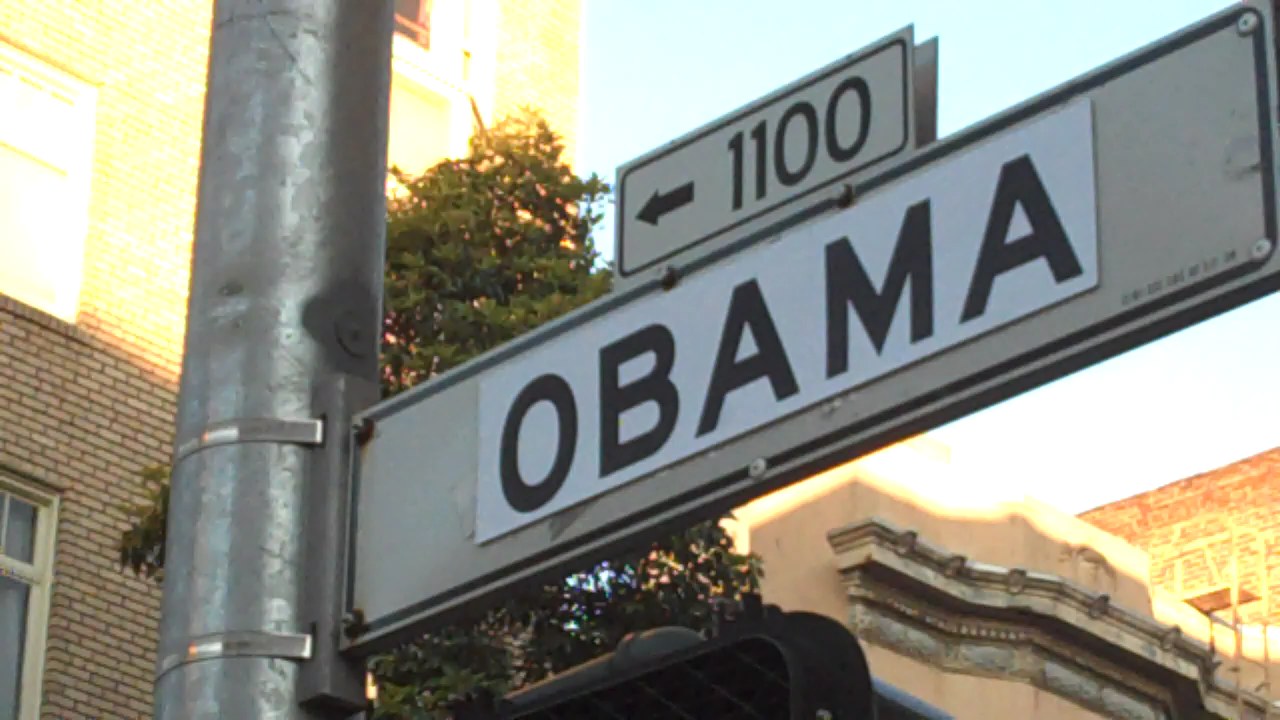
As on Election Day, Bush Street in San Francisco was transformed into Obama Street.

It looks like nobody was hurt, but still ... important safety tip: do not cut in front of the armored car.
Then go see. It's perfect.
Bettie Page
Pin-up model
1923-2008
You may not recognize her name, but you surely recognize her. The only woman's image whom you could argue has been more reproduced and imitated than Bettie Page's is Marilyn Monroe's.
Maybe.

Like with Marilyn, Bettie worked a strange magic with the American virgin-whore dichotomy, knowingly sexy and innocently pretty at the same time. But Bettie could walk even deeper into the paradox; she did countless pictures that were a lot racier (and fetishier) than Marilyn ever did. Don't let that deter you from looking for them, though, as even the wickedest of her pictures are only wicked by ’50s standards—and more importantly in every one of them she radiates joy. I remember reading somewhere that the photographer best known for working with her, Bunny Yeager, said that she didn't have any unreleased photos, because Bettie had been so uncannily photogenic that she had never managed to take a picture that wasn't good enough to publish.
Life was not nearly so kind to her as the camera had been. How could it have been?
On December 10, 1948 the General Assembly of the United Nations adopted and proclaimed the Universal Declaration of Human Rights the full text of which appears in the following pages. Following this historic act the Assembly called upon all Member countries to publicize the text of the Declaration and “to cause it to be disseminated, displayed, read and expounded principally in schools and other educational institutions, without distinction based on the political status of countries or territories.”Good reading.Preamble
Whereas recognition of the inherent dignity and of the equal and inalienable rights of all members of the human family is the foundation of freedom, justice and peace in the world,
Whereas disregard and contempt for human rights have resulted in barbarous acts which have outraged the conscience of mankind, and the advent of a world in which human beings shall enjoy freedom of speech and belief and freedom from fear and want has been proclaimed as the highest aspiration of the common people,
Whereas it is essential, if man is not to be compelled to have recourse, as a last resort, to rebellion against tyranny and oppression, that human rights should be protected by the rule of law,
Whereas it is essential to promote the development of friendly relations between nations,
Whereas the peoples of the United Nations have in the Charter reaffirmed their faith in fundamental human rights, in the dignity and worth of the human person and in the equal rights of men and women and have determined to promote social progress and better standards of life in larger freedom,
Whereas Member States have pledged themselves to achieve, in co-operation with the United Nations, the promotion of universal respect for and observance of human rights and fundamental freedoms,
Whereas a common understanding of these rights and freedoms is of the greatest importance for the full realization of this pledge,
Now, Therefore the General Assembly proclaims this Universal Declaration of Human Rights as a common standard of achievement for all peoples and all nations, to the end that every individual and every organ of society, keeping this Declaration constantly in mind, shall strive by teaching and education to promote respect for these rights and freedoms and by progressive measures, national and international, to secure their universal and effective recognition and observance, both among the peoples of Member States themselves and among the peoples of territories under their jurisdiction.
Article 1.
All human beings are born free and equal in dignity and rights. They are endowed with reason and conscience and should act towards one another in a spirit of brotherhood.
Article 2.
Everyone is entitled to all the rights and freedoms set forth in this Declaration, without distinction of any kind, such as race, colour, sex, language, religion, political or other opinion, national or social origin, property, birth or other status. Furthermore, no distinction shall be made on the basis of the political, jurisdictional or international status of the country or territory to which a person belongs, whether it be independent, trust, non-self-governing or under any other limitation of sovereignty.
....
There's growing support among many Nebraska lawmakers to limit the safe haven law to children no older than three days. But several lawmakers said they'll push for something closer to a 30-day age limit.The safe haven law was meant to protect infants, but there is no age limit under the current law. Five of the abandoned children were brought to Nebraska from out of state. Parents have traveled into Nebraska from Michigan, Indiana, Iowa, Florida and Georgia.
Tysheema Brown drove from Georgia to leave her teenage son at an Omaha hospital.
“Do not judge me as a parent. I love my son and my son knows that,” Brown said. “There is just no help. There hasn't been any help.”
As a teenager, I'd watch Doctor Who on Sunday afternoons on PBS. (Pertwee, Baker, and Davison, for those who care enough to recognize the names; otherwise never mind.)
My father would always comment that he didn't understand the appeal. “All they do is walk around in corridors and talk!” But like many American fans, I loved the cheerful goofiness of the show. It's difficult for me to imagine what it's like for Brits, who grow up as children watching from behind the sofa, terrified of the un-threatening Daleks.
I'm late to the party on the recent revival of the show. A little while back I finally sprung for the first couple of seasons on DVD but didn't motivate to watch them. I write this having finally watched the first episode. Exactly the sort of good fun I was hoping for.
And oh, the ending. Young Rose Tyler, her boyfriend in tow, has just survived the adventure in which she meets The Doctor.
Who doesn't want that to be their life?
Much as I hesitate to assert that my inclination to admire the beauty of women reflects some deep commitment to Truth, Spiritual Enlightenment, and Social Justice, a recent bit of news has gotten under my skin and has me tempted, just a little bit.
A week or three ago, someone pointed me at this little music video by Amanda Palmer, of cabaret-punk band Dresden Dolls fame, for her song “Leeds United:”
How good is that? It's a super spiffy pop song, a fun video full of stuff that makes my cabaret-lovin' heart sing, and — bonus! — Ms Palmer is awfully ... ah ... charismatic. (If you dug that, I also commend to your attention LeAnne Rimes' video for “Nothin’ Better to Do.” Zowie.)
I don't buy a lot of new music, but I got to thinking that it was past time I invested in the Dresden Dolls and Ms Palmer.
Then, via Warren Ellis, I learned that the record company had really jerked her around about this video. She explains:
the label i’m on (roadrunner records) had wanted to pull shots from the video so that my bare belly wasn’t exposed. they thought i looked fat. i thought they were on crack.
dude. i’m a vain motherfucker. i know when i look fat. i had beth hanging out on the set of the pope videos, keeping an eye on my figure as i pranced around in my slip in case pope was getting a particularly pregnant-looking angle. i hate shots of myself where i look heavy with child.
but THIS?? this was just nonsense. i thought i looked HOT. i really, really didn’t see where they were coming from. at all.
so i didn’t budge.
they weren’t happy, but then again they’re not very happy with anything i’m doing lately (including putting out a record that has “no commercial potential” and is impossible to promote, since nobody will like it).
the video was left as is.
WTF?
Look, as someone who was on the leading edge of the “video killed the radio star” generation, I hate to bite the hand that gave me Annie Lennox, but what the %#&@!! is wrong with these music industry clowns?
What the &*%!! is wrong with a society which creates people paid to tell sexy pop stars that they are unattractive?
I know as a good feminist my first reaction should be to point y'all at the reBELLYon where fans are posting pictures of their “no commercial potential” bellies in a zany pro-postive-body-image protest, rather than to allow a BS chivalrous reflex of protectiveness toward pretty girls to muck up the discourse, but my tastes in pretty girls are better than theirs nyah nyah nyah and I'm pretty fromaged off about it.
Clearly I must go see her show and thereby put some money in the lady's pocket. That'll show ’em.
The question, for me, is even if we only save ONE child from rape or attempted rape, or even just lots of uncomfortable hugs from Creepy Uncle Dave, is that not worth leaving a couple naked bodies out of a comic?He answered, at length, with the post Why defend freedom of icky speech? Some key bits:
If you accept -- and I do -- that freedom of speech is important, then you are going to have to defend the indefensible. That means you are going to be defending the right of people to read, or to write, or to say, what you don't say or like or want said.It's worth reading the whole thing; Mr Gaiman really kicks out the jams.The Law is a huge blunt weapon that does not and will not make distinctions between what you find acceptable and what you don't. This is how the Law is made.
....
I was born the day of the conclusion of the Lady Chatterley trial in England, the day it was decided that Lady Chatterley's Lover, with its swearing, buggery and raw sex between the classes, was fit to be published and read in a cheap edition that poor people and servants could read. This was the same England in which, some years earlier, the director of public prosecutions had threatened to prosecute Professor F R Leavis if he so much as referred to James Joyce's Ulysses in a lecture (the DPP was Archibald Bodkin, who also banned The Well of Loneliness) , in which, when I was sixteen and listening to the Sex Pistols, the publisher of Gay News was sentenced to prison for the crime of Criminal Blasphemy, for publishing an erotic poem featuring a fantasy about Jesus.
....
you could rewrite Jess's letter above, explaining that only perverts would want to read Lady Chatterley, or see images of women being abused, or read Lost Girls or the works of Robert Crumb, and mentioning that if only one person was saved from a hug from a creepy uncle, or indeed, being raped in the streets, that banning them or prosecuting those who write, draw, publish, sell or -- now -- own them, is worth it. Because that was the point of view of the people who were banning these works or stopping people reading them. They thought they were doing a good thing. They thought they were defending other people from something they needed to be protected from.
....
So when Mike Diana was prosecuted -- and found guilty -- of obscenity for the comics in his Zine “Boiled Angel”, and sentenced to a host of things, including (if memory serves) a three year suspended prison sentence, a three thousand dollar fine, not being allowed to be in the same room as anyone under eighteen, over a thousand hours of community service, and was forbidden to draw anything else obscene, with the local police ordered to make 24 hour unannounced spot checks to make sure Mike wasn't secretly committing Art in the small hours of the morning... that was the point I decided that I knew what was obscene, and it was prosecuting artists for having ideas and making lines on paper, and that I was going to do everything I could to support the Comic Book Legal Defense Fund. Whether I liked or approved of what Mike Diana did was utterly irrelevant ....
And this makes today a particularly good day to donate to the CBLDF.
Steven Croop at The Escapist reflects on how this happened.
So, how in the world did a secluded online community, widely considered to be a bunch of social misfits and outcasts with little vested interests beyond expanding their collections of violent fetish porn, become a potent, organized activist group that has protested against the Church of Scientology since January in an operation called “Project Chanology”?He doesn't manage to offer an answer per se but he does have some interesting history of what happened.
How, then, did the raid on the Church go from DDoS attacks to standing on street corners in major cities around the world with signs, masks and cake — all within less than a month? How was it that Bunker watched “Anonymous virtually pivot on a dime?” For his part, Bunker became Anonymous' advisor, Wise Beard Man. “I made a video to suggest they stay within the law and do things the right way,” Bunker says. “I worried Anonymous would attack me for daring to make the suggestion, but I felt I had to say something. Happily, most understood my points and agreed with me. They dubbed me Wise Beard Man and started to rethink their involvement and their tactics and quickly transformed in a way Scientology has never been willing to do.” And there it is, in all its glorious simplicity — Anonymous rethought, transformed and changed. Did a convincing paradigm shift carry Anonymous into the real world with an ennobling goal?Croop basically supposes that it may turn out that in a Fredrick Jackson Turner-ish way, the existence of internet-based troll pits may help to actually help stabilize social activist movements. I'm skeptical, but it's an interesting datum.Not necessarily. It was also an internal polarization: We only saw the more elevated, optimistically charged side in the real world, while its opposite sunk further ...
It turns out Obama was thinking several moves ahead.
The Obama plan as presented during the campaign had a gaping policy hole in it. If private insurers were required to cover individuals regardless of pre-existing conditions, but individuals weren't required to purchase coverage, then it would be reasonable for people, and especially for the young and healthy, to forgo coverage until they got sick. That would have bankrupted the private health insurance industry by driving its premiums so high that it couldn't compete with the alternative public plan.This Obama guy seems to know what he's doing with this politics stuff.At that point, one of two things would have happened. The private insurance industry would have collapsed — good riddance to bad garbage — thus backing the country into a single-payer system, or the private insurers, with their army of lobbyists, tame think-tank pseudo-scholars, and captive Congressmen and Senators would have had to demand a mandate, which the Democrats could then graciously grant.
Now it looks as if the insurers have jumped the gun, agreeing to offer individual insurance with no exclusions for pre-existing conditions as long as there's a mandate to buy insurance.
If Obama had proposed such a mandate, the health insurers would have had “Harry and Louise” all over your TV set talking about how oppressive the whole idea was and how they could never afford it. Now it's their idea.
Though it is not likely to be the case with Obama, some presidents chose not to attend church while living in D.C.Hmmnn. It says “some presidents chose not to attend church while living in D.C.” Let's review what it tells us.President Bush is widely known for his religious beliefs, but for eight years has not frequented a local church, at times citing security concerns. Ronald Reagan also did not attend a church regularly, saying that after the attempt on his life it was too great a risk. And Richard Nixon opted to have Billy Graham come to the White House for private religious services.
“The logistics of a president going to a worship service are a nightmare,” Cromartie said.
But security does not make regular worship impossible. Both Jimmy Carter and Bill Clinton, for example, attended D.C.-area churches. Clinton’s church, Foundry Methodist Church, installed metal detectors because many tourists attended services on Sunday — some simply to catch a glimpse of the president.
| Attended | Did not |
| Nixon | |
| Carter | |
| Reagan | |
| Clinton | |
| Bush | |
| Obama? |
It seems like there's a pattern in there, somewhere. I'm sure if I think about it for long enough, it will come to me.
This mark was proposed by the French poet Alcanter de Brahm (alias Marcel Bernhardt) at the end of the 19th century. It was in turn taken by Hervé Bazin in his book Plumons l’Oiseau (1966), in which the author proposes several other innovative punctuation marks, such as the doubt point (), certitude point (
), acclamation point (
), authority point (
), indignation point (
, essentially ¡), and love point (
or
). It was also featured in the art periodical Point d’Ironie by Agnes b. in 1997.
Its form is essentially the same as the late medieval
, a percontation point (punctus percontativus), which was used to mark rhetorical questions.
When I first moved to Los Angeles, I saw a hand lettered sign in a crappy little mini-mall coffee shop that read “Comida China y Donuts.” Chinese food and donuts is a standard fast food combo out here, but that homemade Spanglish sign somehow summed up the culinary soul of LA better than an army of clever foodbloggers. Humble or haut cuisine, we love our ethnic fusion chow out here.As a friend of mine says, if you look inside the kitchens of Italian restaurants, French restaurants, and even Chinese restaurants, and see who is actually preparing the food, you realize that all restaurants in California are Mexican restaurants.So in the spirit of that mix-and-match dining philosophy, the intrepid Eric Stone, his pal Bill and I set out last night on a quest for Bulgogi tacos. That would be MexiKorean fast food composed of traditional, thinly sliced Korean beef in a sweet soy marinade but served carne asada style in a soft corn tortilla, with or without kimchi.
I presume that this is even true of the place this story reminded me of, a little spot in downtown LA that serves “Kosher burritos” made with pastrami.
I am reminded by several folks that today is the 10th annual Transgender Day of Remembrance, which marks deaths by trans-hate-motivated violence. Because of course the list is long enough that it would fill our calandars if we had individual days for each person lost.
Yezida, borrowing from Tristissima, offers a mourning poem.
In the first week of August, the list began receiving essays and letters from someone who called herself "Doctress Neutopia." She immediately proved herself to be a prolific writer, highly imaginative and not prone to holding back her opinion. The writings of The Doctress dealt consistently with issues of sexism and the oppression of females by males, and were generally of tremendous length and great personal investment. In shorter e-mailed notes, she spoke of adding a love saga to the rapidly-developing Fixion project. She also told us she was looking for "the A/O (Alpha/Omega) Man," who would join her in rule over the Earth when the Lovolution came. (In an early letter to me she asked if I was that man; a little stunned, I bounced back Mitch's address, figuring she was looking for the author of A/O.) Day after day, her writings poured in, screenful after screenful. She seemed to care little for our already-developing lines of work, preferring instead to stick to her own campaign and agenda. For a week or so, her words seemed illuminating in a unique way; her over-the-top, egocentric, dyslexic metaphor seemed intentionally postmodern, and her research skills were undeniable (even if her prose tended toward hyperbole). The Doctress was unconditionally welcomed to the list. Relatively speaking; Aleph had found another weird sister.Reading it was tinged with nostalgia for the Mondo 2000 era ... while also being a timeless example of the challenges of virtual community.
I bring it up because a major office supply manufacturer now sells it as a product.
For most of 1985, my favourite song was Del Shannon's 1961 hit “Runaway”. So for over twenty years I've been puzzling over the question what the hell is that instrument from the break in the middle of the song?
It sounds like a synth, but that can't be right; this was 1961.
It turns out that yeah, it is a synthesizer, homemade by keyboardist Max Crook, which he calls the “musitron”.
Max developed the Musitron out of a variety of musical instruments and other electronic and electric devices. The initial keyboard is a clavioline, a french organ developed by Constant Martin in 1947. The clavioline is very similar in sound to that of the ondioline, developed by Georges Jenny, also of France. Crook created the Musitron by incorporating the majority of the clavioline, but being an electronics genius, Max was able to further enhance the clavioline by expanding the octave range to infinity (beyond human hearing). He inserted extra resistors, pots, and capacitors. The clavioline also lacked reverb. It was a dry sounding monophonic organ. Crook developed a spring echo reverberation unit custom-built from garden gate springs and other mechanical parts to create an echo chamber which, though crude, produced an amazing and natural echo sound resembing the acoustics of a tile-plated bathroom.
Even without the mystery, I still love the song.
When Michael Lewis was first hired, right out of college, as a salesman at Solomon Brothers, his instinctive belief that things have an actual value was something that got relentlessly mocked by his coworkers. In his early days on Wall Street, they explained to him that there is a pecking order in the financial services industry. For a variety of cultural and regulatory reasons, investment firms are required to have people working for them who are experts at calculating the actual value of an investment based on current mathematical models and best available data. Their department is called “Quantitative Analysis,” and the people who work there are derisively called “quants.” Quants have the lowest prestige jobs in the entire industry, draw remarkably low salaries considering the level of education you have to have to get those jobs and the long hours and the awful working conditions, and Lewis says that they are routinely and cruelly and ruthlessly snubbed by the other half of the business. Those are the people whose specialty is sales. And at the absolute top of the pecking order, Lewis taught us, are the people who were called the Big Swinging Dicks, people who demonstrated the superiority of their manhood by being able to sell anything, however worthless the quants said it was, for however much the company needed it to sell for.Lots of examples of the principle, in tales well told, if you click through.How does a BSD make his money? First, he starts by asking, “what do I have available to me to sell?” How much of it is there? Now divide that into his assigned sales goal. Add in the cost to sell it. That tells him what the thing he has to sell has to be worth; for it not to be worth that is flatly unacceptable. Which leads to the next, and last, and hardest part: what lies does he have to tell to himself to convince himself that it really is worth what he needs to sell it for, and how does he fool himself into believing his own lies? That's the only use that any BSD has for a quant: once in a very, very rare while a quant says something to him that, if he ignores the caveats and footnotes and fine details, he can twist into a justification. The quant doesn't have to have been right. Even if the quant was right, the salesman doesn't even have to accurately remember, let alone accurately pass on to others, what the quant said. He just needs to be able to believe that he is honestly representing what the quant told him when he quotes some bit of (what is to him) quant bullcrap about what the investment is “really worth” when he's on the phone to the client. And he really, really has to believe it, himself, even if he used to know that he was lying, even if he used to know that he was making this stuff up out of whole cloth. Humans kid themselves that they're good at detecting it when people tell them things that aren't true. They aren't. But to the limited extent that they are, they're really only good at detecting one thing: whether or not the other person believes what they're saying. So the ultimate BSD is the guy with the greatest talent for figuring out what he needs to believe in order to get you to give him money, and then making himself believe that, and believe it really hard.
....
I guarantee you that in every firm involved in this market, somewhere in some windowless cubicle in the basement, there was at least one quantitative analyst screaming his head off in emails about this, about how the mathematical modeling that underlaid the calculations that determined pricing on collateralized debt obligations was based on statistical analysis of customers who were buying their primary home, not as an investment vehicle but to live in, and pricing those homes based on reasonable expectations of what someone in their social class could afford to live in and paying no more for them than three times their income. And no BSD in the entire industry wanted to hear that caveat. He didn't dare. He almost certainly paid people to intercept those emails and keep them from him. Because if he let himself get drawn into what must have seemed to him like an arcane and wrong-headed argument about what something is “actually worth,” when there really is no such thing, when everybody knows that the only accurate way to value something is to put it in the hands of a talented salesman and see what he can sell it for? He wouldn't have made his numbers.
I leave the parallel to another conflict between people who have been successful by virtue of believing their own BS and the “reality-based community” as an exercise for the reader.
In a Salon interview, Bernard-Henri Lévy defines “the left.”
I think it is the same definition: to have freedom and equality, the two dreams of freedom and equality walking at the same pace. To refuse to choose between the two. This is written in the motto of the French Republic, as you know, “Liberté, égalité, fraternité.” And it is also written in the DNA of the best of America. The real dream of equality, which fed the battle, for example, for the civil rights, Martin Luther King and so on, and the battle for individual freedom. Those who ask to choose between the two — if you have freedom you do not have equality, if you have equality, you do not have freedom — for me, they are not leftist. This is a good definition of the left.
Emphasis mine.
To refuse to choose between freedom and equality. I can go for that.

Aside from the economic differences brilliantly documented by political geographer Joel Garreau in his old best-seller The Nine Nations of North America, St. Louis has one huge important cultural difference with the southwestern corner of the state: a bizarre kind of apathy about what other people are doing that borders on tolerance. There really is no such thing as an extremist for any political cause here in St. Louis. The local descendants of the Ku Klux Klan, the Mystic Knights of the Veiled Prophet, are a charitable organization. The local chapter of ACT-UP changed the national group's motto to, “We're here, we're queer ... and we'd like to get to know you better.” The local chapter of Earth First!'s biggest act of defiance was hanging banners over the highway.He goes on to talk about how that the rest of Missouri has a very different attitude ...I'd love to hear from local Obama organizers, and even more from Obama organizers who were parachuted into the state with Axelrod & Plouffe's brilliant book on political organizing to check one of my guesses: my bet is that they got roughly 1/3rd the turnout of other organizers anywhere else in the country using the same system, and got roughly half the volunteer hours out of the people they did get that volunteers gave in every other city that used the same system. What makes me say that? Because that's what every volunteer organization that comes to St. Louis reports. Even when a volunteer-run movement starts in St. Louis, like Neopagan Wicca did, the locals put in a third of the numbers and half the volunteer hours per person of anywhere else in the country. It's just how we are. Do you know about the biggest “battle” anywhere near St. Louis during the American Civil War? Pro-slavery and anti-slavery militias both stormed the US Army arsenal in St. Louis, on a rumor that the other side was about to seize it. The side that got there first waited for the other side to show up. Other than a few warning shots and some shoving, they then settled down on opposite sides of the nearest street and just waited patiently, maintaining watch for several days; it was enough for them to make sure that the other side wasn't going to grab all those weapons and do something with them. For just about as long as there's been a St. Louis, our natural defense against violent political extremists has been apathy, usually polite apathy with a hint of disdain, but occasionally shading into enforced apathy.
The paradox of McCain is pretty simple: He projects a strong general message that government spending is out of control, and that Congress needs a president strong enough to say NO to its wasteful ways, so that we can continue to cut taxes and yet return to fiscal responsibility. But when the audience asks him about any particular thing the government does, he promises to continue it or even do more of it: He wants to stay in Iraq as long as it takes, keep Social Security and Medicare strong, do something about global warming, take care of veterans, make health care and college educations affordable, start a land-a-man-on-the-Moon-like program to make the United States independent of foreign oil, defend our borders against illegal immigration, and on and on and on. He rails against procedural stuff like Congressional earmarks, but never once does he say, “Here's an expensive government service that the American people are going to have to get along without.”Pericles goes on to describe the habits of mind which make this reasoning possible.


