26 October 2023

İyad el-Baghdadi on Israel, Gaza, and beyond

Posts on this subject are obviously fraught, so first:
  • I keep an index of resources
  • the moral question is simple:
    Palestinian liberation is right & necessary
  • the history is complicated:
    I have a survey which addresses many common misunderstandings
  • the praxis is complicated:
    antisemitic entryism into the movement for liberation is subtle, pervasive, and unacceptable

I posted this not in October 2023 but in August 2024, but I dated the post to match the timing of the source.

In my August 2024 post What I think Israel is trying to do, I included a capture of a bracing Twitter thread by İyad el-Baghdadi | إياد البغدادي from 13 November 2023, about understanding Israel’s attack on Gaza as genocidal and what that does and does not imply. That thread became the anchor for a Twitter thread in which I accumulated resources I found clarifying, which eventually developed into that “What” post.

Baghdadi was originally prompted to write that thread when a commenter on a previous Twitter thread of his from 23 October 2023 objected to him calling Israel’s attack genocidal. That previous thread provides an instructive time capsule of the state of what was happening and what we knew in the very earliest days of Israel’s attack on Gaza. It holds up astonishingly well (though a handful of his predictions did not come true in interesting ways). I have various quibbles and a few sharp disagreements, but I don’t want to examine those here, not least because in most places where I disagree I admit that I may well be wrong.

If you benefit from his commentary half as much as I did and have a buck or three to spare, I encourage making a one-time or recurring donation to Baghdadi’s Kawaakibi Foundation. I just did.

Past this point, this post is not my writing; it is a capture of Baghdadi’s earlier long original thread and its sequel responding to questions, which I have created for readability, convenience, and in case Twitter implodes:

23 October 2023 intro

Here’s a thread outlining the geopolitical situation around the Israel-Gaza war its possibilities, impossibilities, and possible outcomes. Heads up, it’s my longest thread yet. It’s also raw, unedited, and unevenly paced. Sorry, none of us are well but at least we’re trying.

A note that this thread rhetorically departs from my usual tone because it’s about geopolitics. I’m analyzing the actions of many actors the majority of whom are awful. I’m trying to do that from a position of objectivity, which is hard when you actually value all human life.

Hamas & 10/7

Hamas’s stated objectives for their Oct 7 operation were:

  • Release Palestinians in Israeli prisons
  • Stop normalization pacts between Israel & Saudi
  • Punish Israel for violations / attacks on Palestinian holy sites
  • (there was a fourth objective I can’t find right now)

Most coverage of Hamas’s attacks in Western media have focused on the atrocity factor (the mass killings & kidnapping of civilians). Virtually none have actually covered it from a military strategy standpoint. But it’s important to look at that to get a full picture.

Hamas’s attack was very well coordinated and meticulously planned. They first used drones to take down surveillance systems on the border fence, rendering them “blind”, then moved bulldozers to knock down sections of the fence. Other fighters used tunnels. Others used paragliders.

Israel had relied upon high tech surveillance including tunnel detection systems for the security of the Gaza border fence. Hamas seems to have dug deeper than these systems can detect. The tunnels they dig across the border seem to be one-use only and are abandoned afterwards. Their first targets were intelligence posts, police stations, and IDF points. They knew exactly where to hit and how long it’ll take them to encounter a response. Their fighters were able to operate within enemy territory for [more than] 24 hours, meaning they were well supplied.

Why is this important? Because we want to understand what Hamas was expecting as an Israeli response. Was it expecting or planning on a ground invasion? Or did they think this will be a kidnap operation that will be followed by bombing and then negotiations and a prisoner swap?

There are indications & early statements suggesting that Hamas’s attack was more successful than they had expected. In one statement I came across: “The army collapsed as we attacked, what do we do in this situation? So we just pressed forward as far as we could”. Other statements suggested that the wanton massacres and atrocities that followed as being the result of them running out of targets and trying to just gain as many hostages as possible. Basically a coordinated military operation descended into an unimaginably bloody massacre.

But even if we assume Hamas planned this as a complex hostage-taking op, I find it hard to believe that they did not anticipate a ground assault in response. Whoever planned an attack this sophisticated couldn’t have not planned for an unprecedented Israeli response.

In the early days after Oct 7 there were messages (originating on Telegram channels, copied into group whatsapp chats etc) that say that Hamas has “8 months of supplies”, and that in addition to their homemade weapons they also have Iranian, North Korean, etc weapons. About the tunnel network — some say it runs ~500 kms in total. For comparison Oslo’s metro is 85 kms (and a lot of it is overground). It’s multilayered and was built over many years. Also there’s thousands of tunnels across the Egyptian border, plus temp tunnels into Israel

So, did Hamas at least anticipate, if not actually plan, on a ground invasion? I think they did. Now for question 2 — did Hamas coordinate this with its allies (Hezbollah & Iranian regime)? I also think they did:

There are strong indications that Hezbollah at least knew, if not coordinated the attack. If we go by the report on this link, then Hamas’s attack wasn’t a one-off hostage operation, it was part of a much broader strategy.

Some people familiar with the operation said that a tight circle of leaders from Iran, Hezbollah, and Hamas helped plan the attack starting over a year ago, trained militants and had advanced knowledge of it. That account is based on interviews with three Iranians affiliated with the Revolutionary Guards, one Iranian connected to senior leadership, and a Syrian affiliated with Hezbollah.

New York Times | Hamas Attack on Israel Brings New Scrutiny of Group’s Ties to Iran

If this is a coordinated broad plan, and if the Hamas attack planned on an Israeli ground invasion, then it would make sense for Hezbollah to wait until Israel is bogged in Gaza before they open a major new front to Israel’s north. But I’ll come back to this. I’m thinking aloud.

Israel

But let’s look at Israel now. When discussing state actors and their decision-making, there’s a kind of hierarchy that serves me well: The most fundamental imperatives are geopolitical; then the political; then the ideological. Keep in mind when analyzing Netanyahu’s response.

What I mean is that what you see isn’t just Israel acting for its own security (its geopolitical imperatives) but also Netanyahu acting for his own political career. And there’s also his electoral allies acting out their ideology. The Oct 7 attacks are a huge repudiation of much of Netanyahu’s career. It’s almost like everything he built for decades crashed in a matter of hours. Netanyahu presented himself as a master statesman who can do the impossible for Israel. His project was to liquidate Palestinian national project:

  • Normalize with Arab regimes to break the “land for peace” paradigm
  • Strengthen Hamas to weaken the Palestinian Authority
  • Annex the West Bank to make 2SS [a two-state solution] impossible
  • Treat Palestinians as a security problem to be managed indefinitely

Btw, the point about how Netanyahu’s policy was to strengthen Hamas, a lot more can be said about this failure but here’s a good place to start:

This is solidly documented. Between 2021 and 2018, Netanyahu gave Qatar approval to transfer a cumulative sum of about a billion dollars to Gaza, at least half of which reached Hamas, including its military wing. According to the Jerusalem Psot, in a private meeting with members of his Likud party on March 11, 2019, Netanyahu explained the reckless step as follow: The money transfer is part of the strategy to divide the Palestinians in Gaza and the West Bank. Anyone who opposes the establishment of a Palestinian state needs to support the transfer of the money from Qatar to Hamas. In that way, we will foil the establishment of a palestinian state (as reported in former cabinet member Haim Ramon’s Hebrew-language book Neged Haruach, p. 417).

[⋯]

In an interview with the Ynet news website on May 5, 2019, Netanyahu associate Gershon Hacohen, a major general in reserves, said, “We need to tell the truth. Netanyahu’s strategy is to prevent the option of two state, so he is turning Hamas into his closest partner. Openly Hamas is an enemy. Covertly, it’s an ally.

In a tweet on May 20, 2019, Channel 13 quoted Egyptian President Hosni Mubarak saying: “Netanyahu isn’t interest in the two-state solution. Rather, he wants to separate Gaza from the West Bank, as he told me at the end of 2010.” Mubarak said that during an interview with the Kuwaiti daily Al-Anba.


[emphasis Baghdadi’s]

Ha’Aretz | Opinion | Why Did Netanyahu Want to Strengthen Hamas?

It was also under Netanyahu that Israel expanded its disinfo capacities and leaned hard into relying upon cyber capabilities and high-tech occupation. Also a reminder, Netanyahu is one of the first pioneers of the “war on terror” paradigm: the US War on Terror doctrine was influence by Israeli doctrine, and particularly by a certain Benjamin Netanyahu who had been arguing that the US should adopt it since the early 1980s. “The Bush doctrine in NSS-2002 was taken from the Shultz doctrine, and … the Shulz doctrine in NSDD-138 was taken from Israeli doctrine.”

So after Oct 7 Bibi had one of two options —

  1. Gesign & admit that this is the result of a series of failures most of which lead back to him
  2. Go all out and try to accomplish a “victory” his allies always wanted but couldn’t do. Ethnically cleanse 2 million Palestinians.

So my analysis is that Israel’s response so far reflects primarily not Israel’s security imperatives but Netanyahu’s political calculations. His first statement was “We’re going to change the Middle East”, which if you follow Netanyahu you know is a very Netanyahu thing to say. Netanyahu even seems willing to sacrifice the hostages for that. He’s not even meeting with hostage families, and pro-Netanyahu mobs are calling hostage families “traitors” for calling for a cease fire to allow for hostage negotiations before a ground invasion.

I understand when people ask "What else could he have done in response to such a brazen attack". Ami Dar and others have written good posts about this.

Some people have asked, “What would you do if you were in Netanyahu’s place?” After thinking about this, here’s what I would have done last week: Nothing. Nothing at all. Not one bullet — at least not for a while. I would have said, “We will secure our borders immediately. We will bury and grieve for our dead. We will sit shiva together. And we will think before acting. I promise you this won’t happen again. But we will do this methodically, surgically, politically, economically. With most of the world behind us, and while keeping an eye on the future we want to build here. I understand the desire for action now. But we have to be strong and smart. And Hamas is in Gaza. They can’t leave. They, and we, can wait a bit. We will win. But we will do this right.”

This would have been hard-to-impossible to pull off politically, but that's what leaders are for.

But while such a response would have been good for Israel it would have been bad for Bibi’s career.

(Btw, Israel will come out of this a much more polarized and right-wing country. You’d expect people to rally to their leader and to unite versus a common threat after such horrors, but Bibi is placing his political career above everyone’s security in Israel and regionally / globally.)

And so the Israeli (Netanyahu & co) response to a humiliating failure is to “achieve the impossible” and ethnically cleanse Gaza. I’ll come back to the actual Gaza op and the stated objective of “destroying Hamas”. But now let’s look at Egypt in all of this.

Egypt

According to multiple Israeli commentators (and even think tanks), the Israeli demand is to transfer Gaza’s population into the wilderness of the Sinai desert. It’s even clear that the US, and perhaps other Western countries, tried to pressure Egypt’s Sisi into accepting this.

Here’s the thing — Egypt would never accept this, as a matter of geopolitical imperative. If 2 million Palestinians are displaced into Sinai, it could be fatal to Sisi’s regime (not exaggerating when I say the regime could fall). And it won’t even stop Hamas. Hamas already has ~2500 smuggling tunnels across the Gaza-Egypt border + ties with smugglers in Sinai. If Sinai becomes the new Gaza, Hamas will just start to rebuild on the Egyptian side where they’d also have the advantage of a recruiting pool of millions of angry Egyptians.

Not to mention that Egypt was already getting screwed over with Biden’s India-Middle East-Europe Corridor that bypasses Egypt and devalues the heavy investments they’ve made in modernizing their own infrastructure. So they were getting screwed even before these events.

Reminder that a significant part of the modern Egyptian national identity was forged in conflict with Israel. The current Egyptian regime itself was founded by army officers who overthrew the previous regime (the monarchy) after blaming it for the 1948 defeat vs Israel.

So not Sisi nor anyone else who wants to stay in power in Egypt would allow Gaza population transfer into Egypt. I am not exaggerating when I say that Egypt would sooner break the Camp David accords or even start covertly supply Hamas with weapons than accept such an outcome.

It is within this context that I read today’s (?) call between Egypt’s Minister Of Foreign Affairs and Iran’s Minister Of Foreign Affairs. Sisi is feeling the heat and is looking for options in case of an escalation. He wants to be in contact with all sides. I can’t imagine he’s been sleeping easy these days.

Jordan too would never allow it. In Jordan the fear is that if population transfer happens in Gaza then the West Bank is next. Historical note: Jordan saw a 10-month civil war in the 1970s when Palestinian militants stationed themselves there to fight Israel.

Egypt and Jordan have the longest lasting peace treaties with Israel. That even those are being tested tells you something. Biden adopting Bibi’s position shows he’d rather coddle Bibi than appreciate Egypt & Jordan’s vital national security concerns.

It’s insane that the US actually adopted the Israeli position and wanted Egypt to accept population transfer. This has far-reaching implications for how regional leaders will see the US going forward. You can get your allies to do many things, but not slit their own throats. Those in charge of US policy on this seem insane, incompetent, senile, or a combination of the three.

Strained relations with both the US and Israel prompt the Egyptian president to snub President Biden and dismiss plans for Egypt to offer a temporary refuge for Gazans fleeing the Israel-Hamas conflict

The Medialine | El-Sisi Rejects US-Israeli Proposal for North Sinai Refuge for Gazans

Alliance means mutual interest / benefit. When you ask someone to slit their throat for you, the alliance is over. It means these countries no longer can trust the US to make their interests a priority. It also means they can start looking for an ally who’d respect their interests.

Basically if he gets his way the Bibi & co plan is to expel Gaza Palestinians into Egypt, and probably later expel West Bank Palestinians into Jordan, so Israel can have all the land without any of the Palestinians. And so for Palestinians to no longer exist as a national group.

(Also, I swear if I get another comment from a clueless person who seems to think Arab countries should accept refugees because “refugees should be welcome”. This isn’t a humanitarian operation you fucking morons, this is ethnic cleansing and the liquidation of a nation.)

Saudi Arabia

Ok. Now let’s talk about Saudi Arabia, which was in the process of negotiating a normalization deal with Israel which included US security guarantees. Summary: MBS [Crown Prince Muḥammad bin Salmān Āl Su‘ūd] is annoyed that this war spoiled one of his main strategic aims, but has no choice but to take a hardline on Israel. MBS has a project and it’s to secure the Saudi regime’s future. He wanted Israeli tech & investment in his pet project in Neom. He wanted US security guarantees. He wanted the prestige of being a hero for “making peace in the Middle East” etc. And he knows how to play hardball.

For over a year before the war MBS dangled public Israel normalization before both Bibi and Biden to get a long list of concessions and he kept asking for more. But he’s aware that his people can’t stand by with Gaza being slaughtered. He has no choice but to take a hardline. Because MBS has a project, he doesn’t want war. He really, really doesn’t want war. The Iranian regime knows this of course, and for years had presented a simple formula: If they go to war against Israel/USA, they’ll consider US/Israel’s Gulf allies to be targets as well.

In 2019 when there was an escalation with Iran MBS immediately deescalated and engaged them. Now again and shortly after Oct 7, MBS called Iranian president Raisi (first time ever!) and shortly after Iran’s foreign minister visited Saudi. Basically “hey if this escalates I’m not part of this.”

So it’s not only that MBS thinks his people (including his own family) won’t tolerate witnessing the massacre / ethnic cleansing of 2 million people nearby. He also has to send a clear signal to the Iranians that he’s not on Israel’s side in this

That said, MBS would be hoping that this dies down and he can get back to the Israel normalization project in due time, but he knows that if this escalates it may be many years (if at all) that this can happen. He’ll continue to engage Israel in private. (probably already is).

(Weirdly enough MBS now prefers Biden to Trump because while Biden seems ready to entertain a US security guarantee Trump won’t. Biden’s agenda is securing the US empire in the world. Trump’s is securing white supremacy within America. Choose your poison.)

Iran

Back to the Iran axis. Iran has assets in Yemen, Iraq, Syria, and Lebanon. The relationship between the Iranian regime and much of this militant network is complex. Calling them “proxies” reduces their agency. Calling them “allies” makes it seem they’re totally independent.

Anyway. I don’t think Iran wants a regional war at this point. The question is whether in case of an escalation, they’ll go all in, or whether they’ll stand by and sacrifice Hamas. Some think they’ll sit it out and allow Hamas to be destroyed. I think they won’t, here’s why.

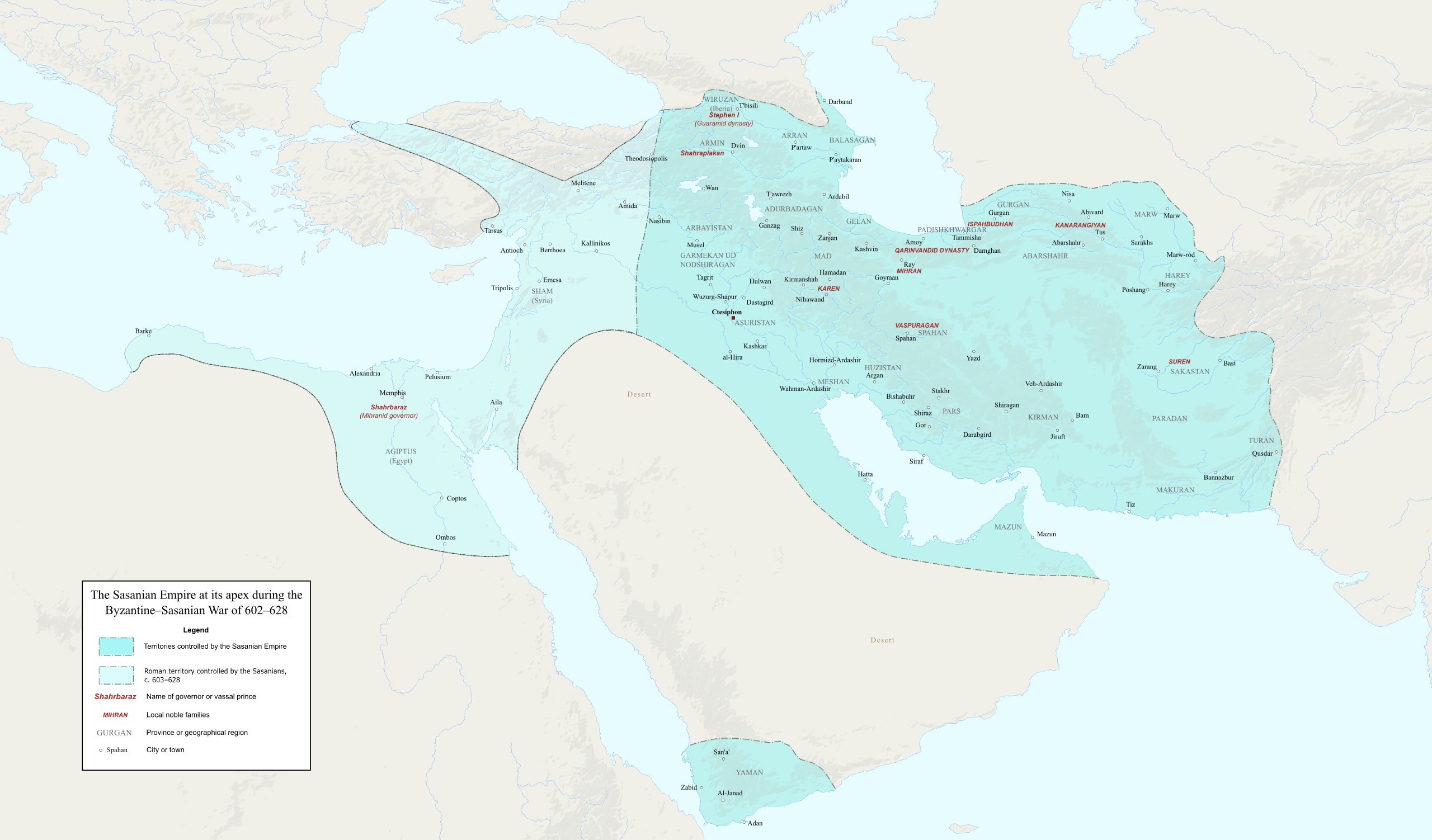
Btw Iran's proxy network isn’t just about ideology but geopolitics. Look at this map of the Sassanid empire (6th century AD), note how Persia at the time extended its influence into the Levant and the Gulf, and also … Yemen. It just makes geopolitical sense on this chessboard.

If Iran sacrifices Hamas it’ll:

  • Lose a critical asset
  • Suffer a serious ideological & political setback
  • Send a signal to its other proxies that it doesn’t stand by its allies

The third point is critical and other analysts haven’t considered it fully. Iran’s network is built over decades and based on long-term relationships. The regime really stands by its allies (look at Bashar in Syria). They don’t waffle like others. To allow one of its allies to be destroyed while it stands by will really damage its network.

A similar calculus applies to Hezbollah. If Hamas is gone, and Israel no longer has a military threat to its south, then it can then focus all of its efforts on the enemy to the north. Hezbollah cannot allow Hamas to fall because it’ll be next.

Btw Iran’s assets have already been activated. Houthis fired missiles & drones towards Israel that US navy intercepted. US assets in Iraq & Syria were also targeted. US still has a lot of assets in the region. Iran’s m.o. is to attack using proxies. The Houthi missiles / drones were really a shock, Yemen is 1700 kms away from Israel. The fact that they have missiles and drones of this range is astounding. But it’s also likely the Houthi attack isn’t meant to actually threaten Israel but to tie up US navy assets in the Red Sea.

But there’s another side to Iran’s calculus — opportunity. If this becomes a major war, it would be a chance to use the chaos to attack US presence across the region. At best keeps the US distracted among multiple fronts; at best force US withdrawal that would be hard to reverse. This is amplified by the fact that unlike other US wars in the Middle East this isn’t coming after significant pre and in line with overriding strategy. For years US geopolitical thinkers have focused on the China threat. Nobody serious has said “let’s get involved in another war in the Middle East.” So in this particular case the US is caught flatfooted, it hasn’t prepared for this, it’s not in line with its long-term geopolitical aims, it’s just reacting, and from everything we’ve seen so far there’s a lot of incompetence in their response. Even the messaging is confused.

What about the IRGC, Iran’s real army? They won’t get directly involved unless the US gets significantly involved. Keep in mind the US moved assets to “deter nonstate actors from exploiting the situation”. I don’t know if that means the US would act directly vs Hezbollah. Is the US prepared to get directly involved alongside Israel? Put boots on the ground? Attack Hezbollah positions? Bibi clearly wants the US to be involved directly. Some even suggesting the IDF can’t win this on its own. Some of Biden’s messaging too can be interpreted this way.

If the IRGC acts its likely target would be to block off the Straits of Hormuz where 30% of world energy passes. Send oil prices skyrocketing, hurt the West in its pockets.

They’ll do it cheaply too using drones, mines, etc. They won’t even claim responsibility. China sent navy assets to the region. It’s extremely sensitive to oil shocks and its main interest in preventing escalation is to ensure the oil flows. It’s also a friend of Iran, perhaps it’ll want to make sure shipments headed to itself can still pass. There’s also a non-zero chance that if this escalates to a significant degree and drags in the US, China will see this as a golden opportunity to move on Taiwan. But let’s not even go there, this is already apocalyptic without another major war in the world. But non-zero chance.

Here’s the thing about an oil shock. Russia will benefit twice (hurts West, more profit on oil sales). But you know who else greatly profits from oil shocks? MBS. Recall he was a pariah pre-Ukraine war. After the Ukraine war he was a darling of the West again.

IDF (Israel’s military)

Back to Gaza. Some have blind faith that the IDF will absolutely win and eliminate Hamas. I don’t share that view. Bibi painted himself into a corner with “destroy Hamas” as [his] objective. He clearly doesn’t have a well thought out plan.

Israel has not won a land war since 1967, and even then, it relied on a preemptive strike. It is quite experienced in military occupation and dropping bombs from the sky on civilians, but fighting face to face or urban combat and guerrilla warfare is something it fears.

This is true. Many seem to have blind faith in Israel’s military dominance. But the IDF hasn’t operated in a real urban warfare situation for a generation. Its army is not well trained for the battle for Gaza and isn’t prepared for the mass casualties they’ll see during it. And this isn’t just me saying it. Here’s an article from Israel Today giving the full assessment of a retired IDF general. “We have lost the ability to field an effective army and have become a one dimensional aerial power that can’t win a war on its own.” Today’s IDF is really effective at sniping unarmed journalists, raiding undefended Palestinian towns, and helping extremist settlers harass and beat up Palestinian farmers. But fighting a war in a potential urban meat grinder? I don’t think so.

To really “destroy Hamas”, [Netanyahu will] have to wage a bloody, prolonged urban war to dislodge a well trained, highly motivated, well supplied army that has spent over a decade digging in and preparing for such a day. The IDF has never fought such a battle. He’ll have to take all of Gaza and hold it, and either push out its inhabitants or fight among them. A partial invasion will only relocate Hamas. An occupation will make IDF a target for a prolonged and bloody attrition war.

The deeper he gets into Gaza, the higher the risk of a second front opening to his north, plus multiple fronts vs the US, and a regional conflagration erupting. The regional escalatory potential will be almost infinite. Also the deeper he gets into Gaza and the more desperate the situation gets for civilians there, the more likely it is that even his long-term partners Egypt and Jordan will turn on him, despite their hatred of Hamas, because they can't afford not to. And even if he actually wins, all he'd have done is relocated Palestinian militancy from a besieged and blockaded Gaza to a slightly further but much deeper (and suddenly much less stable) Egypt.

Right now in Israel a major shitstorm has erupted between Bibi and IDF. He wants them to take the blame for Oct 7. IDF [are] also suspicious of the military aims he’s set up and think some are unrealistic. Meanwhile the hostage families who want to see negotiations are being ignored.

The most likely outcome is he’ll go in as far as he can but as the risks rise for everyone he’ll have to stop, declare victory and pull out. The report card will be:

  • Israel isn’t safer
  • Relations with long-term partners (Egypt & Jordan) damaged
  • Impossible for Saudi to normalize for a while
  • Real damage to US standing in the region
  • Hamas can claim victory because it wasn’t destroyed

In the words of Noam Shuster Eliassi:

There’s so much coverage about the Israelis who are kept hostage by Hamas and so little coverage of Israelis who are kept hostage by Netanyahu.

Many Israelis and their future & security are also captives of Netanyahu. De-escalation is in everyone's benefit. Except Netanyahu.

Biden

  • He has his own domestic political calculus
  • He’s coddling Bibi (they don’t get along)
  • He revealed his cards to Iran by making it clear he doesn’t want escalation
  • His whole “diplomacy” amounts to ensuring Israel can attack Hamas without a spillover happening

Answering questions a few days later

I want to start by thanking everyone for their engagement & their questions. I’m particularly grateful that the thread did change some minds. I try not to preach to the choir and to write so that everyone, pro-Palestinian or not, will read. I hope others take note, this isn’t a popularity contest where you try to say whatever is most extreme in order to get followers. You speak in order to be heard.


Several asked for sources (they didn’t doubt the info but wanted sources for additional research). There are some in the thread, but I’m afraid going back and sourcing every single claim is prohibitive. The amount of info we have to consume daily is immense and esp under these circumstances it’s very hard to keep track. I’m not saying I’m 100% sure of every fact I cite and I’m happy to be corrected.

Several asked about US posture and whether the carrier strike group will sufficiently deter Hezbollah & Iranian allies. Umm, difficult concept for some — the US isn’t as intimidating as it used to be 20 years ago. The US simply doesn’t have as much leverage in the region as it used to have. Militarily everyone knows that whatever the US does, it’ll eventually leave. Even regional countries (other than Israel) that used to be closely allied don’t trust the US as before. This isn’t 2003.

Some asked about Hezbollah’s capabilities. Well they’re estimated to have 100k fighters, and they have the strategic depth (via Syria, Iraq, and Iran) to bring in more soldiers & supplies. They’ve spent the last 17 years rebuilding & stacking up weapons, many of them pretty advanced and accurate missiles. I believe their capabilities to be significant. But I’m happy to defer on this to experts watching the group more closely.

There were questions about Netanyahu and his ideology. Reminder, in politics, consistency is a liability. There are certain ideas Netanyahu always held — prevention of a Palestinian state a main one — but otherwise he’s less an ideologue and more a slimy, populist, but also skilled politician. He’s very good at building coalitions and he’s often the most secular & liberal member of the coalitions he builds (which are mostly people further to the right than him).

Questions about Netanyahu strengthening Hamas etc because some people were shocked. Well Ha’aretz did this job for everyone because now they have a pretty detailed article, A Brief History of the Netanyahu-Hamas Alliance. Yup you read that right, the Netanyahu-Hamas alliance.

There were people casting doubt about the “genocide” claim (that Israel’s actions amount to the crime of genocide under international law). On this me and many others are relying upon actual genocide scholars (such as Arnesa Buljušmić-Kustura & others). Maybe someone can post a thread about all the genocide scholars who took this position. Also a reminder that ethnic cleansing and genocide aren’t always separate things; they’re a continuum of each other.

Someone asked about Russian involvement alongside Hamas. The question shows a lack of understanding of the Russia-Israel relationship and what Israel means for the modern Russian psyche. Many of the founders of Israel were born in the Russian empire or the USSR. The USSR was the very first country to recognize the state of Israel. And “defeating Nazism” is almost a moral foundation of the modern Russian national identity. About ⅙th of Israelis today are Russian speakers.

Russia may get pissed with Israel now & then but it’ll always maintain friendly relations. This also explains why Israel was rather slow / reluctant to take Ukraine’s side or supply it with weapons vs Russia. Russia may use this crisis to attack / criticize the West but it will not back Hamas.

An update / correction regarding Russia’s involvement. Many have responded and made me realize I’ve made a mistake. You can read their responses under the tweet. While the facts in my tweet are correct, I made the mistake of confusing the ideological / cultural with the geopolitical. Geopolitically yes, in case of an escalation it makes sense for Russia to stand against the collective “West”, that is against the pro Israel alliance. Putin’s relations with Israel have been worsening. He has relations with Hamas and has criticized the West for its response so far but there’s no indication he’s giving any sort of material support to Hamas and I don’t think he will, even in case of an escalation.But I do think in case of a regional escalation, Russia would give material support to the Iranian axis.

There was a question about whether Palestinians would rather “leave” than get bombed and whether they’ll leave Gaza if it’s damaged beyond repair. How do I explain the Palestinian concept of “sumud صمود” (staying put)? Like I said elsewhere Palestinians are survivors of erasure. After the Nakba, Palestinians adopted a popular attitude of “staying put” (sumud), this is ingrained in our psyche. Perhaps this song can explain?

I’m staying put
In my land, I’m staying put
They can take my livelihood, I’m staying put
They can kill my children, I’m staying put
They can blow up my house, and in its ruins, I’m staying put

A few asked about the Biden-Netanyahu relationship. A lot of my insight came from this reporting from Axios. Basically, Biden and Netanyahu don’t get along, and while Biden declares strong support in public, in private he’s been trying to rein him in.

There were questions about my conclusion that we’re more likely to see a limited incursion that doesn’t go as far as everyone initially thought. I think since I posted the thread, more people are seeing it this way. There’s also this thread [from Dimi Reider] that talks about how the US keeps asking for delays to the ground invasion, but also how the IDF is now walking back the imminence of the invasion.

This is one of those threads that might age very badly, very fast, but I’ll risk it: I don’t think there’s going to be a ground incursion, or a regional war, yet. ֿֿIn fact, barring another hospital hit or something similarly ghastly, we’re going to de-escalation, of sorts:

  1. The IDF not only wasn’t prepared on the defensive on October 7th; it was also massively underprepared to launch a successful counter-attack. It didn’t have the intel (as evidenced by Hamas attack itself), the plans to suppress Gaza (having subcontracted Hamas for that) or the gear, hardware or supplies. This impression is partly anecdotal, but it bears out through the sheer number of public fundraisers big and small for various bits of gear, from vests to rations.
  2. This scramble, alone, created a delay which you think would have been surmounted by now. Buf if anything, the signalling from Netanyahu and his circles AGAINST a ground assault is becoming ever more urgent, even as he himself is promising to destroy Hamas, rewrite history, find the Holy Grail and mine the Moon and/or other patently achievable objectives. Signals since Sunday include: IDF saying it won’t be dictated timings by Biden but launch the assault “at a time of their choosing”, which is literally what Hezbollah says when it decides against ever reacting to an IDF bombing raid; a flurry of press statements and leaks about Netanyahu holding “meetings” and “consultations”, which is diplospeak for dawdling; an interview by key coalition partner Aryeh Deri, who candidly said the army simply didn’t have the plans in place to retake the Strip and would need time to prepare them;the quiet demobbing of some of the urgently mobilised reserves; and, hilariously / grimly, a transparently astroturfed campaign urging Netanyahu not to invade, led by a former Netnayahu staffer (grimly, because the campaign says just keep bombing Gaza).
  3. The delay has been filled by Israel’s brutal but overwhelmingly aimless bombardment of the Strip, which not only killed an astonishing 5,000 or so people (a third of them children), but has cashed in most of cart blanche offered up to Israel by Europe, the US, Saudi and Egypt. You can track for yourself the increase in caveats in support announcements from the West, and the increasingly assertive setting of boundaries closer to home, esp by Egypt. Israel had a chance to radically and brutally reshape the post-Oslo landscape. Thankfully, that’s gone.
  4. Although word is being put about Israel thinks Hamas sufficiently cowed to whip round and attack Hezbollah — the stronger adversary — first, it would seem this window has been missed as well — and there is no evidence (publicly at least) of army being redeployed northwards.
  5. And this would also go against the priorities of world powers, starting with both US and China. It’s hard to see what US can gain from regional war, whether or not it participates; its assertion its sending significant forces to avert rather than fight a war seem plausible.
  6. So what can we expect? Two scenarios: An increase in speed and volume of hostage release culminating in a ceasefire; or a very overhyped but limited incursion aiming to slice off the northernmost tip of the Strip — either just to show we can or to create the buffer zone touted by Galant, which is such a jaw-droppingly stupid idea — even for Galant — that I personally refuse to believe even he takes it seriously (ask me why). Then it’s back to scenario one — release of hostages, ceasefire.

And then?

This deserves a separate thread on a separate day, assuming THIS thread doesn’t collapse in the face of events overnight. Which can happen in any number of ways, beginning with the obvious — Israel actually embarking on a giant offensive contrary to all public evidence. Also, the current status quo is fluid, and the possibilities for unplanned escalations are endless (e.g. Israel bombs a hospital, a Palestinan rocket backfires on a hospital or hits an Israeli schoolbus, etc). And obviously, the RIGHT thing to do is an unconditional ceasefire NOW. Which is not going to happen. But as of 11pm GMT, it seems the current round is petering out. It might only be in anticipation of a more definitive round to come. But it does give the actors working against relentless bloodshed to regroup — both domestically and internationally.

The next day

Update, of sorts.

Breaking: In special statement, Netanyahu says Israel still “preparing” for ground incursion, and emphatically declines to say “when, how, how many.” Says timing of incursion will be determined by war cabinet “unanimously”. Has no update to make about hostages, does not take responsibility for any of the fuckups. “Everyone will have to answer questions, even me — but only after the war.” The rest of the speech is sloganeering.

Israel’s national TV: We have to say we were expecting some dramatic announcement from Netanyahu, and, yet again, we got the opposite … he’s once again evading the issue of accountability … the prime minister is basically saying, I’ll see you at 6 o’clock after the war.

There were questions about whether Hamas political leadership would have known about the attack. On this I generally deferred to this interview by a respected researcher who thinks the political leadership did not know and were only informed shortly before:

My debut on BBC Newsnight explaining Hamas’ internal leadership & power dynamics. The brutal violence unleashed by Hamas against Israeli civilians represents a take-over by hardliners in the military wing, sidelining political moderates who argued for engament & compromise.

There was also this illuminating additional context [on the interview above] by a Palestinian commentator who talks about how the military wing of Hamas has really been the one in charge since 2006.

This isn’t the case; I’m sorry. Hamas, the political movement, became entirely a follower of its military wing in 2003 (Yassin & Rantisi’s Assasi.,). Al Qassam brought Hamas to power in 2005 and saved them in 2007 against the Palestinian Authority. There was a chord that syncs the political and military actions, and it faded away. Hamas was excluded from the operational level that is meant to serve a political aim, and the timing, tactics and red lines of the attack on the 7th of October were drawn by Al Qassam. Now, Hamas leaders in the diaspora need to find solutions.
“Every discussion about the day after or the presence of Hamas in Gaza will be decided in Gaza and nowhere else,” Arab diplomats say.

Arab diplomats who recently met with Hamas leader Ismail Haniyeh and other senior officials in Qatar say that every proposal or discussion about the future of the group or the hostage deal was met with the answer, ‘We’ll see what they say in Gaza’

Ha’Aretz | Hamas Officials Abroad See Power Wane as Gazan Leaders Take Control

There were questions about Qatar’s role — well, Qatar is in a mediation role because Hamas political bureau members live there. But also, would be remiss not to mention that Netanyahu wanted Qatar to be an in-between long ago, and convinced it to continue to send money to Hamas. In fact, in 2019, Qatar considered walking away from this deal, so Netanyahu sent his Mossad chief + an IDF officer to convince them to continue to send money to Hamas.

There was a question about Hamas and the hostages. Well, it seems that Hamas is playing an interesting game with the hostages, releasing a few every few days to forestall a ground invasion and to increase political pressure on Netanyahu and the pro-Israel coalition. You can’t start a ground invasion when hostages are being released every few days. In fact there’s reporting that Netanyahu and the IDF have been very frustrated by this. There was also reporting that when Hamas said it would release some hostages, Israel initially ignored them.

Several questions about the atrocities committed on Oct 7. I’m preparing another thread on this but there are now many reports by credible journalists that make it impossible to deny that horrific atrocities were committed on that day. Israel says Hamas planned every single atrocity from the start. Hamas says some of the worst atrocities were done by other opportunistic parties from Gaza that used the border fence breach to go on a rampage. They also say that at least some of the civilian deaths were due to a disorganized and heavy-handed IDF response. Like I said I have another thread coming on this but at this point I don’t think anybody who’s objective can doubt that Hamas committed serious war crimes that day.

Questions about Turkey’s role. Funny, this reminded me of this article (published a week before Oct 7) in Israeli media talking about a “Turkey-Azerbaijan-Israel coalition” (really). Turkey won’t get involved in the conflict directly or diplomatically and has lost leverage over Hamas when it agreed to expel its members in order to re-normalize relations with Israel last year. There’s another report that says more Hamas members were asked to leave Turkey after Oct 7. Erdogan is a geopolitical opportunist and will use any chaos to secure Turkey’s southern border; he’s also a domestic populist who’ll praise Hamas as Palestinian resistance but acts opposite to this.

Someone asked whether Israel’s electorate want Gaza ethnically cleansed. The answer is actually no, the Israeli electorate were largely satisfied with the pre-Oct 7 status quo and thought it was manageable (Palestinians of course were not, it was just relentless and escalating violence and pain). Did they change their minds after Oct 7? We don’t know, but I don’t think so. The ethnic cleansing push is coming from certain people in Israel but I don’t think it’s a mainstream opinion, not yet at least.

Someone asked, how should Israel defend itself if not with a ground invasion? Reminder that the pre-Oct 7 status quo was supposed to be “the solution”. Hamas was caged & blockaded, but Netanyahu kept sending them money (via Qatar) and they eventually broke out of the cage in a dramatic and devastating way. But really, the problem is the assumption that this is a security-only problem with a security-only solution. This is the kind of thinking that failed explosively on Oct 7. Without a long-term political solution, there will be Palestinian militancy in some form or another.

Someone asked if this is an existential threat to Israel. Well, a regional war which drags in the full force of Iran’s proxies, with Egypt and Jordan staying neutral (or secretly hoping Israel doesn’t win), and Saudi Arabia remaining neutral, and with the US kinda iffy — well that can be catastrophic for Israel’s security. But I don’t think it’s an existential threat. I do think however that the stance of Western powers is bad for Israel long term. They need to be pushing Israel towards a political solution, not coddling the worst of its right-wing impulses in a way that makes a solution impossible.

Question about whether the Palestinian Authority can take over Gaza’s administration after / if Israel “dismantles Hamas”. Well given the mass murder and potential ethnic cleansing, it would be a poisoned chalice, and any Palestinian faction that agrees to “take over Gaza” after will be seen as collaborators in their own people’s genocide. But also, remember that Bibi strengthened Hamas explicitly in order to weaken the PA. Not to just hand them over Gaza and allow them to administer all territories under Palestinian control for the first time since 2006.

Someone asked about Iran and its nuclear program. Some experts believe that Iran has developed its program to the point where it can, if it wanted, develop a nuclear weapon within weeks or months, but it will hold that off until a time of serious crisis. I do think that if there is a serious escalation that becomes an open war, Iran could take that step. Noting also that Iran has put its entire army on alert and started military drills.

Iran is mobilizing its ground forces and conducting widespread military exercises. Everything is pointing to a massive regional escalation at the moment that would have absolutely devastating consequences. The lunatics in Washington prefer this over telling Israel to stop murdering thousands of Palestinian families.

People also asked about the two-state solution (2SS) and whether if we have a de-escalation we can see a return to that. The short answer is no. There is no path to a 2SS under current conditions and there hasn’t been for at least a decade. I posted about this here

Since the phrase “two state solution” is in the news a lot, I thought I’d re-share this thread from 2021. “Two state solution” is what people say about Palestine-Israel when they don’t know what to say and want to sound like they’re saying something when in fact they’re clueless.

The US must immediately work with our partners to stop Hamas’s rocket attacks and Israel’s airstrikes, then get to work on ending the illegal settlement expansion and impending forced removal of Palestinian families from E. Jerusalem and bringing about a two-state solution.

Elizabeth Warren

As a Palestinian I find this statement hostile. There will never be a two-state solution and white liberals need to accept that and stop deceiving themselves and gaslighting us Palestinians. There is a one-state reality and it’s called apartheid. Wake up and smell the apartheid.

Speaking as a Palestinian who was a child when the Oslo Accords were signed: Those who supported a two-state solution owe us an apology. Meanwhile those who still think a two-state solution is possible are out of touch with reality and no longer deserve to be taken seriously. The 2SS framework has for decades allowed Israel to extend the status quo and escape accountability, thereby extending Palestinian suffering, all towards an unworkable goal. It was smoke & mirrors pulled upon us while they annex more of our land and establish apartheid

White liberals yammering about a 2SS should never be interpreted as being about Palestinians, it’s not about us and does not center us, it’s about their white guilt as they try to find an in-between position that salvages Liberal Zionism from its tragic incoherence. Speaking of a 2SS in 2021 belongs in the realm of fantasy, a lie used to lull Palestinians into passivity and help Liberal Zionists and their mostly white allies to pretend that their worldview continues to be coherent. At this point it’s cruel and outright violent.

The perfect situation for Israel is to maintain the status quo and be free to annex the West Bank piecemeal and further enshrine Jewish supremacy and kill us at will, all while maintaining the ghost of a 2SS. White liberals yammering about a 2SS help them do exactly that.

A 2SS is the necessary fantasy that liberal Zionists believe in to reconcile their emotional desire for a Jewish ethno-state with their moral pangs about Palestinian suffering. My job isn’t to help you deceive yourselves further. My job is to center my people and tell the truth.

Also: What often goes unsaid in the whole 1SS / 2SS debate is that

  1. Israel will never allow Palestinians to have a truly sovereign state anywhere in historical Palestine
  2. Israel’s settlement expansion was never about “natural population growth” but preempting a Palestine state.

Pro-Israel folk want to have their cake and eat it too, they want to live in a fantasy world in which Israel actually accepts to coexist with a truly sovereign Palestinian state and wants to gaslight Palestinians by forcing us to live in their fantasy world too.

Bottom line, in the short to medium term, neither a 1SS nor a 2SS is possible. A huge reason is unqualified, unconditional, uncritical historical Western support for Israel. We can have a 1SS in 20-30 years if we work hard. Meanwhile we can have a 2SS when hell freezes over.

I actually get triggered when someone fucking marches into my mentions to tell me a 2SS is still possible or “you’re deluding yourself”. I’m not deluding myself, you’re deluding yourself and trying to gaslight us. We’re living in a 1SS reality and that reality is called apartheid.

Also this must be said: The existence of an ethnic nation state anywhere in historical Palestine is incompatible with any path towards peace, stability, coexistence, democracy, or human rights. Nobody can exist with a state that sees his kind a “demographic threat”.

Ultimately, 1-state, 2-state, 233-state, 3252-state is not the correct argument to have, it’s not the number of states that’s the root problem but the type of state. Two peoples can coexist in a narrow strip of land. Two ethnic nationalisms can’t. لا يجمع السيفان في غمد

… but I think I’ll post more about it in the coming days. The fact that after this carnage we’ll just return to the same/worse impasse is depressing, but we have to face the truth. Bibi could be gone but his project to make sure the 2SS is impossible has succeeded.

Someone pointed to additional reasons why Iran will likely stick by Hamas: Among their network of allies, Hamas is the only major Sunni force. This allows Iran to project itself not as a “Shia” power but as a pan-Islamic power. To lose Hamas is to retreat back into being a sectarian network of extremist organizations, which would deal a heavy ideological & soft power setback.

Also “supporting Palestine” will give them a huge popularity boost across the region that they can leverage politically. They had lost an enormous amount of soft power for their stance on Syria/Bashar since 2011.

Someone asked if Hamas is good for Gaza or for the Palestinian cause. I have another thread coming on this but Hamas does not really see itself as an administrative but as a resistance movement, and through its 16 years running Gaza never took steps to mitigate or reduce Palestinian civilian casualties. Also since 2017 they never really put forth any political proposal or initiative. I kinda talked about this earlier:

Historically [Hamas’] decisions have had a catastrophic impact on the Palestinian cause. But many Palestinians look at the West Bank vs Gaza and know that if there was no armed movement in Gaza, it would be ethnically cleansed piecemeal as well. I mean, there’s no Hamas in the West Bank but there’s settlements, settler attacks, land theft, erasure, and violence. But all of this applies to before Oct 7. I’m terrified to consider what Oct 7 and its aftermath mean for everyone.

Some people got miffed at my Biden vs Trump comment. Here’s the thing, Trump isn’t a fascist. He has no ideology. He’s a populist kleptocrat who’s out for himself. But he’s a battering ram for a movement of explicit white supremacism to take over. Meanwhile Biden’s foreign policy represents a continuation of the same old — ensuring US strategic & geopolitical supremacy. That is, the preservation of the US empire.

Someone asked about Biden’s political calculations. Well, taking a very strong position on Israel will ensure that he can’t get criticized by the GOP for being insufficiently invested in Israel’s security. In fact right-wingers went nuts over this. (Can you believe Tucker Carlson actually called for de-escalation?) But it’s really more likely Biden is acting on political impulse/instinct. He’s a Zionist through & through, he said so himself.

A few people triggered me by cheering for this side or that or talking about “winning” or “losing”. Do you see anyone winning? These are human beings being killed and human lives being shattered, destroyed.

I hate geopolitical-centric thinking even though I have to engage in it (and as you see I’m pretty good at it). It trains you to look at the world as a game of chess and almost ignore the human lives. Reminder of my comment “A note that this thread rhetorically departs from my usual tone because it's about geopolitics. I'm analyzing the actions of many actors the majority of whom are awful. I'm trying to do that from a position of objectivity, which is hard when you actually value all human life.” I’m sorry but cheering for war either way is disgusting.

People asking how representative I am of Palestinians. I am extremely Palestinian and I represent only myself. Palestinians are a diverse people with diverse opinions. My comment (from 2021) stands:

Palestinians are a very diverse group of people. We were already diverse pre 1948, but since then we were also forced to live under very different realities from each other. Please do not assume that one Palestinian represents everyone. Follow a whole bunch of people for balance.

For this exact same reason, there needs to be a flurry of initiatives for intra-Palestinian conversation after these events. Including difficult ones. We need to get to know each other, not only in terms of our ideas but where they come from, and what realities we lived under.

Also if you’re Palestinian you need in this moment to prioritize your identity over your ideology. Those Palestinians you disagree with were also uprooted, crushed, and traumatized. They lived different lives and came to value different things. Don’t hate them, get to know them.

Another important update. Overnight it seems that Israeli projectiles fell into Egyptian territory injuring several people. Unlike the Israeli strikes that injured several Egyptian workers near the Gaza border, these projectiles were in a whole different area (to the south).

This is coming a few days after USS Carney operating in the northern Red Sea (second image) shot down missiles & drones supposedly fired from Yemen towards Israel. Egyptian commentators [are] very pissed with Sisi and seeing this as an attack/provocation by Israel. The attacks near the Gaza border are probably deliberate but those projectiles likely interceptors. Again the fact that Houthis in Yemen (see map) have this range & sophistication of drones is astounding.

Some people were complaining about inaccuracies here & there. Guys, it’s a thread. I gave you more info in a single thread for free than you’ll find by reading 100 Western op-eds so give me a break?

But seriously most people were grateful and I’m grateful for them too.
12 October 2023

The Democracy Laptop

Quasi-Normalcy names a dream I share.

You know what, fuck it, I don’t want some frivolous, artisanal, lighter-than-air computer with no customizability, no upgradeability, no reparability, no ports, and a lifetime of maybe 3 years if you’re lucky. I want a fucking great BEAST of a computer that’s designed to last a minimum of 50 years, with ports up the wazoo and optional drives for every kind of media! I want modular components that you can drop in a bog for a year, dry them off, and have them still work fine! I want them to make a noise like “ker-chunk!” when you slide them into place! I want a switch that you pull to turn it on! And I don’t want software that constantly forces you to get a pointless, cosmetic “upgrade” every few months either! I want durability! I want longevity! I want satisfying haptics! I want Silicon Valley to go fuck itself!

Damm straight. I want a computer designed and built for the ages, meant to deliver a lifetime of use. The Honda Cub, the Leatherman Multitool, the Fender Stratocaster of computers.

This is of a piece with my dream that tech platforms should be democratically accountable public utilities, because contrary to the assumptions of capitalism, both industrial manufacturing and software / electronics technologies incline toward robustness and democratic pervasiveness. So I have thought for a long time about an Office Of Reference Computing which releases a new Democracy Laptop once every ten years. For the rest of the decade, the design stays unchanged save for necessary bug fixes. As much as possible it employs open standards; when it cannot it sets an open standard. The ORC would be the opposite of Agile, engineering with the kind of flinty deliberateness and caution they use at NASA.

The hardware would be designed to be durable, reliable, inexpensive, and easy to maintain. There would be maybe a few variations — the smaller one, the bigger one, maybe an extra-nerdy one that is more hackable — but they would be interoperable, use as many of the same parts as possible. The ORC would manufacture an initial run of maybe thirty million of them, and sell them at cost … that is to say, projected per-unit cost to manufacture in year four, so they would initially sell at a loss, to seed the ecosystem. Of course every schoolkid would get one.

The operating system & core applications would be designed to be stable, secure, and wicked fast on the hardware rather than cutting-edge. They would be released open source, and use file formats legible as plaintext as much as possible. Encryption and other privacy measures would be baked in from top to bottom. The UX design would focus on accessibility, coherence, patterns which they hope other applications will steal, graceful handling of text, and a nice steady learning curve which makes them easy to pick up but also worth digging into.

The ORC would maintain an application agora which makes it easy to publish open-source software components, datasets, and complete applications. They would police these tools to make sure they were not engaged in shenanigans. A user would be able to download whatever applications they wish from the agora at no cost. One can make money on stuff released to the agora — a Democracy Laptop watches what software it runs for how long, and tallies up a hashed report to the ORC so they can say, “hey, Ms. Developer, 1000 people each spent 10 hours with your tool this month, so here’s 10,000 pennies for your trouble”. Of course to be eligible for that, someone at the ORC is going to look at that tool, to make sure it isn’t breaking things.

Those pennies, plus the cost to design & develop and tool the construction of Democracy Laptops, come from the public purse. I like Georgist taxes but I bet you may have even better ideas?

See also: major tech platforms should be democratically-accountable public utilities.

11 October 2023

At last, a noble lie

Posts on this subject are obviously fraught, so first:
  • I keep an index of resources
  • the moral question is simple:
    Palestinian liberation is right & necessary
  • the history is complicated:
    I have a survey which addresses many common misunderstandings
  • the praxis is complicated:
    antisemitic entryism into the movement for liberation is subtle, pervasive, and unacceptable

I am fascinated by Fareed Zakaria’s short interview on CNN with Palestinian National Initiative leader Mustafa Barghouti shortly after the surprising Hamas strikes in Israel on 7 October 2023. There is a lot going on in it.

I confess objections to many particulars. It was early enough that one had to be cautious about trusting any particular report, but it was already unmistakable that Hamas had committed atrocities and Barghouti was too coy about admitting that. In the quote I want to focus on below, I am salty that there is no maybe about Hamas’ refusal to recognize Israel — they are fundamentally committed to destroying Israel. I could grumble more, but I do not want to, because Barghouti also clearly expressed a lot more hard truth and moral clarity than I am accustomed to seeing on teevee. I found it refreshing to see a thoughtful voice speaking for Palestinian liberation on mainstream anglophone political media at all. I was tickled to see Zakaria disoriented but willing to give Barghouti space to say something substantive.

And starting at 1:10, I found one bit of rhetorical slight-of-hand thrilling

This situation that has evolved is a direct result of the continuation of the longest occupation in modern history: Israeli occupation of Palestinian land since 1967. This is 56 years of occupation that has transformed into a system of apartheid, a much worse apartheid than what prevailed in South Africa. Yes, maybe Hamas did not recognize Israel, but the PLO did, and the Palestinian Authority did. What did they get? Nothing.

Barghouti here and throughout the interview makes the cause of Palestinian liberation entirely a question of Israel’s occupation of Gaza & the West Bank and the repression of Palestinians there. I want to focus on that, too. The occupation is indeed an unjust and brutal apartheid regime. Like countless principled observers on all sides have done for decades, I call for a two-state solution of a fully sovereign Palestinian state in Gaza & the West Bank, with Israel returned its pre-1967 Green Line borders.

Barghouti implies that this has always been the heart of the cause. He does not directly lie in making that implication, but he frames the story to mislead anyone who does not know the history, which of course reflects most of the CNN audience. Yes, the Palestine Liberation Organization did recognize Israel ... as part of the Oslo Accords in 1993, three decades after their founding in 1964 ... which was three years before the occupation, under a charter which clearly states the PLO’s commitment to a Palestinian state comprised of the whole of British Mandate Palestine: not just Gaza and the West Bank but also all of what was then and is now Israel.

Ordinarily this kind of legendermain annoys me. I hate how propagandists on all sides have made it maddeningly hard to understand even the most basic bare facts of history. But this myth is terrific. If a Palestinian movement wants to pursue a two state solution by pretending that it was the righteous dream of the Palestine Liberation Organization, in solidarity I will gladly pretend to forget the truth.

19 September 2023

Hungry spirit

A word of advice from joint chiefs of stuff <@heyMAKWA>, transcribed against the possible Twitterpocalypse.

hey settlers there's an anishinaabe spirit you regard as a cryptid, you think of it as antlered and very hungry

don't use the name. don't star out the name. don't use the imagery. don't talk about it. nobody can stop you thinking about it, but don't even ask questions about it.

you can sometimes find anishinaabek talking about it or drawing or painting it online. we're not supposed to, traditionally, but there's always someone willing to Go There if it'll upset someone else. we're people.

you can find out a lot if you are critical in how you search, to see who says what, under what circumstances. you can paint a complete mental picture of the nature of it and why we don't talk about it if you strictly avoid settler campfire and cryptid stories.

also i have seen various art created of it, by us, and it is always always reflective of the colonial trauma inflicted on the artist, as they experience it, externalised

to call it a cryptid is a cultural misunderstanding by people fundamentally unwilling to understand it

i'm sitting here trying to figure out a way to talk about not talking about something i am unwilling to and should not describe, like someone attempting to create a shape in the air around an object

there are some things ignorance IS preferable to.

"well why do you all know about it then" because there are modes of thought that need to be ingrained in you, an understanding of your place in the world, social reflexes that need to be understood and internalised, before you can properly understand the horror of their absence.

so pretty please, with a cherry on top, stop using that goddamned word

yes, this IS a sub tweet thread related to a popular settler making a thread about an "Antler Guy" and not deleting it.

if that seemed fun or clever to you it's because you were raised to think of natives as your mascots, and our existence is a theme park for you to play in.

it isn't ill-wishing to tell you there is no amount of stolen sage that can fix that shit, and salt, iron, and hazel will not help you

the curse is coming from inside you and the only safeguard is a set of cultural values you self-evidently do not possess and have no interest in

i am Big Mad about this, cos authors are supposed to check their damn sources, and the only reason for a settler thinking they're an idle expert on this is white supremacy and colonial entitlement.

"ok but you're basically leaving a trail of breadcrumbs for settlers to learn about it by reading anishinaabek accounts" yes, and by urging you to do it with your mouth shut i'm hoping you will absorb just enough ojibwe worldview to understand that we are real and this matters.

this isn't superstition, this is foundational cultural ethics that play out in real and existential ways. there are solid, material reasons for why we treat it like this.

for folks who don't understand how Indigenous ways of knowing are modern: from a sociological perspective, the naming taboo functions as an intensifier on the inhumanity of the act. there is no opportunity to become comfortable with the ideas, so it functions as prophylaxis.

this is not a greater or lesser understanding of community health than talking about spiritual contagion. we still do not have all the answers, but after tens of thousands of years of living here with each other, we have practical solutions for community safety.

it frankly isn't your fuckin business whether we see it as a spirit or a decision, individually or collectively, particularly when you treat it with contempt while letting it run unchecked

"well EYE don't believe in—" ok. i don't care.

"but SUPERSTITION" big talk from someone afraid to look in the mirror after you close your medicine cabinet in case someone appears behind you, clownshoes

12 September 2023

Aziraphale, Crowley, and politics

Spoilers for the streaming series adaptation of Good Omens, and the Sandman storyline A Game Of You

There is a meme image making the rounds showing Aziraphale with the caption “the system is broken and must be fixed” and Crowley with the caption “the system is working exactly as intended and must be dismantled”. In my cultural politics and politics politics, I side with Meme Crowley. But I think the meme badly misunderstands the story of Good Omens and the political questions it raises.

Crowley just does not hold the position attributed to him in the meme. Though we see his stance change over time, he always acts on the assumption that The System cannot be disrupted. In the “present day” of GO2 he wants to personally stand outside The System and pursue what joy and love he can in his own life, and this is integral to the ending.

Considering the flashbacks presented in GO2, I read Crowley as having come to this position having actively rejected the attitude the meme misattributes to him. Maybe he fought in the War In Heaven to destroy The System … or maybe he supported the view often attributed to Satan that The System is fine, the problem is just that the wrong person holds authoritarian power. If the latter, he was on the wrong side; what we see of demons in Good Omens suggests that it is a very good thing that Satan lost the war.

Seeing Crowley as an agent of Hell in S1 and most of the S2 flashbacks, he operates within The System. He often does so by disrupting the exercise of power when that offends his fundamental kindness, yes, but he never disrupts the institutions themselves, even when he finds himself opposed to The System’s core project of The Apocalypse. The end of GO1 has Crowley content to leave Heaven and Hell in place, having successfully prevented them from destroying either the home he enjoys (Earth) or his relationship with Aziraphale.

His experiences trying to act kindly within The System, culminating in the crisis of trying to prevent The Apocalypse, give us the Crowley of the present-day plot of S2, so pessimistic about any complicity with The System that he would rather lose his beloved than enter into complicity again. That is a rejection of The System, yes, but not the same thing as working to alter — much less destroy — The System.

The story of GO2 offers a lot of reasons to think that Crowley is right to not challenge The System. The love between Gabriel & Beelzebub sets them out of The System rather than against it; them walking away without even attempting to alter The System which would keep them apart is our happy ending.

Indeed, the story of GO1&2 gives us a much stronger case for Aziraphale’s choice than one can make for it in our real world. The meme’s “the system is broken and must be fixed” is where he stands. Unlike in our world, in the world of Good Omens there has been one and only one effort to disrupt the cruel logics of The System, and that was through violence at the direction of a Satan whom we can only evaluate indirectly. Again, all of the indirect evidence we have — Hell and the work of the demons — tells us that the guy was a shithead.

Someone needs to take a crack at proper reform, at least once, before tearing everything down!


This grumbling about the meme wound up making me even more excited about the prospect of a GO3.

If we get the GO3 which Gaiman says GO2 was intended to set up, based on the idea he and Pratchett worked out, it seems unmistakable to me that the Gabriel & Beelzebub relationship foreshadows how the GO3 story will have love between Crowley & Aziraphale prove be stronger than The System separating them, just as it was in GO1. But it will have to deliver that differently from Gabriel & Beelzebub, else what’s the point?

GO’s cozy-ness makes it more a Pratchett story than a Gaiman story. Gaiman’s core theme of The World Is Beautiful And Terrible is blunted into Don’t Miss How Beautiful The World Is. That’s not a fault; we will get plenty of Scary Trousers Gaiman from the next season of the Sandman streaming series, if that’s what you want. I don’t know Pratchett as well as I know Gaiman, but I do know that his core theme is Kindness Is The Most Important Thing. It is deep kindness which draws Crowley and Aziraphale together, brings them to redeem each other, and enables them to save the world along the way.

I think this gives us at least three sides of Gaiman in competition with each other to shape whether the implication in GO2 that ending one’s complicity with The System is sufficient gets reïforced or countered.

  1. The Sandman takes the long way around the stories of Dream, Destruction, and countless minor characters to understand why sometimes we can and must just walk away, whatever the cost, to end our complicity with The System.
  2. Good Omens is one of many Gaiman riffs on Paradise Lost, and Gaiman likes to hint at what Milton tried to prove: The System is just beyond human ken, and Lucifer’s seeming rebellion against The System is the hidden truth of how The System is ultimately just … maybe.
  3. There is a thing about the Sandman arc A Game Of You which I think about a lot. There are things in the trans representation in Game which are A Problem, but there is one criticism of it which I flatly reject: when the Moon refuses to accept that Wanda is a woman, the story is not making Wanda’s womanhood incomplete, it is saying fuck The System, the Moon is wrong. To make sure we don’t miss that point it ends the whole story by bringing the wisest and most compassionate being in the Cosmos to ratify who Wanda is. So maybe in GO3 Crowley or Aziraphale or the two of them together will reach past the Moon and tear down Heaven itself.

23 August 2023

Tony Stark’s phone

Andy Warhol talked about the democratizing power of certain industrial age products.

You can be watching TV and see Coca-Cola, and you know that the President drinks Coke, Liz Taylor drinks Coke, and just think, you can drink Coke, too. A Coke is a Coke and no amount of money can get you a better Coke than the one the bum on the corner is drinking. All the Cokes are the same and all the Cokes are good. Liz Taylor knows it, the President knows it, the bum knows it, and you know it.

Emphasis mine. This is what the Campbell’s Soup can paintings were about.

Not everything obeys that logic. The fantasy of the Batmobile reflects how a zillionaire who is (or has access to) an engineering genius can have a much better car than you, because it benefits from using rare materials, labor-intensive machining on the parts, more time from a mechanic devoted to tuning and maintainance, et cetera.

Software and consumer electronics are mostly like a Coke. Tony “Iron Man” Stark in the movies having a much better smartphone than you do, but this does not make sense. The hard part of making a smartphone is the up-front design & development of the chipset and the software. Once you have covered those costs to make one, making additional copies of it is very cheap. Everyone can have the best.

I have long joked that Apple’s business model was spending enormous fortunes to make the toys Steve Jobs wanted, and then covering the cost of doing that by selling identical copies of his toys to everyone else.

If you ask me, the implications are not just democratic but socialist.


See also: The Democracy Laptop.

17 August 2023

Dishonestly if you can, honestly if you must

On Twitter, Julian Sanchez offers a news clip featuring video (starting at 5:08) of Roger Stone dictating a Trump campaign memo two days before the 2020 election:


Starting at 5:08, Stone says:

Although state officials in all fifty states must ultimately certify the results of the voting in their state, the final decision as to who the state legislatures authorize be sent to the Electoral College is a decision made solely by the legislature. Any legislative body may decide, on the basis of overwhelming evidence of fraud, to send electors to the Electoral College who accurately reflect the President’s legitimate victory in their state, which was illegally denied him through fraud.
[⋯]
We must be prepared to lobby our Republican legislatures by personal contact, and by demonstrating the overwhelming will of the people in the their state — in each state — that this may need to happen.

Sanchez says:

So they were plotting to cry “fraud” and attempt to steal the White House even before the election.

Stating the obvious and all, but this seems relevant to the question of whether Trump believed what he was saying. They’d decided on this course before any of the specious “evidence of fraud” had even been fabricated.

Obviously I remember Trump planting the “if I lose they cheated” seed well in advance, once it was apparent he was likely to lose. But I hadn’t realized the whole scheme of pressuring state legislatures to throw out the results was being actively planned so early.

John Holbo expands:

[ deep breath ]


It’s worse. It’s so, so bad — so much worse even than that — that it’s hard to keep the big picture in view. But let’s try.

Trump was denouncing vote-by-mail as “dangerous” and “fraudulent” as early as April, 2020. So they were plotting to cry “fraud” and attempt to steal the White House even before the election. In fact, he made similar claims way back to 2016. All totally baseless.

But let’s just go back to April, 2020. As many have noted, as many Republicans’s have regretted, this was shooting himself in the foot. His voters believed him. He depressed his own turnout.

Why would Trump do that? He deliberately lowered his chances to win honestly because he calculated that doing so increased his chances to cheat — to steal the election by falsely alleging the election was stolen by Democrats. To repeat (this is so incredible but it’s true): he was so invested in stealing the election, even as early as April, 2020, that he calculated that it was worthwhile to sacrifice his chances of winning the election honestly, to increase his chances of winning dishonestly.

Can I really crawl inside his head and know this was his plan, not just his moment-by-moment instinct? Isn’t he just a guy who always screams ‘fraud?’ It’s like breathing? Yes. Even so. His Machiavellian mind, or lizard brain, as you like it, was enacting the plan by April. By April, he was putting an awful lot of chips on this:


Election night, Trump is ahead in at least some key states, and then we get up the next morning and he’s behind. Then he screams fraud. Then there’s total chaos, and Trump hopes to emerge holding the vote bag — somehow.


This has been his modus operandi in business for decades. Profit in the chaos of collapse. Trump is the guy who convinced me Gary Gygax was right. There is such a thing as “chaotic” as a stable alignment. Trump wants to do it the chaos way. He feels he’s strongest then.

I’ll say it one last time and move on to my next point: expending political capital, diminishing one’s own strength, to invest in capacity to convincingly allege fraud, based on nothing, shows intent to falsely allege fraud.

We want what we are willing to spend to get. Trump spent.


Next point: what are we forgetting about election 2020? What has faded in the rearview? And what are we forgetting about January 6, as well? What common denominator of both events - that seem so seared into our brains - has sort of slipped away?

Answer: the ex ante likelihood of way more confusion than there turned out to be, in the event. Epistemic chaos. The day before the election, it seemed so, so likely that there would be at least a few places in which the results would be legitimately disputed, after the fact. Maybe there would be violence on the day. But at least there would be nailbiters, jurisdictions in which something goes wrong, at least looks bad. Trump was planning on that. If there is any epistemic chaos, he can scream ‘fraud!’ and provoke a constitutional crisis.

Then it’s a jump ball and he figures Republicans are going to be more ruthless than Democrats in that sort of environment. (Probably right.) Plus there’s a Republican majority on the Supreme Court.

The fact is: there wasn’t any ‘epistemic chaos’ whatsoever. The election results were very clear, and no credible allegations of fraud emerged. Fox called it for Biden in Arizona on election night. 2000 mules is silly. The Kraken ain’t even a shrimp.

And yet, even with that level of crystal clarity, here we are, in 2023, and the 2024 Republican Prez nomination is all about Trump still trying to retroactively gaslight us about 2020. Imagine if he had had anything to work with. Anything at all, beside the pillow guy’s nonsense?

That is to say:

  • Trump was planning on chaos.
  • chaos seemed awfully likely.
  • if there had been chaos, he might have pulled it off. It came shockingly close to working with no chaos.

Which brings us to January 6. What went wrong on January 6 for Trump? The same damn thing that went wrong on election day: no chaos. Of course there was plenty of chaos on January 6, but no epistemic chaos. No real uncertainty about what happened or who was at fault.

Trump was bargaining on some clash that was more ambiguous. Imagine if there had been some Antifa there. Imagine if anyone on the left had done anything wrong - even one thing that even looked sus - on that day? Imagine if the left had not been pure as Caesar’s wife on Jan 6?

But in fact it was totally clear that it was Trump’s fault. It’s all on damn film. There aren’t any real doubts. And still Trump has convinced his followers and he leads the Republican Party. Imagine if there had been actual moral confusion — as opposed to just violence — on the day?

Trump was planning all along to leverage reasonable doubt, on election day, on January 6, to steal the election. He figured he could make doubts break his way. And I think he was probably right.

Because there turned out to be no doubt. And he’s still making a show of it, with absolutely nothing to work with. No one even has a theory anymore about how 2020 was stolen. People at least think they have a blurry snapshot of Bigfoot. So, to conclude this thread: yeah, they were planning to cry ‘fraud!’ and steal the White House as early as early November. Trump was demonstrably planning it as early as April. Heck, he was probably vaguely planning it from November 7, 2016.

But who knows? Maybe, after he won that first time, he planned to ‘go straight’ for a change. Maybe victory went to his head and he dreamed of being a great President by non-fraudulent means. I’m willing to believe he dreamed of that for a day or a week. I’m not such a cynic!

Califia’s Law

Patrick Califia’s essay “Whoring In Utopia” offers a powerful provocation:

  • Utopian social & political visions implicitly assume that in an ideal society sex work would not exist
  • Examination of that assumption reveals it as foolish at best and poisonous at worst
  • Contemplating what utopian sex work in a utopian society might be like is an illuminating exercise for considering our values and ideals in utopias, sex work, and sex in general

I first read it back in the 20th century. Just now it inspired a hypothesis which — in the spirit of provocation — I offer in a voice of certainty:

Califia’s Law

Just as a system which does not make things better for sex workers does not make things better for everyone, a system which does make things better for sex workers will make things better for everyone.

I have a couple of stories about this from my work as a user experience designer demonstrating how huge a blindspot most people in the industry have around sex work.

PhotoBug (not their real name)

A photo-sharing platform — something like Instagram or Flickr — wanted to court professional photographers. They talked about making it easy for folks like your local portraitist to sell high-quality prints and stuff through the service.

“Cool,” I said. “I can design a solution for that. What will be your stance toward porn?”

“Oh, we just will not allow that, obviously.”

“Okay, do you need help with your curation tools, too?”

“What ‘curation tools’? Porn will not be allowed.”

“Um. Well. If you forbid porn on your platform, you have to check every post to make sure it is not porn. Robots can help, but you need people to look. Those people need tools, you need to set policies, and you need to get that set up right away because sex workers are early adopters.”

“Oh no!” said the PhotoBug people. “We don’t want to do all that.”

“There are other approaches,” I told them. “For example, since you are building the infrastructure, you can make two services: PhotoBug and SexyPix. The clever bit is you make the margin for the photographer better on SexyPix, so sex workers do not show up on PhotoBug because you give them a better alternative.”

“But then we are maintaining a porn site! No way!” said the PhotoBug people.

“Okay, then you have to start building out your curation capacity now, as fast as you can,” I told them.

“Let’s stop talking about this. We won’t allow porn. We are paying you to design this for serious photographers.”

PhotoBug were entirely serious in thinking that they would simply “not allow porn”, they therefore did not need to address it in their design, resources, or business model. I was out of line in raising the question.

Guess what happened later.

NiceVideo (not their real name)

A company “democratizing video” asked for a design for “ordinary people” sharing video which was not just YouTube.

I said, “Okay, you have a lot of people posting videos of their kids’ birthday parties to public YouTube because it is easy to send the link to Grandma. It would be better to have a private solution easy enough for anyone to use.” Then I figured out how to do it. Users could create a collection of videos with a list of people who were allowed to see it; people on the list got notified when new videos were posted.

NiceVideo loved it.

I pointed out how the solution would also be useful to sex workers and pirates. The NiceVideo executives said that I should not worry about that, I was being silly.

To my knowledge, they never implemented any curation. They did have problems with server load, though.


Obviously the tech industry has repeatedly made moves hostile to sex workers. I can report that stupidity and consequent panic are every bit as powerful a force as malice, if not more.

16 August 2023

Maestro, cultural politics, and the Nose

I have watched this trailer a few times and looked at the promo pictures and I have a Take.


This Jewish guy thinks the nose is a bad mistake but an honest mistake. The distinction is worth making.


Criticisms like this widely-circulated comparison of images by Joel S <@jh_swanson> go one step too harsh.

Left: Bradley Cooper with his prosthetic nose, playing Leonard Bernstein.

Right: The actual Leonard Bernstein.

This isn’t about making a non-Jewish actor look more like Leonard Bernstein; it’s about making a non-Jewish actor look more like a Jewish stereotype.

I vigorously agree that in historical and cultural context, a Jewish character with a cartoonishly exaggerated nose — especially a real person whose appearance we know — is Doing Antisemitism. There are shots in that trailer where the prosthetic makeup on Cooper’s nose is way too much. The trailer is Doing Antisemitism.

My partial defense of The Nose

So where do I differ from readings like Joel S’s? Why call this an “honest mistake”?

I imagine that a lot of folks have an image of Leonard Bernstein in their mind much like mine. I picture him in late middle age when — as with everyone as they grow older — his nose was a discernible bit bigger than when he was young:

Did you catch that two of those photos are of Bernstein and two are Bradley Cooper? One can identify which is which if one looks attentively, but I think those examples demonstrate how in some framings, at least as Older Bernstein, the nose works, helping a famous-and-thus-recognizable actor like Cooper to inhabit the role rather than read as himself. I understand why folks like Joel S read Cooper as making the bigoted assumption that Jewish person must be portrayed with an outsized nose, but the many shots which land well persuade me that the makeup prosthetic was a more thoughtful choice than just a manifestation of hard bigotry.

“Thoughtful” does not mean “thoughtful enough”, but carelessness is a meaningfully different problem from minstrelsy.


Plus I have to name how very uneasy I feel about folks I have seen using Joel S’s photo of young Bernstein to say “pshaw, Leonard Bernstein did not have a big nose”.

Notice a similarity in the framing in these early photos? I cannot help but suspect that this is because portraits which survived de-emphasized his nose. Because of antisemitism. I do not take these commentators as playing a trick, but I sure do want to steer well clear of criticizing the makeup in Maestro in a way which implies something wrong with Bernstein’s actual nose. I want to stand with the Adrian Brody Faction Of Handsome Ashkenazi Schnozz Pride.

Any biopic is hard

Portraying a famous real person in film is inherently tricky. There are legit reasons to avoid trying to make an actor resemble the real person they portray … or to work hard to try to achieve as good a semblance as possible. I think the two best Movie Nixons are Philip Baker Hall just looking like himself and Frank Langella in prosthetics looking the part.

The way this always-tricky choice is further fraught with the cultural politics of representation makes me think of an interview I saw with Denzel Washington back when Spike Lee’s Malcolm X film was new. He said something about how they worked to make him resemble Malcolm as much as possible, though “obviously” they could not lighten his skin to match the man he was portraying. I was an attentive enough young white guy to see why a white director must not change a Black actor’s skin tone with makeup, and why a Black director would hesitate to do it … but it was not obvious to me that it was entirely out of bounds for Black director. I say “not obvious” not because I am skeptical of Washington & Lee’s judgement but because it is entirely outside my lane. As an attentive white guy, I need to stay aware of my ignorance and reflect on what I can learn from surprises.

The opacity of Lee’s choice to my white eyes shows how the overlap between filmmaking and cultural politics produces choices as subtle as they are important.

This moment is hard

All this comes on the heels of recent lively conversation about media representation in general and of Jews in particular, which makes it sensitive. My own antennæ are up because of some recent examples:

  • I am cool with goyim making Mrs. Maisel because by my lights it lands in the Good Enough To Be Worth Criticizing range. And I respect Jews who feel betrayed by it.
  • I think Tom Cruise as Les Grossman in Tropic Thunder dances closely with antisemitic minstrelsy but succeeds in taking refuge in audacity. I personally love it, but I also have enough of a visceral understanding of Jews disgusted by it that I wonder whether maybe it should not have been made.
  • I hate Hunters with a purple passion. I wanted so badly to love a pulp adventure story about Jews hunting Nazis! But in a way I doubt I could ever truly communicate to someone who is not Jewish, the characters talk and act so much like a gentile’s idea of Jews, so lack a Jewish sensibility, that I find it repulsive. And yet there are Jews who delighted in it, and more power to them.

I imagine that Cooper wanted to tell a story about love — of friends and family and music — rather than about Bernstein’s relationship with Jewish life in America. But the context forbids ignoring it.


Plus I must add that despite having less personal stakes in the portrayal of Bernstein’s romantic life, I am actually more upset that the trailer implies that Leonard Bernstein was heterosexual. I sure hope that is misdirection.

Where I am coming from

Given all the cultural politics here, I must situate myself, to inform how one might read my read.

Do not infer that I claim to have the one true analysis. I stand in solidarity with Jews who have less forgiving readings. They deserve attention and support. I plan to attach links to good commentaries as I find them.

Though I refuse the position that only Jews have a right to comment on this at all, I expect readers to respect the heft which comes from me being an Ashkenazi Jew interested in questions of Jewish representation in pop culture. I have a long rant on this site about the cultural politics of Superman’s hair and his Jewish creators, for Rao’s sake.

In talking about not-Jewish Bradley Cooper’s responsibility here, I want to avoid the common move of faulting actors too readily. An actor needs to place enormous trust in a director making their performance function in the context of a work as a whole, so I believe we need to place responsibility for how characters are represented on directors’ shoulders, not actors’. (Uh, except Scarlett Johanssen, who needs to back up and examine her choices.) Cooper bears responsibility because he directed this film.

I differ from some social justice advocates in how strictly I think we need to watch who tells stories about whom. Obviously we need more stories about marginalized people authored by creators from those groups. And I want creators to embrace a cocktail of diligence and adventurousness in telling stories which include people who come from a different background from their own. When a work is thoughtful enough to be worth criticism for its inevitable failings, let us show our respect by criticizing those failings unsparingly without rendering the entire work illegitimate.

Plus anyone misrepresenting this thread by saying “golly, JK is Jewish and said this is No Big Deal” can fuck right off. That would be dirty pool even if that were what I was saying.

Do better, Cooper

I quite liked director Bradley Cooper’s ambitious, flawed A Star Is Born, I like that he took his swing at Maestro, and I suspect that the picture will prove to be pretty good on the artistic merits. I consider it legitimate for goyish Bradley Cooper to direct a film about Jewish Leonard Bernstein, cast himself, and try to increase his resemblance. But legitimate is well short of good. It does not look like Cooper did his homework carefully enough. He needed to involve and listen to Jews who would tell him ya gotta dial back that schnozz, Bubbeh.

I will reserve strong judgment of the cultural politics until after we have the entire film to consider, but there is already enough cause for concern that Cooper needs to address hard criticisms like these now.

Other commentaries

Daniel Fienberg, the Hollywood Reporter’s film critic, snarks about early set photos:

Sigh. My question, “How many pounds of latex would it take to make Bradley Cooper into an elderly Jewish man?” was supposed to be rhetorical. The answer, BTW, is “Enough latex that somebody should probably find it a hair problematic.”


My critiquing of Bradley Cooper converting to Latex Judaism caused me to fail to even notice Carey Mulligan as Leonard Bernstein’s first wife, who was Chilean-Jewish. That’s a lot of ethnic cosplay for one movie.

What Bradley Cooper’s Makeup Can’t Conceal from Yair Rosenberg:

If you haven’t heard about the controversy surrounding Bradley Cooper’s nose, you’ve made better choices than I have. (Well, until now.) Here’s the short version: Maestro is a forthcoming biopic about the renowned Jewish conductor Leonard Bernstein. The film stars Cooper, who also co-wrote and directed it. Last week, the trailer for the film was released, revealing that the actor’s nose had been … enhanced for the screen. Outraged social-media users and the websites that write about outraged social-media users quickly turned on the movie, creating such consternation that Bernstein’s own family felt compelled to publicly defend Cooper and his creative choices.

As a Jew with a big nose and even bigger mouth, I have some thoughts.

First off, this debate isn’t really about the nose. It’s about a non-Jewish actor playing a famous Jewish figure. Few people would have complained if a Jewish performer—whether with a noticeable natural nose or a fake one—had been cast in this role. Rather, the problem was casting a non-Jew and then accentuating his features in a stereotypically Jewish fashion. At a time when Hollywood is obsessed with representation, such a casting decision compounded by the attempt to disguise it felt like a cartoonish affront to the entire enterprise. Cooper’s artificial nose is not anti-Semitic, but it is understandable why many found it off-putting. Something need not be bigoted to be a bad idea, especially in an industry that today claims to take care to avoid evoking stereotypes of minority groups. That the studio did not anticipate the fuss over Cooper’s prosthetic suggests an institutional blind spot.

But although Cooper’s critics have a point, their proposed solutions would actually make the situation worse. Our cultural conversation is enhanced, not diminished, when diverse performers inhabit other communities and humanize them for audiences. And Jews should know this better than most. After all, though they comprise just 2 percent of the American population, Jewish actors have been able to portray a wide variety of non-Jews on-screen, to the great benefit of both American Jews and American culture (just ask fans of Harrison Ford, Daveed Diggs, or Natalie Portman). Insisting that Jewish roles go exclusively to Jews could constrict rather than broaden the space for Jewish performers, and relegate aspiring Jewish actors to a narrow niche.

The truth is, just as it’s possible for Jews to sensitively portray non-Jewish characters, it is possible for non-Jews to empathetically embody Jewish ones. The merit of Cooper’s portrayal will be determined not by the nature of his nose but by the quality of his performance. The real question is not whether non-Jews can play Jews, but whether they can do the Jewishness justice. To take one example, the problem with the 2018 Ruth Bader Ginsburg biopic, On the Basis of Sex, is not that the trailblazing Jewish judge is portrayed by the non-Jewish Felicity Jones. It’s that the feminist jurist’s deep and abiding Jewish identity was almost entirely effaced from the story.

Leonard Bernstein’s musical career similarly cannot be disentangled from his Jewish commitments. In a 1989 interview, the conductor spoke of how his calling was first kindled in synagogue, recalling how “I felt something stir within me, as though I were becoming subconsciously aware of music as my raison d’etre.” Bernstein’s first complete surviving composition was a setting of Psalm 148. Over the course of his life, he wrote more than 20 Jewish works. His first symphony, Jeremiah, was named and modeled after the biblical prophet of lamentation. His third symphony is called Kaddish, after the Jewish mourning prayer, and alternates between the Hebrew and Aramaic of the original text and Bernstein’s haunting English words, which are rife with biblical references to sources as diverse as the Song of Songs and the Book of Job.

Bernstein saw the piece, in which the speaker argues openly with God, as fundamentally Jewish. “Our great Judaistic personalities of the past, including Abraham, who founded Judaism, and Moses and the prophets, all argued with God,” he said in a 1985 interview. “They argued with God the way you argue with somebody who’s so close to you that you love so much, that you can really fight.”

As the conductor’s longtime assistant Jack Gottlieb put it, “Bernstein may not have been traditionally observant, but he was deeply Jewish in every other way. In fact, he once described himself as a ‘chip,’ not off the old block, but ‘off the old Tanach,’ the Hebrew acronym for the complete Bible. As a teenager he even briefly flirted with the idea of becoming a rabbi.” Judaism was not incidental to Bernstein’s life; it was essential.

Hollywood has shown that it can manufacture a Jewish nose. But can it tell a Jewish story? A mass-market feature film is unlikely to dive deeply into its subject’s Jewish background, which might be confusing to general audiences. But that doesn’t mean the movie can’t make artful allusion to the material. If Maestro manages to encompass Bernstein’s Jewish commitments, then it will have truly captured a reflection of the artist. If not, no amount of makeup will obscure the absence.

02 August 2023

Meta-communication, dishes, and justice


An illustration of washing dishes

Ages ago, I created a Twitter thread starting with a word of advice about outfoxing a gendered norm about working on tasks together:

Fellas, come correct at dinnertime by jumping on washing dishes earlier than feels natural. You should feel like you are being pushy about seizing the dishes.

The object is to overcome a failure that emerges from the different communication & working patterns white American men and women learn. (Keep the usual caveats in mind about generalizations as I break down how this is harder than it sounds.)

When men work on a task together, there is a whole territorial thing; one cannot join in without an invitation, and there is a lot of explicit discussion of who is doing what. Women have different norms. Among women, a good citizen just steps in and shares the work.

Men must resist an impulse to ask “can I help with the dishes?” When women ask each other if help is necessary with these kinds of chores, they are signaling that they want to be excused from doing it; the ritual reply is “no, it’s fine, I’ve got it”. So asking that gets read as double-unhelpful: not only not-helping but asking for approval for not-helping. Plus, women working together on a routine task do not talk about the task itself, they talk about something else, so men must also resist a tendency to confuse things by getting into anything more than than minimal necessary discussion of who will load the dishwasher or whatever. Add these communication disjoints to deep sexist assumptions and simple laziness, and you get women doing all the dishes yet again.

I find that the best way to outfox this communication pattern stuff is to clear a few dishes before everyone has finished eating. If you wait until everyone is done and had a moment, women will suddenly do it when you blink and you are that lazy shmuck.

There is a reverse version of this, when women jump into working on a task with a group of men uninvited. It disrupts men’s expectations of how one should do those things, and the surprised men say, “Hey, hold it a second, don’t mess with that.” Women come away reading the communication pattern as a demonstration that the men are just sexist shmucks hostile to women working with them.

This is one of many ways that when one leaves one’s gendered lane, meta-communication patterns push back and people misread each other as “rude”, reïnforcing a gendered division of labor even among people who reject an expectation that some work is for men and other work is for women. None of which is to say that there are not also conscious and unconscious sexist biases in play in these situations; of course there are. The meta-communication gap compounds those biases and is compounded by them.

This fits together with what work is gendered and how. Men are given Changing A Tire type stuff one does infrequently, making it more important to discuss explicitly. Women are expected to do routine, familiar, repetitive work. Through a feminist lens, one sees how The Patriarchy wants the work it assigns to women to stay socially invisible: don’t talk about it, and say you don’t need help, et cetera.


Men and boys:
Revolution begins in the sink!
  
Only when men take full responsibility for their share fo the cooking, the cleaning, and the washing up … only then can they join with women, and together build a new world!!!
  
  (International Workers of the World)

Erika Hall observes:

This happens in the workplace as well. When we were doing gender bias workshops, some of the biggest problems we encountered were around invisible work and structural incentives. That’s the biggest flaw in most unconscious bias training, the assumption that the issues are totally cognitive and interpersonal, and not at all structural.

Marco Rogers describes another example on Twitter:

Here’s something I've been studying on here for a bit. A lot of men, seem to have been conditioned to think that telling someone that you disagree is the same as asking them a question. Like the way they learn to engage is by creating a conflict. I don’t think this is a small thing. In fact, I think it is the source of a lot of the unintentional frustration that men cause on here. (I’m only talking about those who actually “mean well”.)

It has been helpful for me to see this as unintentional conditioning separate from intent. At least for some men (including myself). Ever since this occurred to me, I’ve noticed how even when men intend to ask “sincere” questions, it often comes in the form of a challenge.

This has a bunch of negative effects. It’s easily misunderstood as a bad faith challenge rather than an attempt to engage. There are a lot of bad faith challenges out there and they sound exactly the same. In fact those bad actors always hide behind “good intent”.

Engaging in the form of a challenge also puts all of the burden on the receiver to unpack what you mean to ask and what kind of response would be appropriate. You are implicitly asking for a tremendous amount of grace when you ask someone to navigate this unexpectedly.

I wanna be clear that even though we can give the benefit of the doubt in seeing this as a an unintentional learned behavior, that doesn’t the people who do this are off the hook. We still need to do better. We can learn to do better.

How do you disagree with somebody when you legit “don’t agree?” Do you think it's as simple as, “I disagree because ?” I guess I'm asking if you think disagreeing with an actual argument is sufficient to make it good faith? Seems like it, but what’s your experience?

I’m glad this thread is resonating with so many people. I wanna spend a little time on this question, which I’ve gotten a number of times today. Essentially what’s “the right way” to disagree? Be warned that a lot of this is gonna feel unsatisfying.

The first question a lot of us need to ask is “why does this person need to hear that I disagree?” Twitter is still largely a uni-directional medium. People post a tweet because they want to express themselves. Not because they’re asking each individual if they agree or disagree.

I’ve talked about this a lot in the past. This is hard because there’s this subculture of men that have decided Twitter is some kinda Thunderdome of ideas and direct debate. “Why post something if you didn't want a response?” Please stop doing this.

Instead, ask yourself what it is that you actually want out of this exchange. Start by framing the conversation you want to have. Do you want them to help you understand their comments? Try saying that first. “I’m not sure I understand, would you be willing to expand on this?”

Taking the time to set context and frame conversations before diving in is a huge part of effective communication. More so, it gives the other person the opportunity to reframe the conversation or tell you they're not interested.

I happen to know a particular consequence of this one which crops up a lot in science eduction. There is a gendered pattern in how people tend to prompt for help when they half-understand something. Men tend to ask a more directly challenging prompt: “It does ... X? Why doesn’t it Y?” Women tend to prompt for an explanation in a positive form: “So it does ... X?” This leads male teachers acting in good faith to still fail to support women students. They hear the prompt they recognize from male students, and offer further explanation, but misread the common prompt from women, hearing it simply as uncertainty, unhelpfully saying, “yes, that’s right”, and moving on. The teacher sincerely attempting to address female students nonetheless ends up answering men’s questions and brushing off women’s questions.

I have a related example from a website about these kinds of breakdowns.

Another study reported that a male science teacher who managed to create an atmosphere in which girls and boys contributed more equally to discussion felt that he was devoting 90 per cent of his attention to the girls. And so did his male pupils. They complained vociferously that the girls were getting too much talking time.

In other public contexts, too, such as seminars and debates, when women and men are deliberately given an equal amount of the highly valued talking time, there is often a perception that they are getting more than their fair share. Dale Spender explains this as follows:

The talkativeness of women has been gauged in comparison not with men but with silence. Women have not been judged on the grounds of whether they talk more than men, but of whether they talk more than silent women.

In other words, if women talk at all, this may be perceived as 'too much' by men who expect them to provide a silent, decorative background in many social contexts. This may sound outrageous, but think about how you react when precocious children dominate the talk at an adult party. As women begin to make inroads into formerly 'male' domains such as business and professional contexts, we should not be surprised to find that their contributions are not always perceived positively or even accurately.

It is a teacher’s responsibility to have the skill to overcome these meta-communication challenges with students and support them all equally, but it is very hard, requiring skill and grit even if one knows what to look for.

Consider how the ask-by-challenging pattern plays in the other direction, when a woman is describing her situation and a man experiences sincere confusion and wants to ask for help understanding better. When a fella asks “you say you are experiencing … X? why isn’t it Y?” women have every reason to read that as a challenge, a refusal to believe and accept their experiences. Not least because of course it all too often is!

One of the tough problems in social justice in our moment is grappling with even registering the difference between good faith and bad faith engagement. We have a lot of bad faith actors deliberately feigning good faith engagement. The particular meta-communication pattern I am talking about comes across a lot like the annoying, deliberately time-wasting troll tactic of sealioning. Part of the perniciousness of sealioning and other anti-social-justice trolling is that it is a deliberate attempt to train all of us to jump to a presumption that others are speaking in bad faith, which throws sand in the gears of all of our ability to talk.

The corrosion of our ability to presume good faith is very severe. I have made the “I hope it’s okay if I push back on this a little. I’m not sure if it makes sense because of X. Am I misunderstanding something?” move Rogers recommends many times and been read as disingenuous. I respect why so many people are in that place but it does not make it any less frustrating for all involved.

And while Rogers describes how fellas should re-tune how we communicate — and I agree with his recommendations — I also have to confess how tricky and discomforting that adjustment plays out. Something deep in me objects that if I don’t frame some questions as “why is it X, why isn’t it Y” I am depriving the other person of clarity about where my confusion lies. Not using my deep-seated pattern feels clumsy, evasive, and rude. Even knowing it is not rude but polite, it still feels wrong every time I do it. This why I counsel fellas that to overcome the pattern of not doing the dishes, we have to embrace feeling like we are a little rudely pushy.

This visceral discomfort one feels stepping outside of one’s culturally-inscribed meta-communication patterns is part of why re-training them in one’s self is so hard — and part of why the skill abandons us in the fraught conversations when we need it most.

Even knowing that meta-communication is a thing at all is itself a difficult competency to develop. Describing these kinds of breakdowns to someone who does not already recognize the type sounds like making a bullshit rationalization, the familiar disingenuous insistence that “no, what I said was fine, you don’t understand what I really mean”.

In these meta-communication frictions, it is hard to resist the feeling that other people are stubbornly refusing to communicate and act in the natural, easy way … while they experience you as the stubborn, awkward, demanding one! Shifting to a radically different meta-communication pattern is very, very difficult. It requires both vigorous will to do consistency and sophisticated skill to do well. Even having first registered the thing with washing dishes back in the 20th century, I still have all too many inattentive moments when I screw it up.

People who call for others to use their preferred meta-communication rarely register how much they are asking. It requires a cultural competence in knowing that meta-communication is a thing, a skill in knowing the particular pattern which creates the particular error, and a skill in recognizing the pattern in the heat of conversation. There are a zillion of these little gendered meta-communication patterns. And a zillion more racial and cultural patterns. And a zillion more social class patterns. And so on. However dedicated one is, one cannot learn them all.

All this is political. Who has to adapt to whose meta-communication patterns to prosper? Having one’s deep-seated meta-communication patterns match those of people in positions of power is a profound form of privilege. Code-switching — taking on different meta-communication patterns than the ones one grew up with — is difficult to learn and demanding to do day-to-day.

And while I would like social justice advocacy to better address disjoints in meta-communication patterns, I also want to raise a yellow flag of caution about leaning too heavily on this account of why things go wrong. I am galled by examples like a fella claiming that women are misreading meta-communication when they register “mansplaining” … with him arrogantly having neglected to even look up the meaning of the term “mansplaining”!

More commentaries on this stuff worth a look:

On Twitter, Rickesh Lakhani addresses related stuff around housework and communication:

Hey, men who are with women. Ever say things like… “Have you seen the …” “Tell me what to do and I’ll do it” “But I do so much around here” “Why didn’t you ask me to do it?” “I do more than my friends” “Let me know if I can help” Then let’s talk about mental load.

Mental load is having to remember and plan for all of things it takes to run a household, which is a huge part of the work outside of the actual tasks. Normally, it's women who primarily take this on, and it's exhausting.

And it’s usually for tasks that are not as celebrated and often go unnoticed. Things like changing the sheets and towels. Planning out what meals are going to be for the week. Making sure there are the right sizes of clothes available for the children. While you are probably carrying out a lot of tasks and perceive that the workload is equal, it’s likely not when you factor in the thinking work. If you aren’t thinking, planning, coordinating, then it’s not equal.

I’m not saying that this is all men or all relationships, or that it hasn’t gotten better over time. But the mass exit of women from the workforce in the last 2 years is largely because of the household responsibilities that have defaulted to women, like childcare.

So what can you do? Take an active role in managing the household. Make a schedule or a list. Have regular conversations. Don’t wait to be told. Don’t assume that everything just magically happens. And celebrate all support of the household, even the unglamorous things.

I’m far from perfect here. I’m still practicing and catching when I find myself doing these things, which is more often than I would like. But I’m trying. It’s not easy unlearning decades of conditioning. But we have to because right now, it’s totally unfair.

There’s a whole other important recognition needed here, which is all of the single folks, lone parent families, and others who do it all solo. Big respect to all of you who make it work.

Some very insightful responses that warrant a couple of additions here: Sometimes couples agree to have one person do more of the planning. As long as the conversations are happening and each person truly agrees to what is happening and is happy with it, that’s what matters.

I’m speaking as a cishet married man with children, but this for sure plays out in other relationships as well. There are so many beautiful different relationships and families (LGBTQ2SIA+, siblings caring for elders, roommates) where mental load needs to be openly discussed.

Have had a few neurodiverse and disabled folks sharing that their relationships or households do things differently, or that they sometimes struggle with executive function. Thank you for sharing this. Hopefully, open conversations are happening that help to make things work.

There are other types of invisible labour too. Emotional labour (investing in the relationship), kinship labour which I just learned about (maintaining ties outside of the home, remembering birthdays), and others, again often taken on by women.

On Twitter That Electrical Engineer has a thread with a lot about the intersections of gendered meta-communication, decision fatigue, neurodivergency, and work which does and does not pay wages:

Someone has asked me what else I’ve observed. And oh boy — there’s another really messed up one. Men outsourcing mundane decision making to women and causing decision fatigue — meanwhile they get to preserve their brains for work. Let me look for the thread.

Then joking about “how women can’t decide what to eat" like it's a cutesy thing. Sir, your {insert} has been making so many decisions that her brain has shut down and won’t let her make any more. She's literally struggling with comprehending the stuff on the menu. Help her!

The human brain doesn’t have limitless decision making capacity - it has a bandwidth which when exhausted, someone struggles to think even the most basic thoughts. It’s why you’ll get shouted at for asking “where can I find the spoon”. That “I don’t know” is honest. The brain, at that moment, doesn’t have bandwidth to figure out where the spoon is - even when it's something they put somewhere every day. It's super easy for Autistics to realize this in themselves because our social bandwidth is near non existent - we guard the little we have.

And do you know what happens when women show up sick in hospital? They are told they are anxious. They are told “it’s all in your head”. Then when we talk about the things that make women anxious and affect their mental health, there’s clowns who want to center themselves.

This isn’t about me. Repeat that to yourself enough times. It’s about people who should start caring for themselves as much as they care for others. Because few people ask “how is the person caring for me doing?” They just take and drain. And that causes health problems.

We are anxious. We are fatigued. Some are burned out. Some are severely burned out. Someone decides to tweet likely explanations to other women. You get offended because “that’s not the case in my life as a man”. Well, great. Clap for your exceptional self and keep moving.

Articles I found useful on the topic:

Paul Ruebens aka Pee-Wee

Paul Ruebens was one of the few celebs I had sort-of hoped to meet because I had a personal story I thought they would enjoy.

I vividly remember watching the first episode of Pee-Wee’s Playhouse. I was a teenaged nerd, too old for it, but was curious.

The air of chaos built with meticulous craft awed me.

I was particularly struck by the genius of the Secret Word Of The Day. On Playhouse, Pee-Wee announced that for the rest of the day, if someone spoke the Word — that first one was “fun” — everyone should yell and wave their hands. They did it several times that episode, to the perplexity of the characters who had not gotten the Word.

I pictured adults across the country baffled by kids bursting into mysteriously synchronized pandemonium. Kids delighted by their shared secret. A perfect gently transgressive kid delight.

After watching Playhouse, Teen Nerd Me ate breakfast, hopped onto a bus, and attended a series of talks at UCLA by local science fiction writers, because of course I did. Dr. Greg Bear’s talk, informed by the research he had done for his then-new novel Blood Music, was the first time I heard about nanotechnology.

During that talk, Dr. Bear said, “XYZ would have applications which would be a lot of fun.”

And hearing the Word Of The Day, the Playhouse did its work and before I realized what I was doing, I reflexively waved my hands and exclaimed “aaaaaah!”


😧


But I was not the only one. Almost half of the audience of a couple of hundred nerds also yelled and waved their arms at hearing Pee-Wee’s Word Of The Day!

Bear looked out at us in astonishment.

I will never forget the look on his face, or what he said.

All of you watched Pee-Wee’s Playhouse this morning, too?”

07 July 2023

Police abolition refrain

With Twitter imploding, it is long past time to name something about my long thread there featuring a recurring refrain:

Fire every cop.

Raze every police station. Salt the earth where they stood.

Start over. No guns. No one who was a cop before.

We cannot reform institutions which do this. We can only replace them.

The legitimacy of liberal democracy is at stake.

The thread captures hundreds of examples of horrors perpetrated by police in the US. I refined my refrain over time.

Fire every cop

People protest that there are good cops who should not be punished.

But I am not talking about punishment. I am talking about remedies. However many “good cops” there may be, sifting them out would be difficult … and I have cause to doubt it is worth doing …

Raze every police station; salt the earth where they stood

Policing in the US demonstrates profound institutional failure, baked into all of its systems. We must reject every part of that inheritance, both pragmatically and symbolically.

Start over

What should we try to achieve? What institutions and practices suit our purposes?

I imagine that we need some rough equivalents to things we have in existing policing; I think something like homicide detectives are a good idea, for example. But for most of what we ask from policing — addressing “crime” — we need social welfare delivered by entirely different means. Police abolition asks what society we would need in order to make it possible to do without police.

We must avoid legacy assumptions. We must think and work from a clean slate.

No guns

Guns in the hands of police create a host of harms. Their mere presence deforms our systems and processes for the worse. We must simply eliminate them from whatever new institutions we devise.

No one who was a cop before

I take institutional knowledge seriously. I hesitate to sacrifice it, but dread even more carrying it over from a monstrous system. Even the best people are bent by their adaptations to the old system.

Moses could not enter the Promised Land.

We cannot reform institutions which do this, we can only replace them

My original Twitter thread shared countless examples of horrifying policing. I shared them not to indict the examples but to indict the systems which produced them. We need a clean break.

The legitimacy of liberal democracy is at stake

Hobbes calls for a state monopoly on use of force. The liberal democratic ethos — that is, not “liberal” as in not-conservative or not-leftist, but as in Locke and Mill and Jefferson and Berlin — legitimizes the state’s power with democratic accountability and a driving purpose of securing universal rights. If agents of the state directly contradict those libdem principles, as they do in the US, it indicts not just policing but the state itself and the state’s animating principles.

I desperately want to rescue the libdem ethos because I have no better alternative. Radicalism about police abolition is necessary to preserve the institutions and ideas we have which are worth saving.

More on why

Nome sharpens my point with a bit of policing history:

Thinking this morning about the Peelian Principles — the principles laid down by Robert Peel (the reason UK police are called “Bobbies”) and codified later by Charles Reith on how to create an ethical police force.

  1. To prevent crime and disorder, as an alternative to their repression by military force and severity of legal punishment.
  2. To recognize always that the power of the police to fulfil their functions and duties is dependent on public approval of their existence, actions and behavior, and on their ability to secure and maintain public respect.
  3. To recognize always that to secure and maintain the respect and approval of the public means also the securing of the willing co-operation of the public in the task of securing observance of laws.
  4. To recognize always that the extent to which the co-operation of the public can be secured diminishes proportionately the necessity of the use of physical force and compulsion for achieving police objectives.
  5. To seek and preserve public favour, not by pandering to public opinion, but by constantly demonstrating absolutely impartial service to law, in complete independence of policy, and without regard to the justice or injustice of the substance of individual laws by ready offering of individual service and friendship to all members of the public without regard to their wealth or social standing, by ready exercise of courtesy and friendly good humour, and by ready offering of individual sacrifice in protecting and preserving life.
  6. To use physical force only when the exercise of persuasion, advice and warning is found to be insufficient to obtain public co-operation to an extent necessary to secure observance of law or to restore order and to use only the minimum degree of physical force which is necessary on any particular occasion for achieving a police objective.
  7. To maintain at all times a relationship with the public that gives reality to the historic tradition that the police are the public and that the public are the police, the police being only members of the public who are paid to give full-time attention to duties which are incumbent on every citizen in the interests of community welfare and existence.
  8. To recognize always the need for strict adherence to police-executive functions, and to refrain from even seeming to usurp the powers of the judiciary of avenging individuals or the State, and of authoritatively judging guilt and punishing the guilty.
  9. To recognize always that the test of police efficiency is the absence of crime and disorder, and not the visible evidence of police action in dealing with them.

When I look at that list, I don’t see a perfect model. It was imagined in the mid-1800s, it’s absolutely a first step towards something just — but I do see the seeds of justice in it. I also don’t see a single principle that is held by police departments in the US.

  • “Police aren’t special, they’re just the people who are paid to focus full-time on the things that are everyone’s duty.”
  • “Police are only legitimate if they earn the respect of the population.”
  • “If you have to use any force, of any kind, you've failed repeatedly — don’t make it worse.”

Imagine the world we’d live in if that was the common understanding.

What comes next?

Many people smarter than me have proposals for radically different policing institutions.

I have one idea of my own:

Police testimony

Law enforcement officers’ testimony for the prosecution should only be admissible in court …

… in the form of sworn statements …

… corroborated by video evidence …

… which the officer had not seen at the time they gave their statement.

The defense may cite any part of officers’ sworn statements at their discretion, whether or not there is video corroboration.

If the content of an officer’s statement conflicts with video evidence, exclude them from serving in law enforcement in any capacity.