31 August 2012

Fiscal responsibility

Corey Robin explains how the Democrats came to be the party of fiscal responsibility.

Consider the two major presidential cycles of the last three decades: Reagan/Bush-Clinton and Bush-Obama.

During the 1980s, the Republicans cut taxes and ran up huge deficits. Then Bill Clinton came into office and announced his intention to reduce deficits. Anxious to appease Robert Rubin and the bond market, he abandoned whatever pretense of a progressive economic agenda he had set out during the campaign. He and the Democrats raised taxes and allowed government spending to decline dramatically as a percentage of GDP. By the end of his second term, Clinton had managed to generate a surplus—with the explicit purpose of not only reducing the debt but also shoring up Social Security—only to have the Bush White House squander that surplus through massive tax cuts and increased military spending.

When Barack Obama assumed office in 2008, he faced a similar conundrum as Clinton ....

28 August 2012

Link rot

So in the update of the format of my blog, a number of old posts have just plain gone missing, with no rhyme or reason.

I am not amused.

The Newsroom

I've not been watching The Newsroom despite my unreasonably vigorous love for Aaron Sorkin's writing because HBO are numbskulls and won't take my money. But I've been catching clips that people have been circulating and I've been unimpressed by them.

Take the very first scene, which really made the rounds.


It's a gorgeous piece of television, no doubt. Sorkin's article How To Write an Aaron Sorkin Script, by Aaron Sorkin article explains some of why, in some justifiable bragging. I'm not immune to the flavor of patriotism it's playing on. But “we fought for moral reasons, we passed and struck down laws for moral reasons”? That's a self-satisfied misreading of American history that I would like to believe ... but I regard it as dangerous precisely because it's such a tasty thing to want to believe.

Then today I saw this clip come up on Facebook:


OK, that's satisfying for a lefty like me for the obvious reasons. A selection of the progressive blogosphere's greatest hits set to music? Oh yeah.

But why do we get Will McAvoy telling us that he's a Republican, that the Tea Party don't represent the real Republican party? It's not just Sorkin trying to hide that he's cribbing from the left-o-sphere again. There's something else.

I presume that Sorkin is trying to preëmpt a criticism that he's just portraying Republicans as a bunch of mustache-twirling villains. See, he protests, my protagonist, the hero of the show, he's a Republican! But to do that we have to believe that there are a great many McAvoys out there who are shocked, shocked to see these right-wing crazies sweeping in and claiming the mantle of the Grand Old Party. Yet the Tea Party is the Republican base who have formed the core of Republican ideology and electoral strategy since Nixon. Anyone paying attention should know this, but Will McAvoy, supposed ace newshound and teller of truths, doesn't.

I smell another manifestation of the Cult of Moderateness. You see Jon Stewart hint at it. It's the animating spirit of Obama-ism. If we could just tone down the crazies on both sides, American politics could be reasonable and we could work out our differences. It's a tasty thing to want to believe. But it's not true.

26 August 2012

Fear of a Black President

Living national treasure Ta-Nehisi Coates has written a vitally important meditation on race politics and Obama, Fear of a Black President. It's long, everyone in the US should read it, and I hesitate to quote it because it's a read-the-whole-thing kind of thing. But here's a taste:

Thus, in hard jest, the paradoxes and problems of a theoretical black presidency were given voice. Racism would not allow a black president. Nor would a blackness, forged by America’s democratic double-talk, that was too ghetto and raw for the refinement of the Oval Office. Just beneath the humor lurked a resonant pain, the scars of history, an aching doubt rooted in the belief that “they” would never accept us. And so in our Harlems and Paradise Valleys, we invoked a black presidency the way a legion of 5-foot point guards might invoke the dunk—as evidence of some great cosmic injustice, weighty in its import, out of reach.

And yet Spud Webb lives.

When presidential candidate Barack Obama presented himself to the black community, he was not to be believed. It strained credulity to think that a man sporting the same rigorously managed haircut as Jay-Z, a man who was a hard-core pickup basketball player, and who was married to a dark-skinned black woman from the South Side, could coax large numbers of white voters into the booth.

Go read it.


Bonus: Up With Chris Hayes has a panel discussion about the essay featuring an awesome line-up of panelists: Coates, Hayes, Melissa Harris-Perry, W. Kamau Bell, and Jay Smooth.

25 August 2012

Blog format redesign

So I've done a major refresh of the design of this blog, which I've been meaning to do for ages. The old design was built using the original Blogger templating feature, which was phased out in favor of a more sophisticated system, but I hesitated to make the switch for years because I had done so much tinkering with the template. But I really want to take better advantage of post labels, and to not have to edit the template every time I want to tweak my blogroll, and this will facilitate that.

The whole thing is frustrating: there are a lot of things about the Blogger templates that I don't like — though I've managed to hack a few things into working properly — so if I were a proper designer I would cook up something that does exactly what I want. But I'm impatient, and I have a big corpus of stuff already published here that I don't want to port over ....

At least I got it to set text width in ems, not pixels.

24 August 2012

Encyclopedia of American Loons

The Encyclopedia of American Loons currently indexes about 350 people promulgating absurd ideas, from familiar faces like Sarah Palin and John Edward to folks who should be familiar like James Dobson to relatively obscure crackpots like Rashid Buttar and Adam McLeod. Each entry provides a succinct overview and links to more resources.

Good times.

23 August 2012

Don't go to the Tenderloin

The Tenderloin neighborhood in San Francisco is an exceptionally skeevy slum that often catches travelers by surprise, because it lies just a few blocks from the posh Union Square district. When I lived downtown, I routinely stopped tourists who were about to blunder into the neighborhood and turned them around.

For the convenience of a friend, I've created a little map showing Where Not To Go. The areas marked in yellow are often scruffy but not scary, though I'd recommend staying out of them at night. The areas marked in red are places to avoid, period.

I have also created a much bigger version of the map.

The Extinction Burst

In a comment at Making Light (where the comments section is, stunningly, often even better than the blog itself), nerdycellist has a striking bit of lore.

In dog training there is a thing called the Extinction Burst. Let's say you're training the dog to not bark when someone comes to the door. You'll be chugging along, working your operant conditioning like a boss, and you'll notice your dog is finally starting to catch on. “Oh, you mean if the doorbell rings and I woof my servant monkey turns her back to me and ignores me, but if I don't make a noise I get a treat? Awesome!” But just when you think the dog has it all down and it possibly the smartest dog in the universe, your friend will ring the doorbell and the dog will go bugshit crazy, barking, woofing, yelping, whatever, and you'll just want to sit down with a pitcher of margaritas and give up. Don't do that. Keep going, because what you've just experienced is the Extinction Burst. A few more tries and your dog will be so silent it's like she's bored whenever the doorbell rings — like she never even reacted in the first place.

Why does it work that way? I have no idea — I'm not an animal behaviorist. But it's what I like to believe is happening with the GOP and greater society right now; they're in their back yard (Fox News) spinning frantically and barking loudly about B*ches and N**rs and F**ts because they know that very soon they're going to have to settle down and behave like reasonable mammals. It won't help if I sit down with a pint of cider and give up, but when they finally realize that their behavior has real consequences (like the Komen debacle, and the backlash that — god willing — will lead to embarrassing losses this election year) they'll behave. This helps keep me from despair. If operant conditioning works on dolphins and dogs, surely it will work on humans.

I believe I will be referencing this in times to come.

Paul Ryan

This is meant to become an index of Paul Ryan stuff. So far it only has a few things:

13 August 2012

Martini FAQ

The Martini FAQ goes above and beyond the call of duty.

A highly vocal minority of Martini drinkers, the Prescriptivists,1 insists that the short answer is in fact the only answer. Any deviation from this definition may produce an enjoyable cocktail, but it will not be a Martini. (There is a single exception: one may use less vermouth.)

Strict adherence to the Prescriptivist position brings with it several undeniable benefits. Foremost among these is the quality of the drink itself: it is difficult, perhaps impossible, to truly improve on the classic American Dry Martini. There are also practical benefits, since the Prescriptivist has no need to stock an elaborate bar. Give him an ample supply of the two base ingredients and a fresh stock of garnishes, and he's set. Finally, there is the bracing sense of keeping the barbarian at the gate, of shielding a flickering flame of culture against the gusts of fad and fashion.

Yes, you're reading that right. It has footnotes.

And yes, of course I'm a Prescriptivist. Vermouth. More gin than vermouth. Chilled. Twist or olive. Cocktail glass. Straight up. Cocktail glass. That's it.

If you add apple-flavored goo, it's now an Apple Cocktail.

05 August 2012

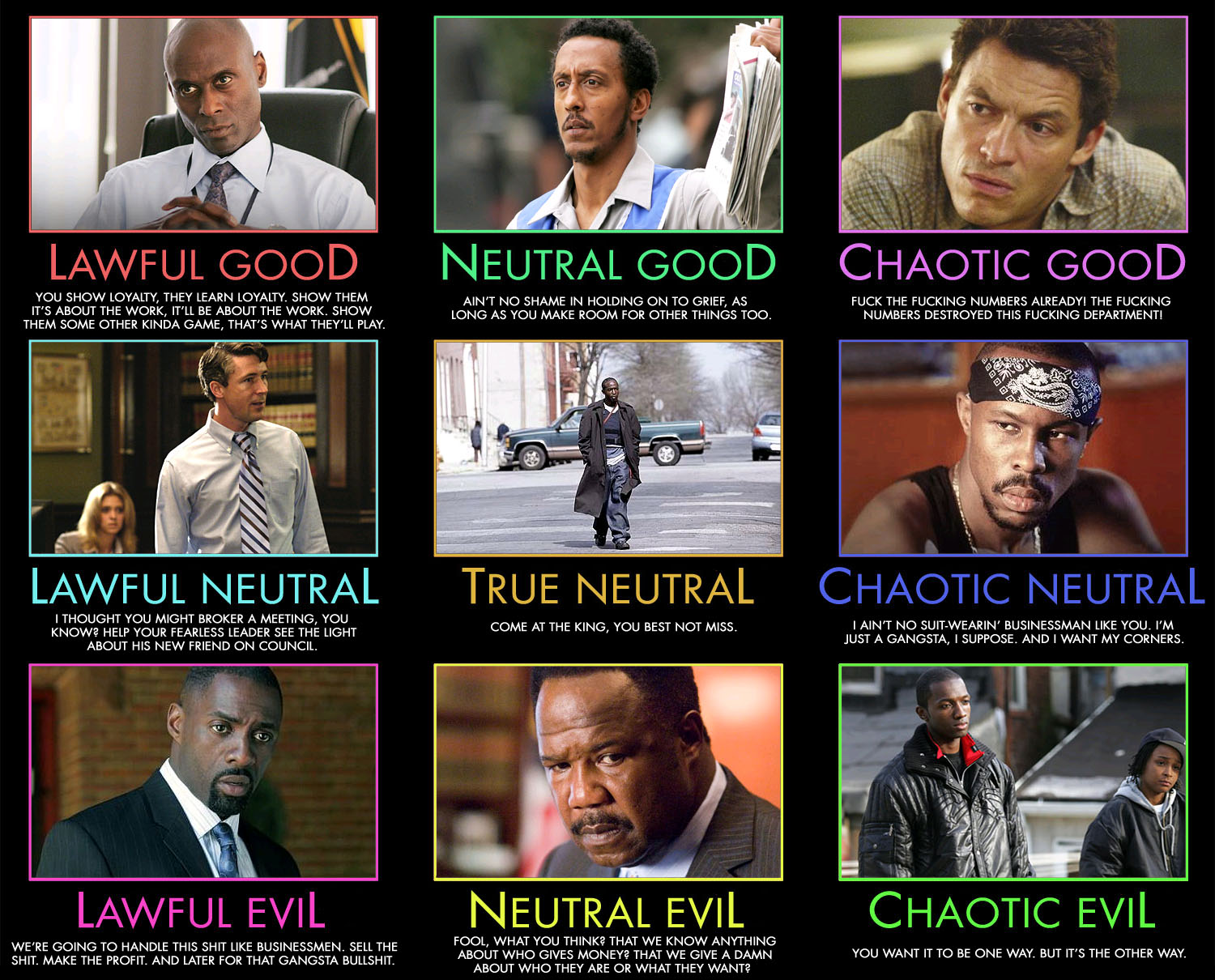
The Wire alignment chart

Dissatisfied with existing versions of a D&D alignment chart for characters on The Wire, I constructed my own. (I also wanted to experiment with a better visual presentation for an alignment chart.)

It's a tricky exercise, precisely because The Wire has a complex morality. I made a point of playing against type and putting a cop in the evil row, though I couldn't quite get a gangster into the good row. I tried to find character quotes which represented both the alignment and the character well.


Lawful Good
Cedric Daniels
“Bend too far, and you’re already broken.”

Neutral Good
Reginald “Bubbles” Cousins
“Man making me sound special for doing what the fuck I need to be doing.”

Chaotic Good
Lester Freamon
“When they said they couldn’t pay for further investigation, I regarded that decision as illegitimate.”

Lawful neutral
Bunk Moreland
“It ain't your turn to give a fuck.”

True Neutral
Omar Little
“It’s all in the game, yo.”

Chaotic Neutral
Ziggy Sobatka
“Like I’m the only guy in South Baltimore that tried to win the affections of a farm animal?”

Lawful Evil
William Rawls
“When I fuck you over, you’ll know it. You’ll be so goddamn certain, you won’t need to ask that question.”

Neutral Evil
“Snoop” Pearson
“Fuck this nailin’ up boards, we could kill a couple motherfuckers with this right here.”

Chaotic Evil
Marlo Stanfield
“Let them know Marlo step to any motherfucker: Omar, Barksdale, whoever.”

The one who knocks

“I am not in danger. I am the danger.” If you don't recognize the quote, an explication:


04 August 2012

Buy more stuff

This old post has been superceded by a new post including the surviving suppliers here, plus more.


In case you want to spend some money on material possessions:

  • Cool tools is Kevin Kelly's index of reviews of all kinds of things ... including lots of unusual books. Most reviews talk not just about the qualities of the product, but about how and why it's useful, like tongue depressors or those glue sticks made of post-it note glue ... and many tools are just tips and tricks that don't require buying anything.
  • The Wirecutter is a useful index of reviews of tech products and more.
  • Better Living Through Design is an index of spiffy things. The bags and desk accessories are my particular weaknesses.
  • Macrumours' buyers guide helps you guess when an Apple product will come out, reducing your chances of getting something and then feeling frustrated to see a spiffy new version released right after you buy it.
  • Koyono and Zagg are great places to look for accessories for those electronic gadgets. (Koyono also sells other stuff, including some exceedingly spiffy raincoats.)
  • Jetpens sells, well, pens, and they have a bunch of weird cool ones if you're into that.
  • Garrett Wade sells absurdly beautiful tools. The garden implements make me almost want to take up gardening.
  • Kaufmann Mercantile is a bit like Garrett Wade, offering not just tools but a range of well-made housewares and “accessories” and whatnot.
  • Saddleback Leather make exceptionally handsome, sturdy luggage. My current gig calls for me bringing my laptop home pretty frequently, so I needed a backpack but wanted one that looked like it belonged to an adult; people comment on the one I got from them all of the time.
  • Thinkgeek, TopatoCo, bOing bOing, and Unemployed Philosophers' Guild offer a range of nifty/cute/clever tchotchkes. Caveat emptor about the more eccentric electronics on Thinkgeek, though.
  • American Science & Surplus is what it says on the tin, full of great, weird stuff. Visit the website just to read the entertaining product descriptions.
  • Deutsche Optik and The Sportsman's Guide both find some eccentric army surplus and related weird cool stuff. Deutsche Optic is at the fancy end of the spectrum; The Sportsman's Guide is more meat-and-potatoes (and features product descriptions with a hint of redneck whimsy).
  • American Giant sells exceptionally well-made cotton basic clothes for men, including a “the greatest hoodie ever made”.

02 August 2012

Agile

In a sequel to a similar silly post, I offer this joke at the expense of the folks at ScaledAgileFramework.com, who may be very smart and capable people for all I know. (Though they obviously could use some help with making clear infographics.)


I myself actually have mixed feelings about the Agile software movement — there's a lot to like, but also a lot I'm skeptical about — but I was struck by a tweet by Kerry Buckley looking at that process map.

Oh, Agile. What happened?

Personally I'd ask if this doesn't mean that the dream of Agile making software development simple (though not easy) through the application of a few key principles wasn't doomed from the start.

30 July 2012

Organizational power

I was struck by this passage in a kvetch from Sean Oliver about the new Apple Genius TV ads:

Collateral like this happens when there is no creative vision coming down from senior leaders. When leaders delegate the vision downward, middle managers end up having to make the final call, but in almost all cases they don’t have the power to do so alone. So, they go about securing buy-off from multiple teams, and the result was leadership by committee.

I'd say this principle applies not just to advertising collateral but to almost everything the organization does. My interests lie in product & design, so I see this pattern all of the time in that domain, but I feel confident in presuming that it applies to just about anything an organization does.

Oliver implies that organizations need more creative vision coming down from senior leaders. That's great when you can get it, but I propose a better alternative: empower those middle managers so that they can make the final call alone.

27 July 2012

Diversity of tactics

Facebook event discussion:


Yeah, that's the problem right there.


Update: More from Eric Throw Molotov:

Let's be clear about something here.

Every time the POLICE MURDER SOMEONE and there is a call to action, you have a certain group of people that have their own agenda and are not interested in anything but preserving the existing social order be it the police state or the everyday normal function of capitalism. Watch out for these people:

  1. Peace Police: nu-protester/stranger who uses violence against anyone in order to maintain the safety of the police, banks, corporations and the mass media.
  2. Conspiracy Theorists: nu-protester/stranger who assumes anyone challenging the system outside of the law is not a revolutionary but somehow an agent of the state. Just because you don't believe in the American Dream. Just because you don't believe in government. Just because you hate the capitalist system. Just because you won't follow governments rule and refuse to obey the American way of doing things. These people really need to WAKE THE FUCK UP put down the Alex Jones garbage and pick up the ------"St. Paul Principles". Seriously. Wake the fuck up!
  3. Aggressive Pacifists: people who are quick to shutdown their emotions against cops and direct their emotions at those who use direction action and condemn anyone who does not do the same when ever some fucked up shit like this happens where cops kill and you know the outcome will be a slap on the wrist unless there is backlash on the street.

    (I have a question? ) What brings you nu-people out here thinking you can control other people and snitch and turn people in? It looks to me like you are on a mission to defend the interests of the police by scaring anyone who dare to rise up and then when the police get off the hook, you subtly walk back into the shadows and we never hear from you again until the illusion of peace is broken by the sound of a gun sending a bullet into someones head or back and more rounds of projectiles for anyone who dare questions that sort of conduct. NO ASSHOLE, THE REAL QUESTION IS WHO THE FUCK DO YOU WORK FOR? You're the one shouting down at people who are angry at the police instead of shouting at the police WHO ARE THE REAL FUCKING TARGET!
  4. Standard Pacifists: these type don't really bother anyone from the radical community but don't really help either. They are the least of your worries.

This is the world that we are being forced to live in and it sucks so bad I wish I could wish it away somehow but it is always going to be here so long as we allow it to exist. I feel the same frustration as all of you out there in Anaheim and all those who truly believe there is no way to co-exist with the state because it is the enemy no doubt about that anymore. It does not work to keep you safe. The police are not your friends. Anyone protecting them right now is either a snitch or a careless idiot.

Good luck to everyone else out there tonight. Times are rough and their only going to get worse and the police grow more hostile everyday knowing this system can't sustain it self any longer. FUCK COPS! FUCK THE SYSTEM! FUCK THE USA!

Syrio Forel's prayer


There is only one god.

And his name is Death.

And there is only one thing we say to Death.

Not today.

19 July 2012

Peak Oil is wrong, alas

George Monbiot reports that there's plenty of oil after all, if we are willing to spend enough money and wreck enough of the environment.

The automatic correction resource depletion destroying the machine that was driving it, that many environmentalists foresaw, is not going to happen. The problem we face is not that there is too little oil, but that there is too much.

We have confused threats to the living planet with threats to industrial civilisation. They are not, in the first instance, the same thing. Industry and consumer capitalism, powered by abundant oil supplies, are more resilient than many of the natural systems they threaten. The great profusion of life in the past, fossilised in the form of flammable carbon, now jeopardises the great profusion of life in the present.

There is enough oil in the ground to deep-fry the lot of us and no obvious means to prevail upon governments and industry to leave it in the ground. Twenty years of efforts to prevent climate breakdown through moral persuasion have failed, with the collapse of the multilateral process at Rio de Janeiro last month. The world’s most powerful nation is again becoming an oil state and if the political transformation of its northern neighbour is anything to go by, the results will not be pretty.


Update: A lot more information about the data and the implications.

12 July 2012

SMOUXD

Programmers often talk about a “SMOP”. It's an exceedingly useful expression. Here's Eric Raymond's instructive Jargon File on the subject:

Simple (or Small) Matter of Programming
  1. A piece of code, not yet written, whose anticipated length is significantly greater than its complexity. Used to refer to a program that could obviously be written, but is not worth the trouble. Also used ironically to imply that a difficult problem can be easily solved because a program can be written to do it; the irony is that it is very clear that writing such a program will be a great deal of work. “It's easy to enhance a FORTRAN compiler to compile COBOL as well; it's just a SMOP.”
  2. Often used ironically by the intended victim when a suggestion for a program is made which seems easy to the suggester, but is obviously (to the victim) a lot of work.
Compare minor detail.

It's a handy expression for an interaction designer to know and use. If a designer says things like I'd rather not break the user's address into a bunch of fields in the UI; let's provide a single big open text box and parse it into name, street, city, state, and zip on the back end and then adds it will be a Simple Matter Of Programming, taking care to pronounce the Capital Letters, the development team will appreciate the designer speaking their language and recognizing that she has proposed that they do so a significant chunk of work.

In that spirit, I'd like to offer the world an expression that I occasionally employ which should really get out more often.

SMOUXD (smucks-dee)
“small matter of user experience design”
  1. A user experience problem resulting from deep in the structure of the system which people naïvely propose could be corrected with simple changes to the visual presentation of the UI.

    Example:

    Product Manager: Our customers are complaining that our order processing system is confusing. Can we fix it by redesigning the input form?

    UX Designer: (Rolls eyes) Sure, fixing the consequences of our broken supply chain spilling out onto our customers is just a Simple Matter Of UX Design.

  2. An opportunity to save a great deal of programming effort though a cunning bit of UX design.

    Example:

    Software Engineer: I think we could spot this pattern in the data using Markov chain analysis and throw errors when we suspect that there's a significant outlier. We will need to get a bunch of our customers to share their back-end data so we can tune the system.

    UX Designer: SMOUXD! We can graph the data in the right format and users will easily spot the cases they care about.

09 July 2012

Drones

The long Esquire article The Lethal Presidency of Barack Obama is an important piece of journalism. It's written as a letter to the President.

This is not to say that the American people don't know about the Lethal Presidency, and that they don't support its aims. They do. They know about the killing because you have celebrated — with appropriate sobriety — the most notable kills, specifically those of Osama bin Laden and Anwar al-Awlaki; they support it because you have asked for their trust as a good and honorable man surrounded by good and honorable men and women and they have given it to you. In so doing, you have changed a technological capability into a moral imperative and have convinced your countrymen to see the necessity without seeing the downside. Politically, there is no downside. Historically, there is only the irony of the upside — that you, of all presidents, have become the lethal one; that you, of all people, have turned out to be a man of proven integrity whose foreign and domestic policies are less popular than your proven willingness to kill, in defense of your country, even your own countrymen ... indeed, to kill even a sixteen-year-old American boy accused of no crime at all.

I'll say it again: when Obama was elected I was prepared to be disappointed but I was not prepared to be horrified. Yet here we are.

Version 1.0

This article from Matt Buchanan at Buzzfeed is framed as advice for consumers, but the important lesson is for tech product and service companies. Yes, you should start by releasing the “minimum viable product”, but that product must in fact be viable. If you find yourself saying “sure this stinks, but we are just releasing it as the 1.0 version”, you're doing it wrong. You won't be able to fix it.

“Just wait for the update” or “just wait for the apps” or “there's more launching soon” has became so pervasive that when I was at Gizmodo we had a badge for it in reviews. Do you know how many products I reviewed that evolved past the “half baked” status into “must buy”? None. Ever. Ever.

Via Daring Fireball.

30 June 2012

Smokey the Bear Sutra

It will lead you to enlightenment.

....

Bearing in his right paw the Shovel that digs to the truth beneath appearances; cuts the roots of useless attachments, and flings damp sand on the fires of greed and war;

His left paw in the mudra of Comradely Display — indicating that all creatures have the full right to live to their limits and that of deer, rabbits, chipmunks, snakes, dandelions, and lizards all grow in the realm of the Dharma;

....

Seriously.

26 June 2012

Thomas Friedman

Occasionally I encounter someone who has become enamored of the insights of New York Times columnist Thomas Friedman. So I have to hunt up links to try to shake some sense into those folks. No more: I'm collecting criticisms of Mr Friedman here.

Let's start with Atrois calling him Wanker of the Decade:

The state of the world is what it is in large part because people in positions of great power think this absurd buffoon of man is a Very Serious Person. This hasn't actually been the Eschaton Decade, it's been the Tom Friedman Decade. And the next one probably will be too.

Seriously, read that and follow the links before you finish reading this post, because it provides a good overview of what's wrong with Friedman. I'll lift just one thing from it, this stunning video clip of Friedman talking to Charlie Rose and cooly advocating war crimes with smug bravado. Watch it, seriously.


That alone should make him outside the realm of civilized discourse, rather than one of the most influential pundits in America.

Matt Taibbi's famous takedown of Friedman's mixed metaphors from the Buffalo Beast, The Word Is Hack, talking about the book The World Is Flat:

Man flies on planes, observes the wonders of capitalism; says we're not in Kansas anymore. (He actually says we're not in Kansas anymore). That's the whole plot right there. If the underlying message is all that interests you, read no further, because that's all there is.

But it's impossible to divorce The World is Flat from its rhetorical approach. It's not for nothing that Thomas Friedman is called “the most important columnist in America today.” That it's Friedman's own colleague at the New York Times (Walter Russell Mead) calling him this, on the back of Friedman's own book, is immaterial. Friedman is an important American. He is the perfect symbol of our culture of emboldened stupidity.

At least mocking Friedman's bizarre mixed-metaphor style can be very funny, even if the content of his ideas is far from funny.

Taibbi has a longer followup article inspired by Friedman's later Hot, Flat, and Crowded, and Belén Fernández at Geurnica picks up the theme in even greater detail in Errata:

Friedman’s writing is characterized by a reduction of complex international phenomena to simplistic rhetoric and theorems that rarely withstand the test of reality. His vacuous but much-publicized “First Law of Petropolitics”—which Friedman devises by plotting a handful of historical incidents on a napkin and which states that the price of oil is inversely related to the pace of freedom—does not even withstand the test of the very Freedom House reports that Friedman invokes as evidence in support of the alleged law. The tendency toward rampant reductionism has become such a Friedman trademark that one finds oneself wondering whether he is not intentionally parodying himself when he introduces “A Theory of Everything” to explain anti-American sentiment in the world and states his hope “that people will write in with comments or catcalls so I can continue to refine [the theory], turn it into a quick book and pay my daughter’s college tuition.”

Alex Pareene imitates Friedman's voice in a howlingly funny article “about” Thomas Friedman.

As I wrote down what he said to use it in my column, it struck me that the world is changing. The world used to be flat. Now, everyone I talk to, everywhere I go, tells me something is bending the world into a new shape. This 4G, 401(k) world is getting rounded. That scares a lot of people. But it doesn’t scare Thomas Friedman. Because while some old media dinosaurs are going extinct thanks to the asteroid of globalization and the giant dust plume of hyperconnectivity, Friedman is a cockroach. A cockroach made of stone. A cockroach made of stone that lives in The Cloud.

In his piece A New Ayn Rand for A Dark Digital Future, Richard RJ Eskow implies that Friedman's peculiar style is part of how his technique works, because once that one can decode what Friedman is saying, to discover that he is really saying something ... something horrifying.

Consider this passage from Friedman's column:

In a world where, as I've argued, average is over — the skills required for any good job keep rising — a lot of people who might not be able to acquire those skills can still earn a good living now by building their own branded reputations, whether it is to rent their kids' rooms, their cars or their power tools.

This paragraph reads like a Zen koan pieced together from cast-away fragments of motivational sales speeches. We're left to infer the meaning of its more obscure phrases from their context, the same way World War II codebreakers cracked particularly difficult passages in enemy telexes. So let's try to tease out its meaning ....

“Average is over” is connected to job skills. Friedman apparently means that you can't get a good job anymore if your skill level is only average. Why didn't he just say so?

What are the implications of a world in which you must be above average to get “any good job”?

This post was inspired by another Belén Fernández piece, at Jacobin, talking about Friedman's philosophical incoherence in Tom Friedman's War on Humanity:

Thomas Friedman, three-time Pulitzer Prize-winning foreign affairs columnist for the New York Times, once offered the following insight into his modus operandi: “I often begin writing columns by interviewing myself.”

Some might see this as an unsurprising revelation in light of Edward Said’s appraisal: “It’s as if … what scholars, poets, historians, fighters, and statesmen have done is not as important or as central as what Friedman himself thinks.”

According to Friedman, the purpose of the auto-interviews is merely to analyze his feelings on certain issues. Given that his feelings tend to undergo drastic inter- and sometimes intra-columnar modifications, one potentially convenient byproduct of such an approach to journalism is the impression that Friedman interviews many more people than he actually does.

A Friedman Unit is a measure of time equal to six months used in the lefty blogosphere, after Friedman's repeated assertions about the war in Iraq that “the next six months will be crucial”.

We have a big problem. The dominant view among the in crowd in Washington is that the next 6 months is a critical time in Iraq. As it has always been. They're all Tom Friedman now.
....
All candidates need to lay the foundation for what they're going to say a year from now (“two Friedmans” in the newly established Friedman time scale) when Iraq is as bad or worse of a clusterfuck as it is now (Yes, yes, I hope to be wrong but it sadly hasn't happened yet).

It is vital to understand that the muddled thinking, hack “journalism”, and endless shilling for the interests of “the 1%” — that is to say, the stratospherically wealthy aristocrats in the top 0.01% of American wealth and income who own the US and run the world — is because he is one of them, as David Sirota points out:

Let's be clear — I'm a capitalist, so I have no problem with people doing well or living well, even Tom Friedman. That said, this does potentially explain an ENORMOUS amount about Friedman's perspective. Far from the objective, regular-guy interpreter of globalization that the D.C. media portrays him to be, Friedman is a member of the elite of the economic elite on the planet Earth. In fact, he's married into such a giant fortune, it's probably more relevant to refer to him as Billionaire Scion Tom Friedman than columnist Tom Friedman, both because that's more descriptive of what he represents, and more important for readers of his work to know so that they know a bit about where he's coming from.

Marc Levy also considers the implications of that:

I’ve rolled my eyes uncountable times after reading Friedman’s columns, but never caught on to why they’re so overwhelmingly misguided. Despite my acknowledgment that I was a willing participant in my own deception, that doesn’t mean I feel any less deceived. Or angry.
....
Friedman does not write as one of us. He is, in fact, one of them — a member of one of the 100 richest families in the country, according to Washingtonian Magazine, one of those who are not hurt by war or globalism and thus cannot honestly discuss it from the level of one who is.

Spread the word: Friedman doesn’t write nonsense; he writes propaganda.

Hopefully all this makes clear why the lefty blogosphere occasionally reminds of his enormous house and refers to him derisively as the Moustache of Undertanding.


Update: Want more takedowns of Friedman's writing? Jillian C. York has assembled a definitive collection.

Here are some of my favorites:

The lefty Driftglass blog regularly features vigorous fiskings of Friedman's commentary. Frankly, I find that Driftglass sometimes lets the snark get away with him, but given Friedman's writing this is a nigh-unavoidable hazard. Tommy Can You Hear Me is a choice example.

Another friend offers a helpful meme from Pejman Yousefzadeh.

James Livingston at Politics and Letters offers a comment on Friedman's use of cliché, Cliche Run Aground, which offers a sharp take on how it forecloses on debate, analysis, and thought.

Glenn Greenwald indicts all of us with his scathing description of Friedman's intellectual incoherency:

If I had to pick just a single fact that most powerfully reflects the nature of America’s political and media class in order to explain the cause of the nation’s imperial decline, it would be that, in those classes, Tom Friedman is the country’s most influential and most decorated “foreign policy expert.”

Greenwald also gives us a couple of good links on Friedman. He has some sharp words from Alexander Cockburn:

Friedman is so marinated in self-regard that he doesn’t even know when he’s being stupid. “While the defining measurement of the Cold War was weight–particularly the throw-weight of missiles–the defining measurement of the globalization system is speed.” Sounds good in a corporate roundtable, means nothing. The man just isn’t that smart, beyond the dubious ability to make money out of press releases praising the New Globalism and American power.

And Greenwald also points us to Current Events Inquiry which has a horrifying sampler of quotes from Friedman aptly called The Sociopathy of Thomas L. Friedman showing that that moment in the Charlie Rose interview is far from an aberration.

Salon uses his presence on the New York Times' editorial page as cause to call out the Times for hackery.

Yes, Friedman used the exact same vague generalization to start two consecutive paragraphs. And yes the second paragraph’s quote is obviously the source for everything Friedman wrote in the first paragraph, making the first paragraph unnecessary. And yes, Friedman thinks that would be a constructive thing to ask Hamas. “Have you considered instituting a strict standardized testing regimen in Gaza????”

Matt Taibbi returns to the well to tell us about Thomas Friedman's new state of grace and his most incoherent column ever.

Brian Mayer gives us an uncanny randomized Thomas Friedman Op-Ed Generator.

Because this is what his writing actually looks like.

Mike the Mad Biologist points to Friedman misremembering his stance on the Iraq war:

As someone who wanted us to partner with Iraqis to try to build a democracy there — in the heart of the Arab world after 9/11

Get Your War On gives us The Moustache of Greenderstanding.

On Twitter, sarah jeong gives us Thomas Friedman's Bad Trip.

On Facebook, Haroon Moghul gives us an instructive fisking of Friedman's column Freud and the Middle East. My favorite part:

Just as there is a little bit of West Bank “Jewish settler” in almost every Israeli, there is a little bit of the caliphate dream in almost every Sunni.

Friedman's in top-form in this essay — he's almost too good at being himself. Either he's mismatching categories (Friedman grew up never understanding why apples and oranges couldn't be compared), or saying nothing at all, which is often how these things go when he's at his best, which is his worst.

“Israeli” is a national identity, tied to a state that was established, in 1947-8, on someone else's land; Sunni is a sectarian denomination. There are several million Israelis. Sunni Islam is the largest religious denomination in the world, with over 1.1 billion adherents. Are we seriously comparing the two? To what ends?

If I'm reading Friedman correctly (which is really not the question we ask; usually, it's more solipsistic and exasperated: Am I the only person who is reading Friedman? Why does he exist instead of nothing? Why, God, why?), then he should be saying, “there's a little bit of West Bank Jewish settler in every *Jew*.”

Since Sunni isn't a nationality....

But he says Israeli. Not Jew. Which is either a cop-out, like it's okay to make grand, sweeping generalizations about Muslims but no one else, but surely that can't be the case, or he's making a completely different “point,” which is only a point in the way a period is a point — phentoypically.

In that case, is there a little bit of Nazi in every German? A little bit of monkey in every human? A little bit of Columbus in every American? A little bit of FOX News in every Republican? A little bit of sinner in every saint?

Which is the kind of revelation that reveals so much, we see the world no differently than we did five minutes before, except five minutes have passed and we'd not get them back, if not for Christopher Nolan's tesseract. (Humbling thought of the day: Thomas Friedman was produced by Western civilization, which Interstellar is all about trying to save.)

Justin Peters' review of a Friedman book makes some sharp comments about the notorious prose and then looks at the heart of Friedman's project:

But too often in Thank You for Being Late, as is Friedman’s wont, distillation becomes oversimplication. “Monterrey has tens of thousands of poor living in shantytowns. They’ve been there for decades,” he writes at one point. Wow, sounds tragic. But don’t worry, friends: “What is new, though, is that it now also has a critical mass of young, confident innovators trying to solve Mexico’s problems, by leveraging technology and globalization.” This is a man who has won Pulitzer Prizes for his foreign correspondence; a man who dearly wants you to know how many countries he has visited. He cannot actually believe that Mexican poverty will be fixed by an app.

Or maybe he does? Friedman takes a lot of things at face value. He spends 100 pages furiously stanning for polarizing companies such as Uber and Airbnb. He earnestly recounts his conversation with a “business visualization” expert: “When we first talked on the phone, he illustrated our conversation real-time on a shared digital whiteboard. I was awed.” He raves about “smart” appliances with the wide-eyed optimism of a man who perhaps has never used one.

25 June 2012

Consent

A friend on Facebook just pointed me to the terrific post The Art of No at CaptainAwkward.com, talking about manners and ethics while dating. I cannot recommend this post highly enough.

But I have an itch because my friend pointed to it by way of a post on the Tumblr blog Gallery of Dangerous Women which just excerpted this segment:

Women are socialized to make men feel good. We’re socialized to “let you down easy.” We’re not socialized to say a clear and direct “no.” We’re socialized to speak in hints and boost egos and let people save face. People who don’t respect the social contract (rapists, predators, assholes, pickup artists) are good at taking advantage of this.

“No” is something we have to learn. “No” is something we have to earn. In fact, I’d argue that the ability to just say “no” to something, without further comment, apology, explanation, guilt, or thinking about it is one of the great rites of passage in growing up, and when you start saying it and saying it regularly the world often pushes back. And calls you names.

Now that alone is a rich and important point. It's one component in the great tangled mass of cultural screwed-upped-ness that feminists like me refer to as rape culture. A lot of men just don't know about it at all, and even those who do have a hard time seeing all of the implications in women's experience. We need to see to that.

Indeed, I'm a fella who read a bunch of feminist theory as a teenager and committed to it seriously and almost three decades later I have to admit that I still labor to truly appreciate the implications. I can tell you from that experience that it is very difficult for even attentive and conscientious men to figure out how to operate ethically and effectively in the face of our failure to make clear consent a part of our culture. I can also tell you from that experience that most women — including most feminist women — don't realize how tricky this situation is for men. The beauty of that The Art of No post is that it focuses, as we should, on the risks and problems which this presents for women but also takes seriously the challenge that men face at the same time and provides some sophisticated answers for how men should navigate these waters.

So check it out before you even get to the rest of my post. I also recommend spending some time with that link above to Shakespeare's Sister talking about rape culture because the first order of business is to look at how this affects women before I get all What About Teh Menz ... indeed I think that the point I want to make about men's perspective on this only makes sense if you take rape culture seriously.

That said, let me invoke the slogan no means no in the context of women are not socialized to say a clear and direct “no” and pointedly observe that a certain ... friction ... exists between those two.

Let me step that up another couple of notches. Here's comedian Louis CK.

[Update: In the time since I originally wrote this, Louis CK's gawdawful behaviors around consent have come to light, which complicates quoting him. But please stay with this. We now know that he is being a disingenuous predator justifying himself with this bit; reading my reaction to it demonstrates how the pattern he describes ends up enabling predators like him.

I used to have an embedded video clip to a segment of CK’s Chewed Up show because getting CK's delivery is important, but that has linkrotted away. If you care to dig it up, the bit is about three-quarters of the way through the show.]

Here is a transcript:

I don't know how I ever got laid, really, ’cause I was awful at it. I still am. I never understood. Like, there's guys that just have this confidence, and they can like go out with a girl, know when to lean in and kiss her and shit. I just — I couldn't, I would just go “CaN i FuCk YoU?” Like, I'd just blurt it out.

I remember one night, I was with a girl, I was like twenty years old, I was already doing standup, and I did a show in Washington DC. And after the show one of the waitresses came back to my hotel. She was really cute. We were making out, in my hotel, and she's into it, she's like humping me. So I start to put my hand up her shirt and she stops me. I'm like, hmnn, okay. So then we're making out more, and I start to put my hand on her ass, and she stops me. So after a while she went home. Nothing happened.

And then the next night I saw her at the club and she goes, “Hey, what happened last night?”

I was like, “What?”

She goes, “How come we didn't have sex?”

I was like, “Because you didn't want to.”

She's like, “Yes I did! I was really into it.”

I was like, “W-why did you keep stopping me?”

And she goes, “Because I wanted you to just go for it.”

I was like, “What does that mean?”

She says, “I'm kind of weird. I get turned on when a guy just gets frustrated and just holds me down and fucks me. Like, that's a big turn-on for me.”

I was like, “Well, you should have told me, I would have happily done that for you.”

And she says, “No! It has to feel real, and dangerous.”

Like, “What, are you out of your fucking mind? You think I'm just going to rape you on the off chance that hopefully you're into that shit?”

That piece makes me laugh and gives me the Cold Spooky every time I watch it. There's a lot going on in it.

If you're not familiar with CK I should underline that he affects a kind of Dopey Middle-Aged White Guy persona, but his cultural politics are not-so-secretly smart and sharply observed. His act commonly looks squarely at homophobia, and one of his bits on White privilege is justly famous. He makes arguably feminist rhetorical moves; again, that we now know that he is being wildly disingenuous with that tells us that we shouldn't think of him as a feminist, but those moves remain unmistakably informed by a social justice analysis. His TV series Louie is also one of the smartest, gutsiest things ever put on broadcast television. All of which is to not just plug CK, whom I do love, (well, not so much any more) but to underline that this bit about a scary, funny sex and dating misadventure is deliberately constructed.

I say “constructed”, but I don't mean to imply that it didn't happen. I feel certain that it happened to CK pretty much the way he describes. I have that conviction because while his story provides an especially vivid example, practically all straight men have had encounters like that.

Encounters. Plural. Listen to the men laughing in the background as CK does his routine. They're not laughing because it's absurd; they're laughing because it's familiar.

Women send men mixed messages. A big part of it is the coercive socialization that the quote from Captain Awkward above talks about, but it isn't the only thing. Look at the way Louis CK plays the voice of the woman in his story: his responsible and necessary refusal to dance with her broken expectations about consent is confusing to her. She finds it surprising and mysterious and — most disconcerting of all — frustrating.

[Again, that we can now hear CK using this story to rationalize his bad behavior should make us uneasy, because making this move worked for him because it alludes to something real which non-predatory men recognize, making his interpretation of events sound plausible to them.]

When my friend pointed to that CaptainAwkward.com quote above, I told her (having not yet discovered the rest of the post it came from):

At the same time, coercion culture — like women trained to send mixed signals — makes it difficult for men to figure out responsible behavior. The resulting confusions further reïnforce the patterns of the patriarchy.

And she replied:

Yes. So opt out.

Hell yes. I hope it goes without saying that Louis CK did the right thing for himself, for the young lady, and for the world.

But at the same time, one does not simply walk out of the patriarchy.

When I was a young fella I lived an opt-out ethic explicitly and deliberately. Recall that I alluded to reading a lot of feminist theory as a teenager? Being young and naïve, it did not occur to me that other people were not thinking about things in the terms I was, informed by that, approaching consent as deliberately as I did. This helped make dating and sex even more awkward and confusing than they already are when one is young. And one day a young feminist with whom I discussed these things took me to task, saying, “So you have decided that when women have an exchange with you, they should be able to discern that you're operating from a different ethic and using different communication patterns than the whole world they're accustomed to? Isn't that a lot to ask?” Because like Louis CK, by trying to date women in a way that took clear consent seriously, I was confusing and surprising and mystifying and frustrating the women I was interacting with. I had to find better solutions.

Not easy. I wish I'd had CaptainAwkward.com back then.

My friend is right, men must opt out, because opting in is the patriarchy and rape culture and I hope that I don't have to explain to anyone reading this why that merits deliberate and vigorous resistance. But let's notice that, per Louis CK's example, opting out means fellas opting out of the embraces of willing women. His example also shows that those women are generally Not A Good Idea To Get Mixed Up With anyway, but there are moments in a young fella's life when that is confusing and cold comfort and can have one asking if you have the whole thing wrong. Which is not to say Poor Men Not Getting Laid but to say that the world does not give men good feedback.

To be clear, I'll repeat that the first order of business is to look at how this stuff affects women and to attend to that. But since there are a lot of good voices talking about that, allow me this post to make a plea to my sisters in feminism, who often forget or don't know: that full post at CaptainAwkward.com talks about how respecting women's consent is genuinely tricky for men to do in the context of a coercive, sexist society.

In light of that, “so opt out” is not answer enough. Part of the conversation has to be to ask, yes, what about teh menz? and to expect that the answers are neither simple nor easy to figure out.


Update: Looking at this again, I realize that I didn't sufficiently emphasize an important point. The Art of No is terrific in large part because it exemplifies the kind of feminist discourse I'm advocating here. It makes the sexist injustices that women experience primary, while recognizing that an understanding of men's experience is also integral to addressing those injustices, and offers realistic practices for both women and men to use in responding to the challenges they present. Part of the frustration which motivates this post is noticing that the quote about women's socialization was separated from the rest and circulated well enough to reach me; while that quote makes its point well, in the context of feminist discourse it's something that has been said many times before, and thus to my point is in a certain sense the least interesting part of the post.


Update: Niki Whiting over on Google+ has an instructive comment.

one of the reasons girls/women don't speak up for what the want/don't want is that to know what we want sexually is usually equated with being a slut. If I say ‘I like it like This and like That’ then our experience as female is often being slut shamed, whether explicitly or implicitly. Hell, even just saying ‘No, I don't like that’ or even just ‘Yes, please’ can be taken as too much sexual agency.

Indeed. Women are subject to vigorous gender policing which punishes clear communication about sex. Men too, in very different ways, though it's important for men to remember that the stakes for women are much higher.


Update: Another point I did not make vigorously enough originally: the example of Louis CK demonstrates how these kinds of encounters from men's lived experience can be exploited by predatory men. When they spin lies about mixed messages and misunderstandings, these sound plausible to men who are not predatory because it rhymes with awkward encounters they have had.


Updates:

24 June 2012

Growing a Language

The talk “Growing a Language” by Guy Steele says a good thing that you may want to know about programming languages. Even if you do not know about programming languages, you may find it says a good thing about all languages, and says it in a smart way.

One can watch it or read it on the web.

Stick with it for a bit and all will be clear. Once you know the trick, you can skip to near the end if you do not care about programming languages. It has a good end.

Pride

This week I have felt a vague sense of guilt that I planned my weekend such that I won't attend the San Francisco Pride parade today. As I have alluded to before, despite the serious critiques one could have of it, the event performs a vital function, and part of that means that heterosexual fellas like me need to represent. Part of the point of Pride, of taking the form of a parade, is having the community as a whole participate and show the simple but profound support of just showing up. That sentiment has a certain lefty-intellectual flavor, but I am a lefty intellectual, so there you have it.

Part of my Pride Failure this year was that last night, rather than toasting to the liberation of my GLBTQ brothers and sisters and less-tidily-gendered-siblings, I raised glasses of champagne in the company of friends with coïncident birthdays, Happily Birthdaying ourselves. A friend and I decided to walk back from that party to catch a late BART train.

The streets were alive with Pride revelers, most of them displaying one variety or another of Fabulousness. Inspired by this, my friend and I talked a bit about the magick of dressing and grooming as a gift to both the world and one's self. Then my friend — who has spent years running continuation schools, the place where kids go when they get expelled from high school — noticed a note in all the Fabulousness which I had only half-recognized until she named it. We had drag queens and drag kings and drag indefinably-regals, whole sleuths of bears and otters, graceful butch-femme lesbian couples, the campy and the elegant, the loud and the quiet, on and on in gorgeous variation. And as we walked down Market Street, our company became more and more composed of people bound for the BART station as we were, on their way home from the heart of the Castro or festivities elsewhere in the City. The note that my friend spotted as we proceeded was a whole other kind of fabulous: Ghetto Fabulous.

This crowd was young and drunk and happy and un-bourgeios, many but not all people of color, many but not all evidently heterosexual (though it was pleasantly hard to say for sure). I am way too White and bourgeois to describe Ghetto Fabulousness without sounding hopelessly square and risking lodging my foot firmly in my mouth, but I am able to recognize it ... and my friend, who encounters it every day in her work, has become a connoisseur of its charms and so of course recognized it before I did.

So these were not middle-aged lefty intellectual straights with windy explanations of why allies need to support a shared community space. These were cheerful bonehead straights who came to party.

I knew that we lived in a time when Christians came to Pride to apologize for the failure of Christ Love from some of their brothers and sisters in Christ. And I knew that we're cooking up some young people who lack the homophobic anxiety that was an unspoken part of the world of my youth. But I hadn't yet absorbed this, that the forgetting of that anxiety was already complete enough that — at least here in the Bay Area — we had a whole generation of straight kids so unaware of that anxiety as a possibility, without needing the huge doses of intellectualized queer theory that brought me to that place, that they would take the train to San Francisco for Pride mostly because it's a good party.

My friend whispered to me, “Look. Victory.”

I don't want to ignore the countless horrific ways in which of course the liberation which Pride symbolizes has not happened. The forces of sex and gender normativity remain powerful and their knives still cut deep. But the future is here, and queer, and we are getting used to it. The forces arrayed against that have already lost, even if they haven't stopped fighting. In my lifetime, I can expect to see Pride become as banal as St. Patrick's Day.

I am blessed to live in such times.


21 June 2012

The Wire

I keep telling people to watch the HBO series The Wire, and it occurs to me that I should have my pitch somewhere handy. Here's the short form:

The Wire is so good that it will make you embarrassed to have ever liked any other television shows. Really.

To expand on that:

The Wire is a TV show about police wiretaps like Moby Dick is a novel about whaling, like uranium-235 is an explosive material, like Elvis was a guitarist. The show’s intelligence, ambition, and craftsmanship make almost everything else on TV look shabby … and at the same time it delivers livelier entertainment than most programs that try for nothing else.

On top of all that, I submit that as an American citizen one has a responsibility to watch The Wire because it delivers such a vital examination of American institutional failure, using the devices of fiction and television to tell the story in the way that a serious book on the subject could not.

So watch it.

That said, I have some recommendations about how one should go about doing that.

Though released as five seasons of a weekly series, one should not think of it like series television. Each season does not just have an overall story arc; each season constitutes a thirteen hour film with nearly arbitrary hourly breaks. The story and characters do not coalesce until three or four episodes in. This means a kind of commitment much like reading a novel; one cannot read most novels in a single sitting, and since it requires a certain momentum to keep the book in your head, typically one reads a novel in a mix of long and short sittings over the course of a week or three. Similarly, I strongly recommend planning for a long viewing session to get started with The Wire, three or four hours. After that you will want to set aside time for 2-4 hour viewing sessions two or three times a week … and by “you will want”, I mean that once the show gets its hooks into you, it will become hard to devote that little time to watching it.

I envy anyone getting to watch The Wire for the first time. But I comfort myself with the knowledge that I can watch it again, which I can attest is every bit as gratifying.


If I cannot convince you, here’s Charlie Brooker:


12 June 2012

Game of Thrones

A refined version of this post appears together with several other comments on my Game Of Thrones master post.

Laurie Penny's article Game of Thrones and its Good Ruler Complex at The New Statesman says some astute things about the racism in Game of Thrones, but says the wrongest thing possible about what the show and series of novels implies.

Game of Thrones is all about kings and queens, all about who gets to be in charge and how they win and retain power, by violence, by force of will or simply by accident. The essential assumption of this story is a familiar one: sovereignty and leadership are inherently good things, common workers need decent kings or queens to make them happy and prosperous, and even if a catalogue of leaders are bad, mad or murderous, if you can just find the right king, the true, wise, noble king who deserves to be on the throne, then everything will be okay.

This is a bit like saying that the message of The Wire is that we need to support good cops in putting a stop to crime. (It's not.)

Yes, the people of Thrones' fictional Westeros think exactly what Penny says. Yes, a lot of naïve readers of “genre fantasy” literature think the same thing. (Authors in the medium have called that out as a problem.) But the book and the TV series do not think that a Good Ruler can save Westeros. The feudal idea that a good ruler will save the realm is the villain of the story. Not the greedy House of Lannister. Not the White Walkers. Not the dragons. Feudalism.

At every turn, we are shown the evils of the feudal order. The honorable suffer. The dishonorable triumph. Both the ordinary people and the nobility suffer in the endless pointless wars it engenders. Westeros is a horrible place to live. The sexist nightmare of rape, prostitution, and chattel marriage that Penny criticizes is a demonstration of how bad things are in Westeros.

And in a direct parallel to The Wire, we see smart characters try vigorously to make the systems in which they are enmeshed work. They play along, or try to game the system, or try to work against it, or try to step outside of it, and meet with failure every time.

Penny is right that Westeros is horrible, and it's madness to wait for a Good Ruler. But that's the point. Which is why I love Game of Thrones so much.


A quick note to my sex-positive readers who deplore the blanket assumption that Prostitution Is Always Bad, as well as to those Thrones fans who will point out that Shae Is Awesome: I assure you that I wholeheartedly agree with you. But I think that we can agree that prostitution in Westeros is generally pretty ugly, yes?

08 June 2012

Wish list

Want to buy me a present? Of course you do.

The ideal gift for me is cufflinks or a big scarf or a colorful pocket square; fun, decadent, modestly expensive, and something I will surely use and enjoy.

I also really need a nice pair of slippers. I've accumulated several cheap and unsatisfactory solutions to the problem, and need to really solve it.

Failing that, I love fancy office supplies; Moleskines and eccentric stencils and Leuchtturm1917 dot grid notebooks and almost all of those overpriced things in the Levenger catalogue appeal to me.

If you're feeling extravagant, there are three multivolume books I lust for: the unabridged McSweeny's edition of William Vollman's Rising Up & Rising Down, an unabridged edition of the Burton translation of The Thousand Nights and a Night, or the 11th edition of the Encyclopaedia Brittanica.

Or chocolate. Hard to go wrong with chocolate.